Important Disclaimer
BatteryStorageHQ provides educational content and estimates only. We are not certified installers, financial advisors, or electricians. Always consult with licensed professionals.
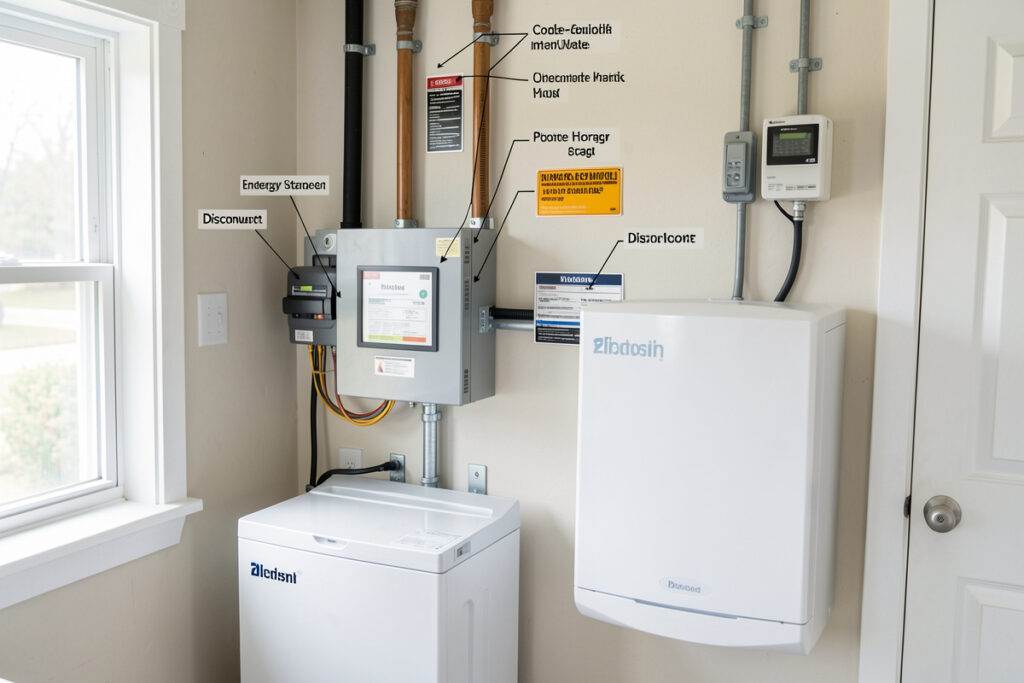
In the US, a home energy storage system lives mostly under NEC Article 706, with Articles 480, 690, 705 and 250 all touching it, and NFPA 855 plus the local fire code governing where you can put it and how much you can install. Equipment is expected to be listed — UL 9540 for the system, UL 1973 for the battery — with required disconnects, labeling, and real limits on energy quantity and unit separation.
I build my banks in Sweden, so the code that governs my own install is European, not the NEC. But most readers asking this question are in North America, and the NEC framework is the one your inspector will hold you to — so this is written for a US install, and it leans on what licensed installers and the published code actually require rather than on my bench. Treat it as a map of which rules apply, not as legal advice: code editions change, your jurisdiction adopts a specific year, and your Authority Having Jurisdiction (AHJ) has the final word. For a permitted job, hire or at least consult a licensed electrician. This article fits under the broader battery wiring safety guide, which covers the physics the code is trying to enforce.
Why code exists: almost every clause maps to a failure
The useful way to read electrical code is as a list of failures someone already had. The disconnect requirement exists so a firefighter can de-energize your system before entering. The listing requirement exists because listed cells and systems passed abuse testing the cheap ones never did. The separation and quantity limits in NFPA 855 exist because of thermal-runaway propagation between units. Read that way, code stops feeling like bureaucracy and starts looking like the distilled, conservative version of the same thermal-runaway and grounding reasoning I’d apply anyway. I treat it as the floor, not the ceiling.
The articles that apply to a residential ESS
No single article covers a home battery system end to end; several overlap. Article 706 (Energy Storage Systems) is the central one, covering disconnecting means, overcurrent protection and installation for ESS. Article 480 covers stationary storage batteries themselves. If solar is part of the system, Article 690 governs the PV side — including rapid shutdown and PV ground-fault protection — and Article 705 governs how the system interconnects with the grid or a panel. Article 250 governs all the grounding and bonding. Underneath the NEC, NFPA 855 and the locally adopted fire code (often via the IRC/IFC) set the siting, separation and quantity rules.
Quick map of the relevant codes
| Code / standard | What it governs | Why it matters to you |
|---|---|---|
| NEC Article 706 | Energy storage systems | Disconnects, overcurrent protection, ESS install rules |
| NEC Article 480 | Stationary storage batteries | Battery-specific wiring and protection |
| NEC Article 690 | Solar PV systems | Rapid shutdown, PV ground-fault, array wiring |
| NEC Article 705 | Interconnected power sources | How the system ties to a panel or the grid |
| NEC Article 250 | Grounding and bonding | System bond point, equipment grounding |
| NFPA 855 | ESS installation standard | Siting, separation, energy quantity limits |
| UL 9540 / 1973 | Listing of system / battery | Equipment listing many AHJs require |
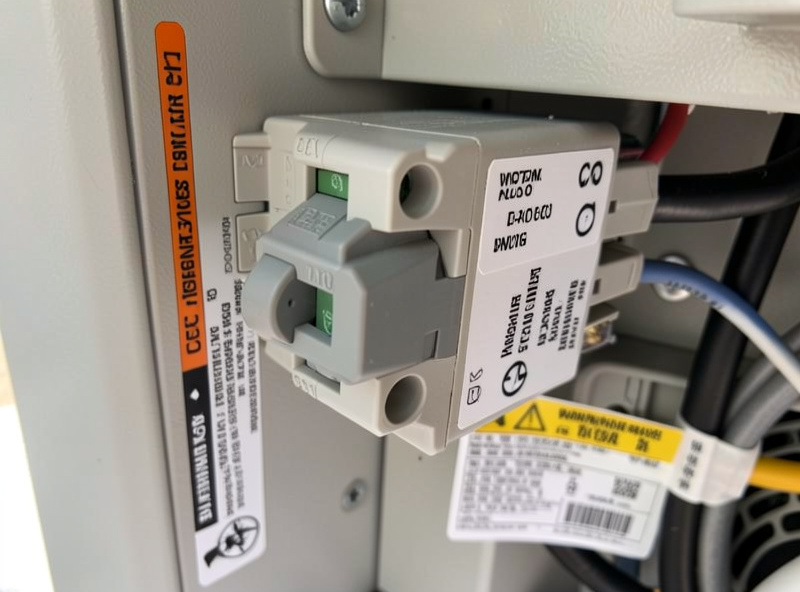
Disconnects, labeling and the firefighter’s view
A recurring theme across these codes is that a first responder must be able to find and operate a disconnect that de-energizes the system, and that the system must be clearly labeled — an ESS placard with nominal voltage, and durable labels on the disconnecting means. This is the same labeling and documentation discipline I keep on my own bank: a laminated one-page diagram, marked disconnects, and a single obvious way to shut it down. The code makes mandatory what is simply good practice. Where the system includes PV, rapid shutdown under 690.12 adds the requirement that the array conductors can be brought to a safe voltage quickly.
Siting, separation and quantity under NFPA 855
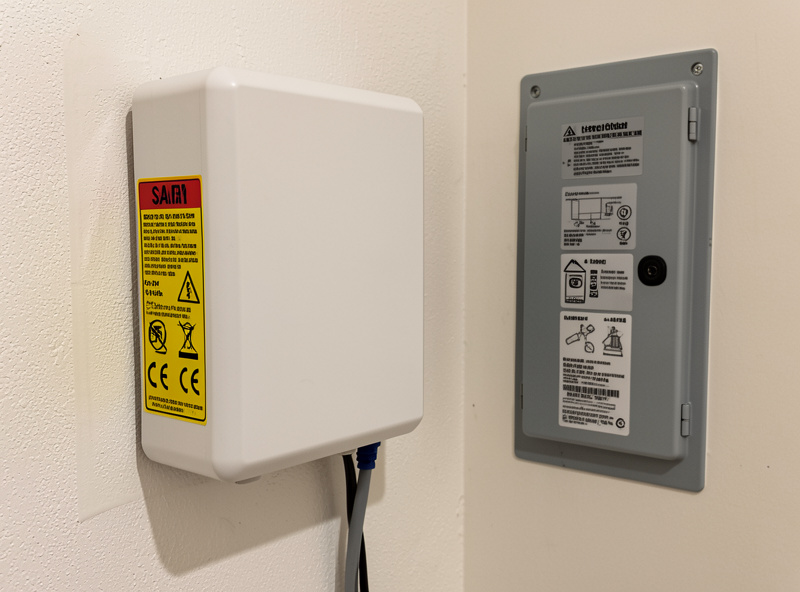
NFPA 855 and the adopted fire code are where the “how much, and where” rules live, and they are the ones that most often surprise DIY builders. Residential standards place limits on the energy stored in a single unit and in aggregate, require separation between units and from certain parts of the dwelling, and restrict installation in some interior locations — with allowances that differ for garages, utility rooms, detached structures and outdoor walls. The thresholds depend on your adopted code edition and your AHJ, so the honest move is to bring your planned capacity and location to the building department before you buy, not after you have mounted the bank.
Where you can put it: room-by-room reality
The location rules are where most residential plans get redrawn. Garages and detached structures are generally the friendliest locations because they offer fire separation from living space; an attached garage usually needs a fire-rated barrier between the ESS and the dwelling. Outdoor wall-mounting is often straightforward given clearances from doors, windows and the property line. Interior habitable spaces, bedrooms and closets are the most restricted — some are outright disallowed, others capped to a low energy quantity. Utility rooms sit in between, depending on construction and the adopted code. Because the energy-quantity thresholds and separation distances depend on your code edition and AHJ, the practical move is to decide location and capacity together, then confirm both with the building department before committing. A 30 kWh plan that is fine on a detached garage wall may be disallowed in a bedroom closet, and the difference is a permit approval versus a redesign.
The DIY listing problem — stated honestly
Here is the part the unboxing videos skip: a battery you build from bare prismatic cells is not a UL 9540-listed system, and many AHJs require listed equipment for a permitted, interconnected residential ESS. That does not make a well-built DIY bank unsafe — mine meets the same physics the listing tests for — but it does mean a self-built pack can be difficult or impossible to permit for grid interconnection in some jurisdictions, and that an unpermitted install can create insurance and resale complications. Some builders use listed batteries to clear permitting and reserve DIY packs for off-grid or non-permitted applications; others work with their AHJ on a field evaluation. Professional installers report that listing and interconnection requirements vary widely by jurisdiction and change with each code cycle, so verify locally rather than trusting a forum thread. None of this is a reason to skip the safety layers — the fusing, connections and ventilation are exactly what makes a bank defensible whether or not it carries a listing mark.
Overcurrent, conductor and clearance rules in practice
Beyond the headline requirements, the articles get specific in ways that change a real install. Article 706 expects overcurrent protection sized and rated for the system — the same Class-T-grade interrupt-rating logic covered in the fusing guide, but now mandatory rather than optional. Conductors are sized to NEC ampacity tables with the continuous-load and temperature rules, which is exactly the method in the wire sizing guide. And the code expects working clearance around electrical equipment — typically a defined depth of clear space in front of the disconnect and panel so the system can be serviced and operated safely. Builders who tuck a bank into a tight closet often discover at inspection that the working-clearance rule, not the battery itself, is the problem.
Grounding and bonding under Article 250 ties straight to the single-system-bond-point practice in the grounding guide: the code wants a defined system bond and continuous equipment grounding, which is why an inspector will look for a clear, single ground reference and properly bonded enclosures. None of these requirements are arbitrary — each one is the code’s version of a safety layer you would want regardless.
The permitting process, step by step
For a permitted residential install the rough sequence is consistent even where the details differ: confirm your jurisdiction’s adopted NEC and fire-code edition, size and document the system, submit a permit application with a single-line diagram and equipment cut sheets (listing documents included), get plan approval, do the work to that approved plan, then pass a final inspection before the system is energized and — if grid-tied — before the utility approves interconnection under Article 705. The two stages that trip up DIY builders are the listing documentation at submission and the interconnection agreement with the utility, both of which assume listed equipment. Bringing your plan to the building department early turns a potential rejection into a conversation about what they will accept, which is a far better place to start than discovering the limits after the bank is on the wall.
If you take one thing from this: code is the conservative floor, your AHJ is the final authority, and a licensed electrician is worth the fee on a permitted, grid-tied install. For the build practices underneath all of it, the DIY LiFePO4 bank build guide and the battery storage safety overview are the companion reads.