Important Disclaimer
BatteryStorageHQ provides educational content and estimates only. We are not certified installers, financial advisors, or electricians. Always consult with licensed professionals.
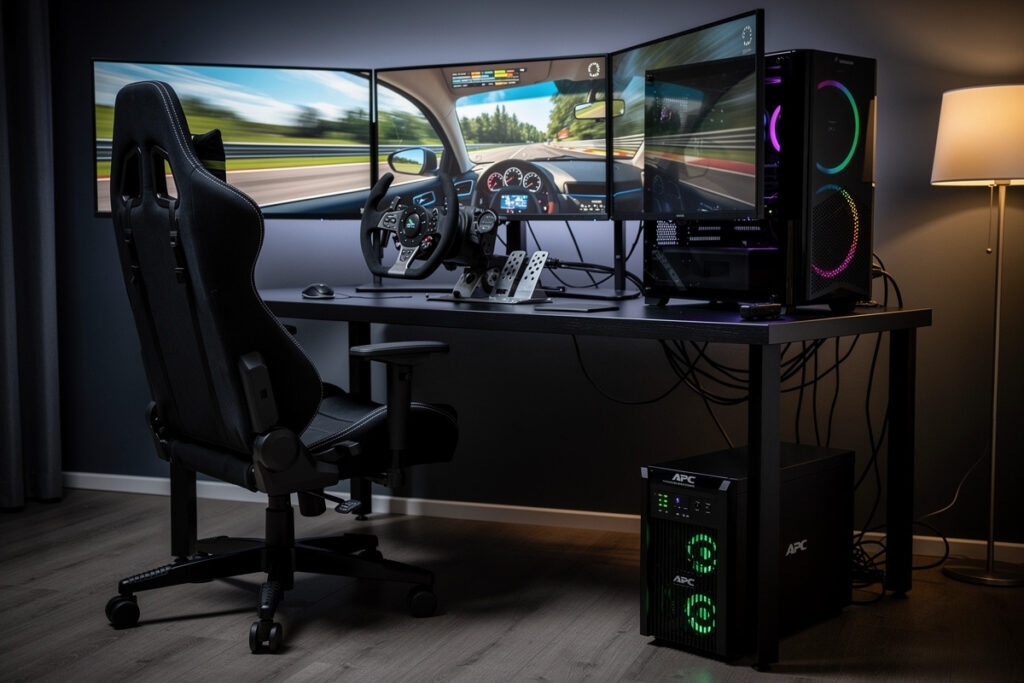
A power blip during the last lap of an iRacing official race costs roughly 80–120 iRating points the first time it happens, plus the entry fee, plus your race reputation if it happens twice. A 1500 VA online double-conversion UPS in front of a sim rig PC, monitor stack, and wheel base eliminates that loss for about $280 and 30 minutes of setup. The math pays back the first time the local grid hiccups during a Daytona 24 stint.
This guide covers UPS sizing for a real sim-racing setup, the difference between standby/line-interactive/online topologies and which one matters here, runtime calculations for the stuff that actually needs to stay up, and how to handle the wheel base — which is often the highest single power draw in the rig. For the rig wiring side that wraps around this, the DIY sim racing rig guide covers the cable runs that determine where the UPS lives.
Why a UPS Specifically (Not Just a Surge Protector)
A surge protector handles spikes — lightning-induced transients, capacitor-discharge surges. It does nothing for the two failure modes sim racers actually hit most: undervoltage sags (when AC drops to 90 V for 200 ms during a heavy household load) and brownouts (sustained low voltage during grid stress). Both reset PSUs that aren’t beefy enough, both crash games, both lose your race position.
A UPS bridges these events with battery power for 5–30 minutes depending on load. That’s enough to finish the race and shut down cleanly. The surge-protect function comes built in.
UPS Topology: Standby vs Line-Interactive vs Online
Three topologies on the consumer market. Each has a transfer time when grid drops; that transfer time determines whether your PC notices.
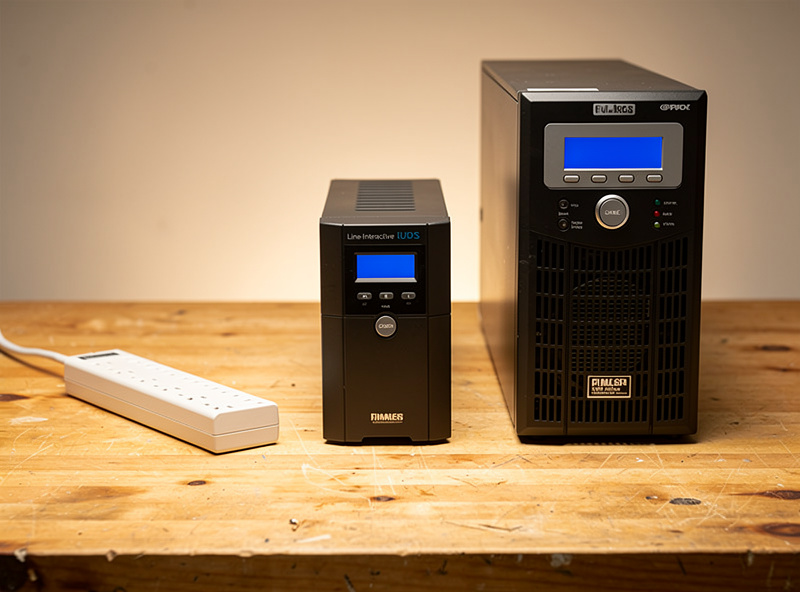
- Standby (cheapest, ~$60–100) — battery kicks in only when AC fails. Transfer time 6–10 ms. Modern PSUs ride through 6 ms easily; budget PSUs sometimes don’t.
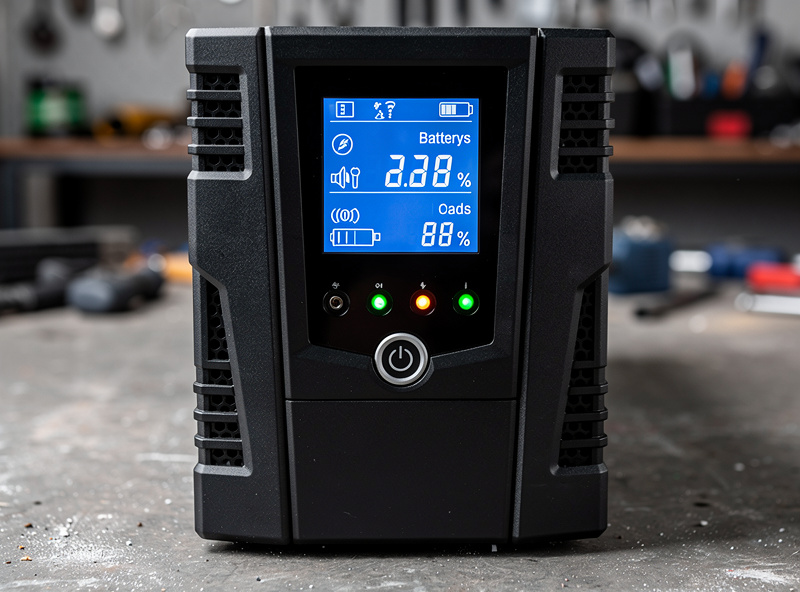
- Line-interactive (mid-tier, ~$150–280) — adjusts voltage continuously through an autotransformer; battery transfer when AC fails. Transfer time 2–6 ms. Handles brownouts without going to battery.
- Online double-conversion (premium, ~$280–500) — always running through inverter; zero transfer time. Continuous clean power regardless of grid quality.
For sim racing, line-interactive is the sweet spot. Online is overkill for residential power; standby loses 1 in 50 transfer events to PSU dropout. Eaton 5SC, CyberPower OR1500LCDRT2U, APC Back-UPS Pro 1500 are the three units most sim racers end up choosing.
Sizing the UPS to Your Sim Rig
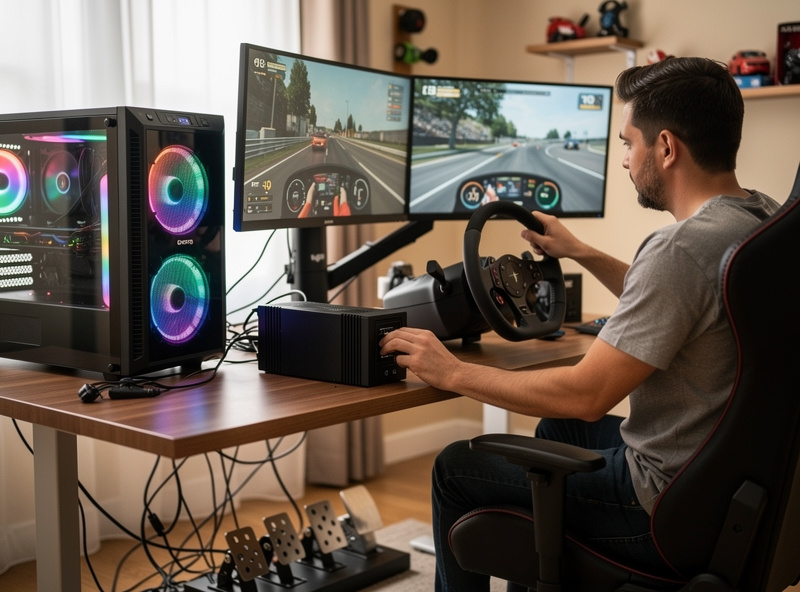
UPS capacity is rated in VA (apparent power) — multiply VA by 0.6 for the realistic watt rating with modern non-linear PSU loads. Sim rig load components:
- Gaming PC at race load: 350–550 W typical (RTX 4070 / 7900 XT / 4080 territory)
- Triple monitor stack (3x 27″ 1440p): 90–135 W
- Wheel base (direct drive): 60–180 W idle, 250–400 W peak
- Pedals (load cell, no motor): 5–15 W
- Wheel/handbrake controller: 5 W
Realistic sustained load: 600–900 W. With wheel-base force-feedback peaks counted, peak load: 1100–1400 W. A 1500 VA / 900 W line-interactive UPS handles this with 8–12 minutes of runtime — plenty to finish a race and shut down. A 2000 VA / 1200 W unit gives 18–25 minutes for endurance setups.
Don’t undersize. A 850 VA UPS overloaded by force-feedback peaks throws “OVERLOAD” and kicks your rig back to grid mid-race — exactly the failure mode you bought it to prevent.
The Wheel Base Question
Direct-drive wheels (Simucube, Fanatec ClubSport DD, Moza R21) have peak draws that exceed sustained draws by 2–3×. A Simucube Pro idling at 60 W can spike to 380 W during a curb hit or crash impulse. Cheap UPS units don’t track these spikes well — the battery sags, the wheel resets, and you lose force feedback for 800 ms.
Two solutions:
- Size the UPS for peak, not sustained — Add the wheel base’s published peak rating to the sustained load when sizing.
- Run the wheel base on grid, PC and monitors on UPS — Acceptable trade-off; wheel base resets gracefully in most modern firmware, where the PC crashing during a race is unrecoverable.
The pure approach (everything on UPS, sized for peaks) is cleaner. The pragmatic approach (PC + monitors on UPS, wheel base on grid) costs less and handles the common case where the wheel base is a recoverable failure.
Calculating Real Runtime
UPS manufacturers quote runtime at suspiciously low loads (typically 50% load). Real-world runtime at full load is roughly 30–40% of that quoted figure.
Quick conversion: a UPS quoted “10 minutes at 750 W” runs about 4 minutes at 1100 W. For a sim race, you need enough runtime to finish the current stint plus 60 seconds of save-and-quit. For a sprint race that’s 30–45 minutes; for endurance that’s 60+ minutes. Most sim racers don’t need full-race runtime — they need “finish the lap and shut down” runtime, which is closer to 5 minutes.
If full-race runtime is the goal, look at extended battery pack systems — UPS units with external battery modules can run a sim rig for 2–4 hours, which covers a Daytona 24 stint comfortably.
Alerting and Monitoring
A UPS that fails silently is worse than no UPS — you assume you’re protected and you’re not. Modern UPS units expose state through USB-HID; PowerChute (APC), PowerPanel (CyberPower), Eaton IPM all run on Windows and report battery state, line voltage, and battery health.
For a sim rig, the configurations worth setting:
- Email alert when on battery for > 10 seconds
- Auto-shutdown PC when battery < 20% remaining
- Self-test every 30 days, log result
- Battery replacement reminder at 3 years (most UPS batteries last 3–5)
Without a self-test log, the battery can fail silently and stay “armed but useless” for months. A 30-day self-test catches it.
Cost vs Risk Trade-off
For casual sim racers (hot-lapping, offline sessions, occasional online lobbies), a UPS is overkill — the cost of losing a session is a re-launch, not iRating. For league racers and iRacing-licensed competitors, a UPS pays back inside one race weekend the first time a brownout hits during a critical event.
Realistic recommendation:
- Casual / occasional online: surge protector only ($30–60)
- League racing, weekly competition: line-interactive 1500 VA UPS ($180–280)
- Endurance (Daytona 24, LeMans-style): line-interactive 2000–3000 VA with extended battery module ($500–800)
- Pro/sim-racer streaming setup: online double-conversion 1500 VA ($380–500)
The casual upgrade path is a $250 one-time purchase that solves a 1-in-30-races problem. Most sim racers are satisfied with the result.
When You Don’t Need a UPS
Skip the UPS if you have rock-solid grid power (rural single-circuit on a stable substation, no recurring brownouts), if you only race offline practice sessions, or if your rig PC is a console (PS5/Xbox; consoles tolerate AC events better than PCs do because their PSUs are simpler and more robust).
Frequently Asked Questions
What size UPS do I need for a sim racing PC?
A 1500 VA line-interactive UPS sized for 600 to 900 watts of sustained load handles a typical sim racing setup with PC, triple monitors, and wheel base. The 1500 VA rating gives 8 to 12 minutes of runtime, enough to finish a race and shut down. Step up to 2000 VA for endurance racing or external battery modules.
Should the wheel base be on the UPS or grid?
Both approaches work. Putting the wheel base on UPS requires sizing for peak draw which can hit 400 watts. Putting it on grid keeps the UPS smaller and accepts that a wheel base reset during an outage is recoverable, where a PC crash during a race is not.
Will a UPS protect my rig from lightning strikes?
Partially. A UPS provides surge protection up to its joule rating, typically 800 to 1500 joules on consumer units. Direct lightning strikes exceed any consumer surge protection. For lightning-prone areas, add a whole-house surge suppressor at the panel as the primary defense and treat the UPS surge as the second line.
How long does a UPS battery last before replacement?
Sealed lead-acid batteries last 3 to 5 years in a UPS in normal home conditions. LiFePO4 batteries in modern UPS units last 8 to 12 years. Manufacturers recommend a self-test every 30 days and battery replacement once capacity drops below 80 percent of rated.
Is online double-conversion necessary for sim racing?
No. Line-interactive UPS units handle residential power events well enough for sim racing. Online double-conversion adds zero transfer time but consumer PSUs ride through line-interactive transfer easily. Online is necessary only for setups where a single millisecond of AC absence is unacceptable, which sim racing is not.
Can I use a portable power station like an EcoFlow or Bluetti instead?
Yes for occasional use, with caveats. Portable power stations have transfer times of 20 to 40 milliseconds which is too long for some PCs. Models with EPS or UPS modes get under 20 milliseconds and work for sim racing. Always test before relying on it for a critical race.
Will the UPS make my electricity bill higher?
Yes by 1 to 3 percent of the connected load. A 800 watt sim rig draws roughly 24 watts continuously through a UPS for inverter losses. Over a year that is about 10 to 15 dollars on a typical electricity rate. The cost is real but small relative to the protection.