Important Disclaimer
BatteryStorageHQ provides educational content and estimates only. We are not certified installers, financial advisors, or electricians. Always consult with licensed professionals.
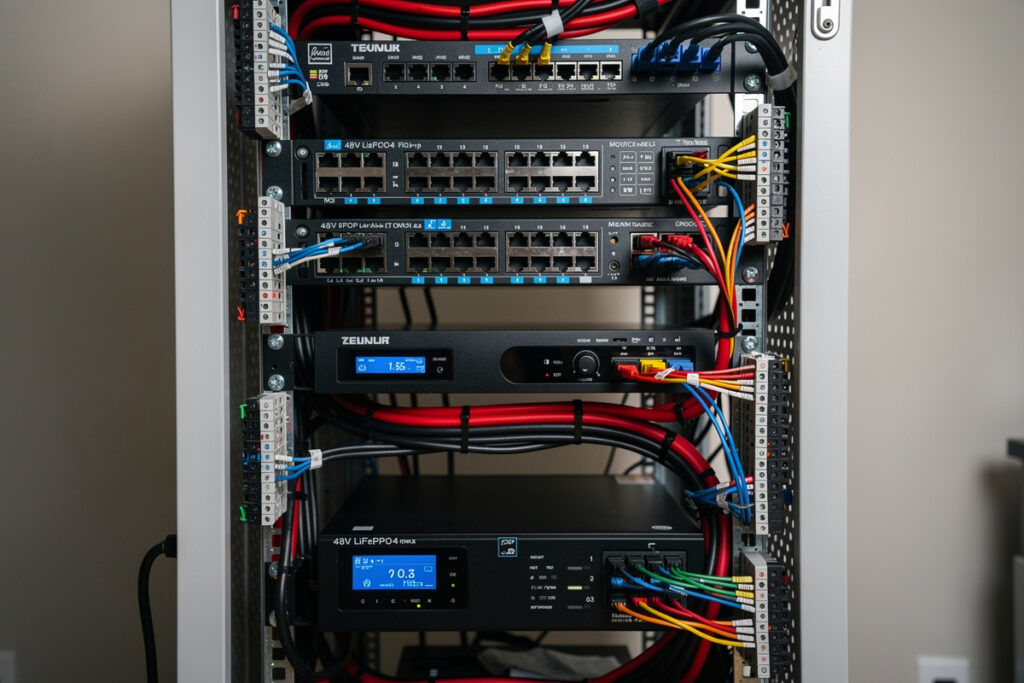
Running network switches, routers, and Wi-Fi access points directly from a 48V DC battery bank eliminates the double-conversion loss of DC-battery to AC-inverter to DC-power-supply — a chain that wastes 15-25% of stored energy as heat before it reaches the network gear. Most managed switches and enterprise routers accept 48-56V DC input natively, either through a dedicated DC terminal block or by bypassing the internal AC power supply. A typical 24-port PoE switch draws 25-40 watts at idle, and at 48V DC that is approximately 0.5-0.8 amps — meaning a single 280Ah LiFePO4 cell at 3.2V nominal scaled up to a 16S pack can run that switch for roughly 280 hours during an outage, not accounting for PoE device draw. The real win is not just runtime — it is the elimination of inverter noise, the reduction in conversion heat, and the fact that your network stays up during a power outage without a single AC-dependent component in the chain.
Which Network Gear Accepts 48V DC Directly
The key specification to look for is “DC input” or “redundant power supply” in the switch or router data sheet. Ubiquiti EdgeSwitch and UniFi Switch Pro models accept 48-56V DC via a terminal block or DC barrel jack. MikroTik CRS and CSS series switches accept 12-57V DC on a barrel jack, making them the most flexible option for direct battery connection. Netgear ProSafe and Cisco small-business switches with external power bricks can be bypassed entirely — the power brick converts AC to 12V or 48V DC, and you can feed that DC voltage directly to the switch’s DC input jack, skipping the brick and its 5-10% conversion loss. For devices that only accept AC input internally, a small 48V-to-12V DC-DC converter ($15-25) taps the battery bus and feeds the switch’s native 12V input, which is still more efficient than a 48V-to-120VAC inverter followed by a 120VAC-to-12VDC power brick.
Wiring the DC Bus: Fusing and Cable Sizing
Every device on the DC bus needs its own fuse, not just the battery. The battery main fuse protects the pack from a dead short, but a short in the cable feeding a switch can draw 100+ amps from a 48V LiFePO4 pack before the battery fuse blows — and that current is enough to vaporize 18AWG wire and start a fire long before the main fuse reacts. A small inline fuse holder with a 5A ATC fuse on each device branch costs $2 and protects the wiring, not the device. For cable sizing: 18AWG handles 5A at 48V with less than 1% voltage drop over 10 feet, which covers the run from a battery rack to a nearby network rack. If the battery is in a garage and the network rack is in a closet 30 feet away, step up to 14AWG to keep voltage drop under 2%.
The DC bus itself should be a pair of DIN-rail terminal blocks or a small DC distribution panel with positive and negative bus bars. Each device branch begins at the bus with a fuse, runs through appropriately sized wire to the device, and terminates at the device’s DC input. The negative bus is common, and the entire DC system is isolated from the AC electrical system — do not bond the DC negative to the AC ground unless your inverter manual explicitly requires it, because doing so can create a ground loop that injects inverter switching noise into the DC bus and causes random packet loss on Ethernet ports as the noise capacitively couples into unshielded cables running parallel to the DC wiring.
What Actually Runs and For How Long
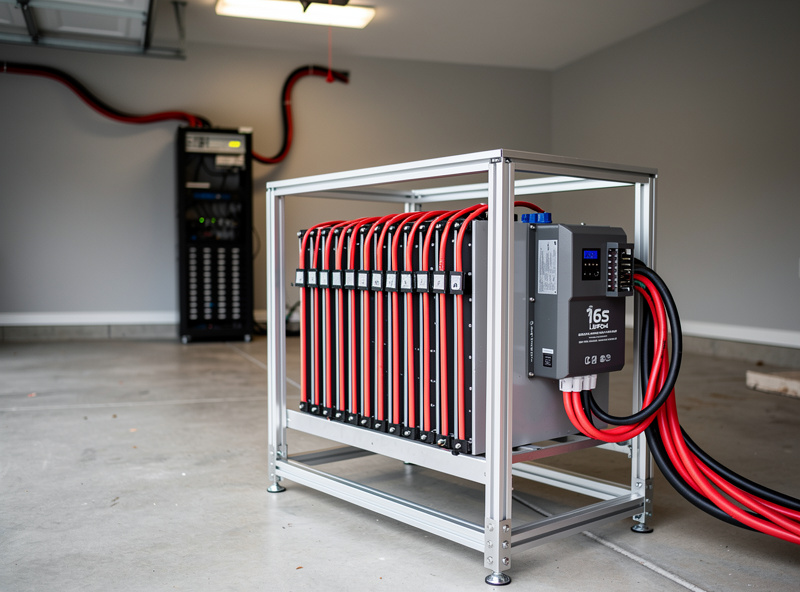
The runtime math is straightforward: a 48V 280Ah battery stores 13,440 watt-hours (48V × 280Ah). A network stack consisting of an OPNsense router (15W), a 24-port PoE switch (30W), a Wi-Fi access point (10W), and a small NAS (20W) draws approximately 75 watts. Runtime at this load is roughly 179 hours (13,440 / 75), or about 7.5 days. In practice, the BMS low-voltage cutoff triggers at 48V (3.0V per cell), and usable capacity between full charge and cutoff is approximately 90% of nameplate — so real runtime is closer to 6.5 days. Adding PoE cameras at 7W each reduces runtime by about 22 hours per camera per full charge. These numbers assume no solar charging during the outage; if the battery bank has solar input, runtime extends indefinitely as long as daily production exceeds consumption, which a 400W panel does easily for a 75W network load in any season with at least 3 hours of usable sun.
For the complete guide to network security and firewall configuration that protects the equipment on this DC bus — including VLAN segmentation for IoT battery monitors, firewall rules for the Grafana dashboard, and how to isolate the BMS MQTT traffic from the rest of the network — the pfSense configuration guide on HomeLabRouter covers the networking layer that the DC power bus physically feeds.
Frequently Asked Questions
Can I run my network switch directly from a 48V battery?
Yes. Many managed switches from Ubiquiti, MikroTik, and Netgear accept 48-56V DC via terminal block or barrel jack. Check the switch data sheet for DC input support. A 24-port PoE switch at idle draws 25-40 watts, and a 48V 280Ah battery can run it for roughly 280 hours without recharge.
Do I need an inverter between the battery and network gear?
No if your gear accepts DC input directly. Skipping the inverter eliminates 15-25% double-conversion loss. For gear that only accepts AC, a 48V-to-12V DC-DC converter feeding the switch’s native DC input is still more efficient than DC-AC-DC conversion through an inverter.
What gauge wire do I need for a 48V DC network bus?
18AWG handles 5A at 48V with under 1% voltage drop for runs up to 10 feet. For runs over 20 feet use 14AWG to keep voltage drop under 2%. Size the wire for the branch fuse rating not the device draw — the fuse protects the wire and the wire must handle the fuse’s trip current without overheating.
Should I fuse each device on the DC bus separately?
Yes. A short in a device cable can draw 100+ amps from a LiFePO4 pack before the main battery fuse blows. A $2 inline 5A ATC fuse on each branch protects the wiring from fire before the main fuse reacts. Every branch gets its own fuse rated for the wire gauge on that branch.
Can PoE cameras and access points run directly from the battery DC bus?
Yes, through a PoE switch that is itself powered by the 48V DC bus. The switch receives DC power from the battery and delivers PoE to the cameras and APs. During an outage your security cameras and Wi-Fi remain operational as long as the battery has charge — typically 24-72 hours depending on battery size.
Do I need to bond the DC negative to AC ground?
No unless your inverter manual explicitly requires it. Bonding DC negative to AC ground can create a ground loop that injects inverter switching noise into the DC bus. Keep the DC system isolated from AC ground unless code or equipment documentation requires otherwise for a specific installation.