Important Disclaimer
BatteryStorageHQ provides educational content and estimates only. We are not certified installers, financial advisors, or electricians. Always consult with licensed professionals.
Battery chemistry is the most important decision in home energy storage — wrong chemistry means inadequate cycle life, fire risk, or thousands of dollars wasted on the wrong technology. This guide compares LiFePO4, NMC, lead-acid, and emerging chemistries (sodium-ion, solid-state) for home storage applications. Each chemistry has specific strengths and clear use cases — pick the right one for YOUR application based on cycle life requirements, energy density needs, safety profile, and budget.
Most beginners default to whatever chemistry their installer recommends or whatever seems cheapest. That works for grid-tied backup applications. By the time you start cycling deep daily (off-grid, full self-consumption), the chemistry choice becomes the difference between a 10-year system and a 3-year system. The four chemistries below cover 95% of home storage in 2026, and each fits a specific scenario.
Battery Chemistry Comparison (2026)
| Property | LiFePO4 (LFP) | NMC | Lead-Acid (AGM/Gel) | Sodium-Ion (Na-ion) |
|---|---|---|---|---|
| Cycle life (80% DOD) | 3,500-7,000 cycles | 1,500-3,000 cycles | 500-1,200 cycles | 3,000-6,000 cycles |
| Energy density (Wh/kg) | 90-160 | 200-260 | 30-50 | 100-160 |
| Volumetric density (Wh/L) | 250-350 | 500-700 | 80-100 | 250-350 |
| Thermal runaway risk | Very low | Moderate-high | Very low | Very low |
| Cold weather (-10°C) | Reduced charging | Reduced capacity | Reduced capacity | Better than LFP |
| Cost per kWh (2026) | $150-300 | $200-400 | $80-150 | $100-200 |
| Best for | Daily-cycle home storage | EV, weight-constrained | Standby backup only | Cold climates, low cost |
The single most important pattern: LiFePO4 wins for home storage in 2026 because cycle life dominates the economic calculation. A LiFePO4 system cycling once daily lasts 10-20 years; the same NMC system lasts 4-8 years. The 3x cycle life advantage outweighs LiFePO4’s lower energy density for stationary storage where weight doesn’t matter.
LiFePO4 (LFP): The Home Storage Standard
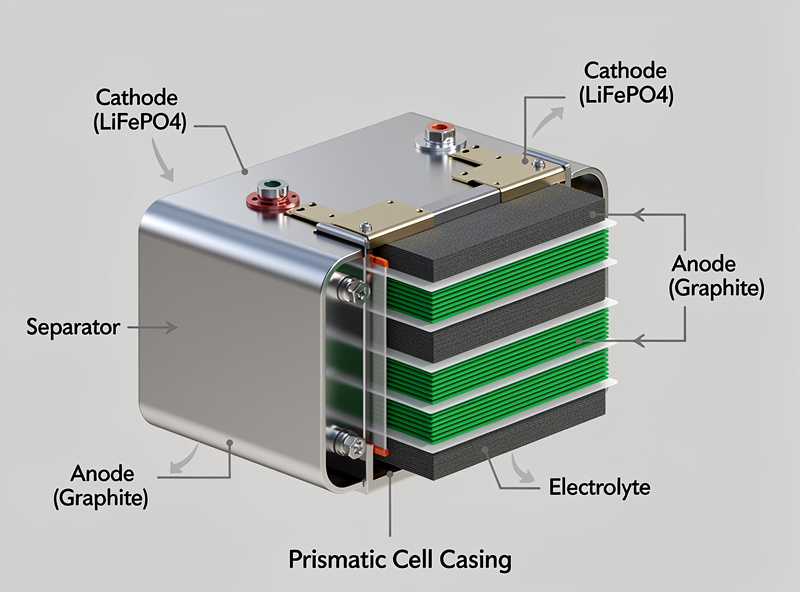
LiFePO4 (lithium iron phosphate) is the dominant home storage chemistry in 2026. Compared to NMC, LFP trades energy density for cycle life and safety — perfect trade-offs for stationary home storage where weight doesn’t matter and longevity does.
Key LiFePO4 advantages: 3,500-7,000 cycles at 80% depth of discharge (vs 1,500-3,000 for NMC), thermal stability (won’t ignite under abuse conditions that would set NMC on fire), no cobalt (cheaper, more ethical sourcing), and stable voltage curve (the battery sits at 3.2-3.3V for most of its discharge cycle).
The downside: lower energy density per kg (90-160 Wh/kg vs NMC’s 200-260). For home stationary storage this doesn’t matter. For EVs and portable applications where every kg matters, NMC wins.
For a head-to-head LiFePO4 vs NMC deep dive, see our LiFePO4 vs NMC comparison. For a deeper foundation in battery basics, see our complete beginners guide to battery storage.
NMC: When Energy Density Matters
NMC (nickel manganese cobalt) is the chemistry powering most electric vehicles and many older home storage systems (Tesla Powerwall 1 and 2 used NMC). The advantage is energy density — more watt-hours per kg and per liter than LiFePO4.
For home storage, NMC’s energy density rarely justifies the trade-offs: shorter cycle life, higher cost per kWh, thermal runaway risk. The Tesla Powerwall 3 switched to LiFePO4 in 2023 specifically because the home storage use case favors LFP’s longevity.
NMC remains relevant for: EV applications (weight matters), portable power stations (smaller package needed), or specific space-constrained installations where LiFePO4’s larger footprint is a deal-breaker. For typical home storage, NMC is the wrong choice in 2026.
Lead-Acid: When and When Not
Lead-acid batteries (AGM, gel, or flooded) are the legacy chemistry. Cheaper per kWh upfront but dramatically shorter cycle life makes them more expensive over time for daily-cycling applications.
Use lead-acid for: emergency backup systems that rarely cycle (UPS, generator-backed systems, occasional grid outages). Standby applications can extract decades of life from lead-acid because the battery isn’t actually cycling much.
Don’t use lead-acid for: solar self-consumption (daily cycling kills lead-acid in 2-3 years), off-grid systems (cycle requirements far exceed lead-acid lifespan), or any scenario with budget for lithium chemistry. The cost-per-cycle math always favors LiFePO4 for cycling applications.
Cell Manufacturers and Quality
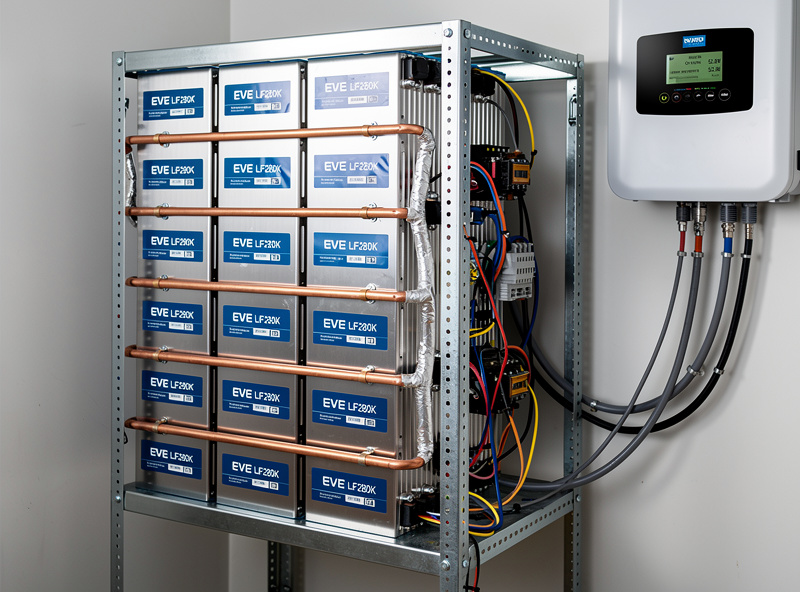
For DIY LiFePO4 systems, the cell manufacturer matters as much as the chemistry — see our EVE vs CATL vs CALB cell comparison for the full DIY-cell sourcing guide. Quality varies dramatically between brands.
EVE Energy: Premium Chinese manufacturer. EVE LF280K (280Ah) and LF304K (304Ah) cells are the gold standard for DIY builds. Excellent quality control, 6,000+ cycle life, and broad availability through reputable resellers.
CATL: Largest LFP manufacturer globally. CATL 280Ah and 314Ah cells appear in many production systems. Quality is excellent but availability for DIY varies — most CATL output goes to OEMs.
CALB: Established premium manufacturer. CALB CA280 and similar cells are reliable choices. Slightly more expensive than EVE; comparable quality.
BYD, Lishen, REPT: Other major manufacturers serving the OEM market. Quality is good; availability for DIY varies.
Avoid: cells from unknown manufacturers, cells without verifiable quality control documentation, and used/Grade B cells unless you specifically understand the trade-offs — covered in our Grade A vs Grade B cells guide. Our DIY LiFePO4 build guide covers cell selection in production-build context.
Top Balancing Before Assembly
Before assembling a DIY LiFePO4 pack, all cells must be top-balanced — connected in parallel and charged to identical voltage. Without top balancing, pack capacity is permanently limited by initial cell mismatches that the BMS cannot fully correct.
The process: connect all cells in parallel via busbars, charge with a 3.5V power supply for 24-48 hours, verify cells reach matching voltage, disconnect parallel arrangement, assemble in series. Our top balancing guide walks through this in detail.
Cycle Life and Depth of Discharge
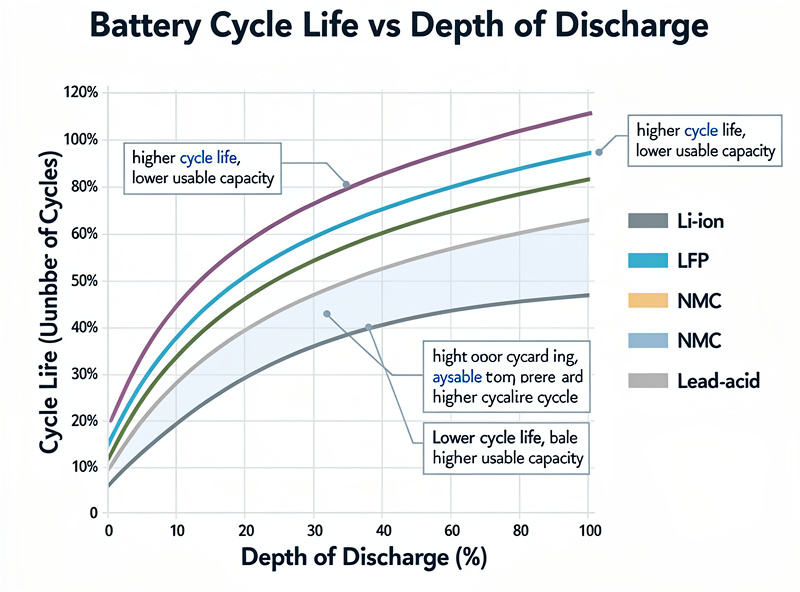
Cycle life depends on depth of discharge (DOD). Discharging to 100% DOD reduces cycle life dramatically; staying above 20% DOD extends it significantly.
LiFePO4 typical figures (rough):
100% DOD (full discharge): 1,500-3,000 cycles
80% DOD: 3,500-7,000 cycles
50% DOD: 8,000-15,000 cycles
20% DOD: 20,000+ cycles (essentially unlimited for home storage)
For home storage applications, sizing the battery to operate at 50-80% DOD on typical cycles produces 10-20 year system life from quality LiFePO4 cells. Our cycle life vs DOD guide covers the math in detail. Sizing for 100% DOD on every cycle reduces system life by 50-70%.
The practical implication: oversize the battery for your actual usage pattern. A system that needs 10 kWh per day should have at least 15-20 kWh of installed capacity, allowing daily cycles to stay below 70% DOD. This sounds wasteful but produces dramatically longer system life.
Cold Weather Performance
Cold weather affects all battery chemistries, with LiFePO4 having a specific weakness: charging below 0°C damages cells permanently. Discharge below 0°C works but reduces capacity 20-30%.
Mitigation strategies for cold climates: heated battery enclosures (most production systems include heaters), insulated enclosures inside conditioned spaces (basement, garage), or BMS-controlled charge cutoff that prevents charging when cells are below freezing.
See our LiFePO4 cold weather guide for detailed mitigation strategies. For climates where outdoor below-freezing is common, sodium-ion batteries handle cold better than LiFePO4. Sodium-ion is emerging in 2025-2026 with lower energy density but better cold-weather performance — useful for cabin or off-grid applications in cold climates.
For typical home installations in conditioned spaces, cold weather isn’t a practical issue. The battery sits in a basement or insulated garage that stays above freezing year-round.
Warranty Considerations
Battery warranties vary dramatically between products. Understanding warranty terms before purchase prevents disappointment when something fails.
Prebuilt 48V batteries: Typically 5-10 years against manufacturing defects. Some include throughput warranties (warranty if total energy delivered exceeds X kWh). Read the fine print — many warranties have limitations around installation conditions, cycling depth, or maintenance requirements that void coverage.
Cells (DIY builds): Quality resellers offer 1-3 year warranty against cell defects. Manufacturer warranty typically requires direct purchase relationships unavailable to most DIY buyers. The reseller warranty is the practical protection.
Inverters (paired with batteries): 5-15 year warranty depending on brand. Sol-Ark, Victron, EG4 all offer competitive warranty terms. Check whether the warranty covers communication issues with battery (CAN protocol mismatches are a common failure point).
For DIY builds, the warranty trade-off is real. You save 30-40% vs prebuilt but lose the integrated warranty coverage. For users comfortable with troubleshooting, this is acceptable. For users who want call-the-installer support when something goes wrong, prebuilt is the right answer.
Prismatic vs Cylindrical Cell Formats
LiFePO4 cells come in two main formats: prismatic (large rectangular cells, typical 280Ah-314Ah) and cylindrical (smaller round cells, typical 18650/21700 sizes adapted to LFP).
For home storage in 2026, prismatic dominates DIY builds. The large per-cell capacity reduces interconnect count (16 cells for a 14 kWh pack vs 200+ cells for cylindrical) and simplifies BMS management. Prismatic cells from EVE, CATL, CALB are the standard.
Cylindrical LFP cells exist (like the Lithium Werks/A123 26650) but are less common in DIY home storage because the cell-count overhead is high. Production systems sometimes use cylindrical cells (especially Tesla’s earlier products), but DIY builds almost universally use prismatic.
The format choice rarely matters for home performance — both formats deliver similar cycle life, energy density, and reliability when properly configured. Pick the format that’s available from your preferred supplier with good BMS support.
The BMS: Why It’s Mandatory
Every LiFePO4 home battery requires a Battery Management System (BMS). The BMS prevents the failure modes that cause cell damage or fires: over-charging individual cells, over-discharging, cell imbalance, and excessive temperature.
Without a BMS, even a properly top-balanced pack will fail within months. Cells drift in voltage, the highest cell over-charges (potentially venting or igniting), the lowest cell over-discharges (causing permanent damage), and the pack capacity drops dramatically.
For DIY builds, BMS choice matters as much as cell choice. Active-balancing units (JK BMS, Heltec, JBD active) shuffle charge between cells continuously; passive-balancing units (Daly, JBD basic) burn excess charge during balancing. Active is the modern standard for serious builds. Our BMS guide covers selection in detail.
Active vs Passive Balancing
The BMS can balance cells two ways: actively (shuffling charge from high cells to low cells) or passively (burning excess charge from high cells as heat through resistors).
Active balancing: Higher-end BMS units (JK BMS, Heltec, Daly Smart) move charge between cells. The shuffling is efficient — energy stays in the pack rather than being wasted as heat. Effective for both initial pack imbalance and ongoing maintenance.
Passive balancing: Budget BMS units (Daly basic, JBD basic) burn excess charge through resistors during top-of-charge. Inefficient (wasted energy) but adequate for well-matched cells with minor drift.
For Grade A cells with proper top-balancing, passive balancing is sufficient. For Grade B cells or imperfect builds, active balancing produces noticeably better long-term results. The cost difference is typically $50-100 — worth it for any serious DIY build.
Thermal Runaway: The Catastrophic Failure Mode
Thermal runaway is the cascade failure where one cell ignites and propagates fire to adjacent cells. LiFePO4’s threshold is approximately 270°C internal cell temperature; NMC’s threshold is 150-180°C. At normal home use temperatures (typically under 40°C), neither chemistry approaches thermal runaway.
Triggers: mechanical damage (puncture, crush), electrical abuse (over-charge, internal short), or external heat (fire propagation from external source). The BMS prevents electrical abuse triggers; physical installation choices prevent mechanical and external triggers.
For LiFePO4 in home installations, thermal runaway is rare. The chemistry is forgiving and the failure modes that cause it require unusual abuse conditions. NMC requires more careful installation considerations because triggers happen more easily and propagation is harder to contain. See our battery storage safety guide for installation safety details.
Prebuilt vs DIY Decision
The choice between prebuilt LiFePO4 batteries (EG4 PowerPro, Pytes V5, BigBattery Rhino) and DIY 16-cell builds is one of the biggest in home storage planning.
Prebuilt advantages: faster install (hours vs days for DIY), warranty included, factory top-balancing and BMS configuration, integrated CAN/RS485 communication for inverter integration, professional build quality and case.
DIY advantages: lower cost (typically 30-40% savings on per-kWh basis), upgradeable cell capacity over time, deeper learning that pays off for troubleshooting and upgrades, and customization for specific configurations.
For first-time builders without electrical experience, prebuilt is the right answer. For users with electrical comfort and time to invest in learning, DIY produces meaningful savings. Production users typically run prebuilt for primary storage and DIY for expansion or specific use cases.
Battery Lifecycle Economics
The right way to evaluate battery economics: cost per kWh delivered over system life, not upfront cost per kWh capacity.
Example: a $3,000 LiFePO4 battery (10 kWh capacity) cycled to 50% DOD daily delivers 5 kWh × 8,000 cycles = 40,000 kWh over its lifetime. Cost per kWh delivered: $0.075. The same money spent on lead-acid (capacity equivalent at 6 kWh useful capacity due to limits) delivers 3 kWh × 800 cycles = 2,400 kWh. Cost per kWh delivered: $1.25 — 17x more expensive per kWh.
This is why LiFePO4 dominates serious home storage despite higher upfront cost than lead-acid. The cost-per-kWh-delivered math always favors lithium for cycling applications. Lead-acid only wins for pure standby applications where cycles aren’t consumed.
For the deeper sizing math, see our battery sizing guide.
Installation Environment
The right installation environment for home LiFePO4: temperature-controlled (10-30°C ideal), low humidity (under 60% RH), well-ventilated for any vapor that might form during BMS faults, and away from flammable materials.
Common installation locations: basement (climate-controlled, well-ventilated, away from living spaces), attached garage (climate-controlled in most homes, easy access for monitoring), utility room (purpose-built for technical equipment).
Avoid: hot attics (excessive heat reduces cycle life dramatically), unheated outbuildings without enclosures (cold-charging damage), confined spaces without ventilation (any BMS fault that produces vapor becomes dangerous), and direct sunlight (heating effects).
Production systems often include weather-resistant enclosures suitable for outdoor wall-mounting; DIY systems usually need indoor installation in conditioned spaces. The installation environment matters as much as the cells themselves for long-term reliability.
Frequently Asked Questions
Why is LiFePO4 better than NMC for home storage?
LiFePO4 lasts 2-3x longer in cycle life (3,500-7,000 cycles vs 1,500-3,000 for NMC), is much safer (no thermal runaway risk under typical conditions), and costs less per kWh of installed cycle capacity. NMC’s higher energy density doesn’t matter for stationary home storage where weight isn’t a constraint. For typical home applications, LiFePO4 is the right answer.
Are sodium-ion batteries ready for home storage?
Beginning in 2025-2026, sodium-ion is becoming commercially available for home storage. CATL, BYD, and others have shipped systems. Lower energy density than LiFePO4 (more space needed) but better cold-weather performance and lower cost. Worth considering for cold climates and budget builds; not yet mainstream for typical installations.
Can I mix battery chemistries in one system?
No — each chemistry has different voltage profiles, charge characteristics, and lifecycle behavior. Mixing chemistries breaks the BMS, creates thermal management issues, and almost always produces worse results than choosing one chemistry. Pick LiFePO4 for daily cycling or sodium-ion for cold climates; don’t mix.
What’s the difference between Grade A and Grade B cells?
Grade A cells passed manufacturer quality control with full specifications. Grade B cells failed one or more tests but are otherwise functional — typically slightly reduced capacity or higher self-discharge. Grade A costs more but produces predictable systems. Grade B saves 20-30% upfront but introduces variability that complicates DIY builds. For first-time builders, Grade A is worth the cost.
How long does a LiFePO4 home storage system last?
Properly sized and maintained: 15-25 years. The system reaches 70-80% of original capacity around 4,000-5,000 cycles (about 11-14 years at one cycle per day). Most systems are retired due to electronics aging (BMS, inverter) before cells reach end of life. Cell longevity rarely limits system life if cells are quality.
Should I buy used Tesla / Nissan modules for home storage?
Risky for typical users. Used EV modules are cheaper per kWh but use NMC chemistry (shorter cycle life) and require expertise to safely repurpose. The BMS doesn’t transfer; you build your own. The capacity history is unknown. Better choice for most users: new LiFePO4 cells with full warranty. Used modules suit experienced DIYers willing to accept the trade-offs.
Does LiFePO4 need a BMS?
Yes, mandatory. The BMS prevents over-charging, over-discharging, cell imbalance, and thermal runaway. Cells without a BMS will fail (or fail catastrophically) within months. Quality BMS units cost $50-300; they’re not optional. Our DIY battery bank guide covers BMS selection and installation.