Important Disclaimer
BatteryStorageHQ provides educational content and estimates only. We are not certified installers, financial advisors, or electricians. Always consult with licensed professionals.
LiFePO4 vs NMC is the central battery chemistry decision for home storage. In ~40 words: LiFePO4 is the right choice for daily-cycling stationary storage because it lasts 3x longer (3,500-7,000 cycles vs 1,500-3,000), is much safer (no thermal runaway), and costs less per kWh of cycle capacity. NMC’s higher energy density only matters for weight-constrained applications like EVs.
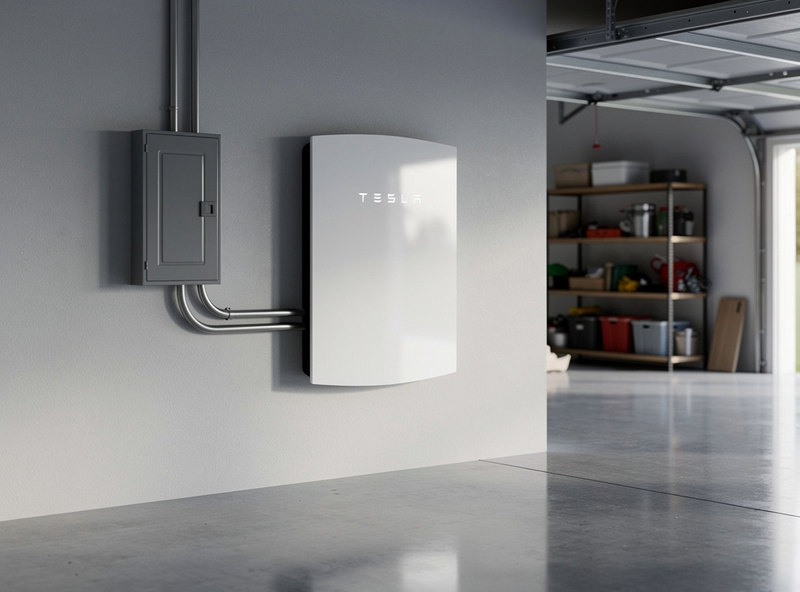
This guide breaks down the LiFePO4 vs NMC decision across cycle life, safety, energy density, cost, and real-world implications. The math strongly favors LiFePO4 for home storage in 2026, which is why every major manufacturer (Tesla Powerwall 3, EG4, Pytes, BigBattery, etc.) ships LiFePO4 in current home products.
Cycle Life: The Decisive Difference
Cycle life is the single most important factor for home storage applications. The battery’s economic value comes from how many cycles it delivers — pay $5,000 once, get 5,000 cycles, and the system effectively costs $1 per cycle.
LiFePO4 typical cycle life at 80% depth of discharge (DOD): 3,500-7,000 cycles. Quality cells (EVE LF280K, CATL 314Ah) hit the high end of this range. At one cycle per day, that’s 9.5-19 years of daily cycling.
NMC typical cycle life at 80% DOD: 1,500-3,000 cycles. Premium NMC cells (Tesla, Panasonic) hit the high end. At one cycle per day, that’s 4-8 years of daily cycling — significantly less than LiFePO4.
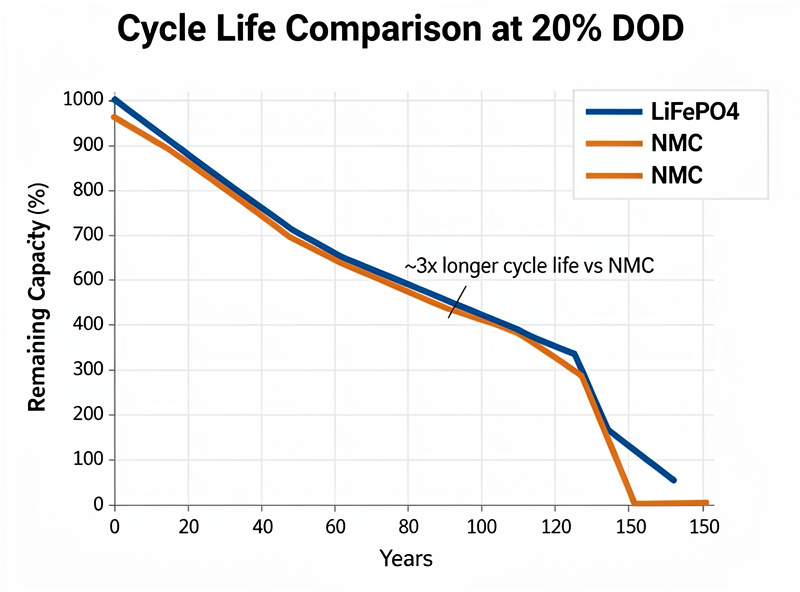
The economic implication: LiFePO4 systems pay back their higher upfront cost (slightly more expensive per kWh than NMC) within the first 3-4 years, then continue producing cycles for another 5-15 years. NMC systems may need replacement before they finish paying back.
For broader battery context, see our battery chemistry comparison covering the full chemistry landscape.
Safety: Thermal Runaway Risk
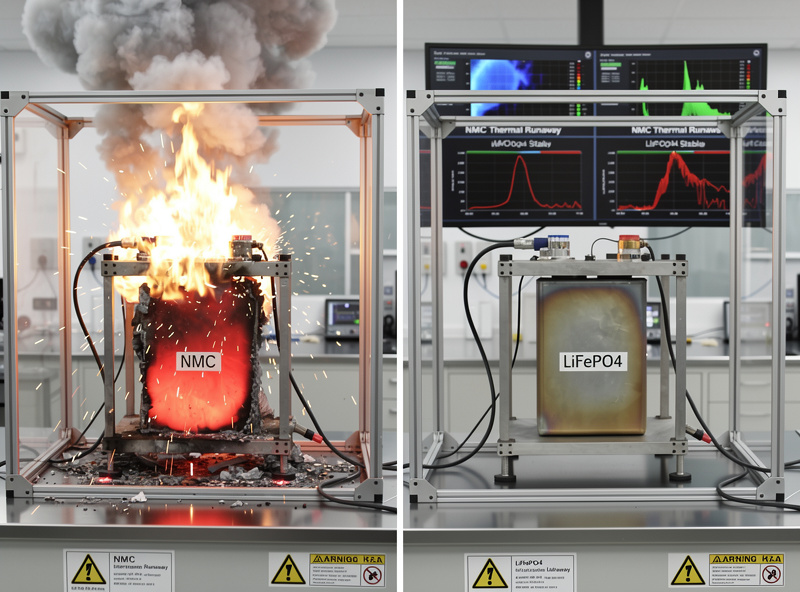
Thermal runaway is the catastrophic failure mode where a battery cell ignites internally and cascades fire through the pack. Both LiFePO4 and NMC can theoretically experience thermal runaway, but the temperature thresholds differ dramatically.
LiFePO4 thermal runaway threshold: ~270°C internal cell temperature. The chemistry naturally resists ignition. Mechanical abuse (puncture, crush) typically causes electrolyte leakage rather than fire. LiFePO4 cells in proper installations virtually never thermally run away under home use conditions.
NMC thermal runaway threshold: ~150-180°C internal cell temperature. Mechanical abuse, internal short, or BMS failure can trigger thermal runaway in NMC. Once started, NMC fires self-sustain — water doesn’t extinguish, fire propagates to adjacent cells, and a single cell failure becomes a pack fire.
For home installations, LiFePO4’s safety advantage is meaningful. Mounting batteries on garage walls, basements, or living spaces requires confidence that mechanical issues or BMS faults won’t lead to fires. LiFePO4 provides that confidence; NMC requires more careful installation considerations. See our battery storage safety guide for installation safety details.
Energy Density: When NMC Wins
Energy density is the only dimension where NMC clearly beats LiFePO4. Per kg or per liter, NMC packs more watt-hours.
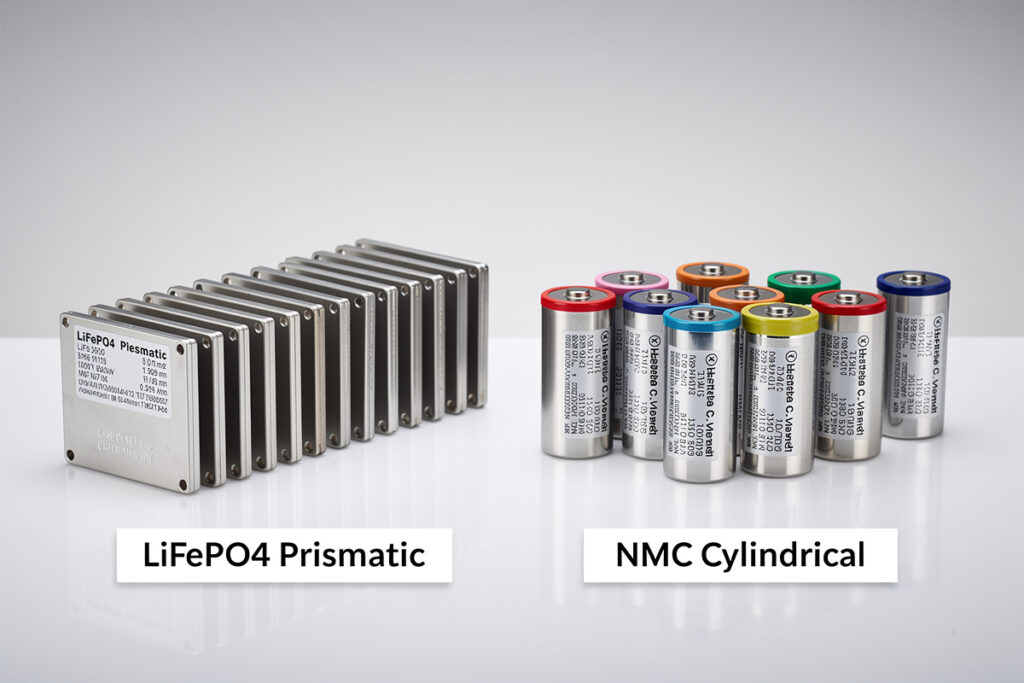
NMC: 200-260 Wh/kg, 500-700 Wh/L. LiFePO4: 90-160 Wh/kg, 250-350 Wh/L.
For EVs, this matters enormously — every kg of battery is a kg less of vehicle range or payload. For portable power stations, the smaller package matters. For home stationary storage, neither matters much. A LiFePO4 home storage unit is bigger and heavier than an equivalent NMC unit, but it sits in the basement; weight and footprint rarely constrain home installations. For buyers choosing between the three brands that now dominate the portable LFP market, the EcoFlow vs Bluetti vs Anker comparison examines how their flagship units differ on chemistry, surge handling, and long-term reliability.
The single home application where LiFePO4’s lower energy density does matter: very space-constrained installations (small condos, RVs converted to permanent homes, micro-units). For these, NMC’s smaller footprint can justify the trade-offs. For typical homes with garage or basement space, LiFePO4 is the right answer.
Cost Per kWh and Cost Per Cycle
Sticker price comparison: LiFePO4 cells in 2026 cost $150-300 per kWh installed; NMC cells cost $200-400 per kWh installed. NMC is sometimes cheaper upfront for budget systems.
The cost-per-cycle math reverses this: LiFePO4 at $200/kWh lasting 5,000 cycles = $0.04 per kWh per cycle. NMC at $300/kWh lasting 2,500 cycles = $0.12 per kWh per cycle. LiFePO4 is 3x cheaper per cycle.
For daily-cycling applications (off-grid, solar self-consumption), cost-per-cycle is the right metric. For occasional-cycling applications (backup power that rarely runs), upfront cost matters more — and lead-acid actually beats both lithium chemistries at minimal cycling.
Cold Weather Performance
Both LiFePO4 and NMC degrade in cold weather, but the failure modes differ.
LiFePO4: charging below 0°C damages cells permanently (lithium plating). Discharging below 0°C reduces capacity 20-30% but doesn’t damage cells. Production systems include heaters or BMS-enforced charge cutoff to prevent cold charging damage.
NMC: charging works down to about -20°C with reduced rate. Discharging works down to -40°C with significant capacity loss. NMC handles cold ambient temperatures better than LiFePO4 in absolute terms.
For cold climate installations (Canada, northern US, mountain locations), this is a real consideration. Mitigation: install batteries in conditioned spaces (basement, insulated garage), use heated enclosures (most production systems include heaters), or choose sodium-ion which handles cold better than either LiFePO4 or NMC.
When to Use Each Chemistry
Use LiFePO4 for: Stationary home storage (95% of home applications), solar self-consumption, off-grid systems, backup power systems with moderate cycling. The right answer for almost every home use case in 2026.
Use NMC for: EVs (weight matters), portable power stations (space matters), space-constrained home installations where LiFePO4’s larger footprint is a deal-breaker. Niche home applications.
Use lead-acid for: Pure standby applications that almost never cycle (UPS, occasional backup). Don’t use lead-acid for any cycling application — the cost-per-cycle math always favors lithium.
Watch for sodium-ion: Emerging chemistry available 2025-2026. Lower energy density than LiFePO4 but better cold weather performance and lower cost. Worth considering for cold climates and budget builds.
Frequently Asked Questions
Why did Tesla switch Powerwall 3 to LiFePO4?
Cycle life economics. Powerwall 1 and 2 used NMC chemistry; Powerwall 3 (released 2023) switched to LiFePO4. The switch reflects industry consensus that LiFePO4’s longer cycle life and better safety make it the right choice for stationary home storage even at slightly larger physical size.
Can I retrofit existing NMC system with LiFePO4?
Partially. The cells must be replaced (incompatible chemistries), the BMS must be replaced (incompatible voltage profiles), and likely the inverter needs reconfiguration for the new battery voltage profile. Effectively a complete system rebuild. Most users planning to switch sell the existing NMC system and start fresh with LiFePO4.
Is LiFePO4 really safer than NMC?
Yes, measurably. LiFePO4’s thermal runaway threshold is ~270°C vs NMC’s ~150-180°C. LiFePO4 fires don’t self-propagate the way NMC fires do. Industry insurance rates reflect this — LiFePO4 home storage is often insurable at lower rates than NMC. For installation in occupied spaces (basement, garage adjacent to living areas), LiFePO4 is significantly safer.
What about LFP vs LiFePO4 — are they the same?
Same chemistry, different naming. LFP (Lithium Iron Phosphate) and LiFePO4 are the same lithium-iron-phosphate cell technology. The chemical formula LiFePO4 is technical; LFP is the marketing/industry shorthand. Both names refer to identical cells.
How long do NMC home batteries last?
Typical 8-15 years for grid-tied backup with light cycling. Daily cycling reduces this to 4-8 years. Tesla Powerwall 1 and 2 (NMC) typically last 8-12 years before capacity drops below useful levels. LiFePO4 systems in equivalent applications last 15-25 years — the cycle life advantage is the main reason for the chemistry switch.
Does LiFePO4 sodium-ion combination make sense?
For cold climates, possibly. LiFePO4 in conditioned spaces handles main storage; sodium-ion handles outdoor or unheated locations where cold weather affects LiFePO4. The hybrid approach adds complexity but works for specific scenarios. Most users stick with single-chemistry systems for simplicity.
Is the energy density gap closing?
Slowly. New LiFePO4 cell formats (like CATL 314Ah) achieve 160 Wh/kg — closer to NMC than older LiFePO4 cells. NMC continues to improve too (250+ Wh/kg in newest cells). The gap won’t close fully because the chemistries have fundamentally different theoretical limits, but the practical difference for home applications is decreasing.