Important Disclaimer
BatteryStorageHQ provides educational content and estimates only. We are not certified installers, financial advisors, or electricians. Always consult with licensed professionals.
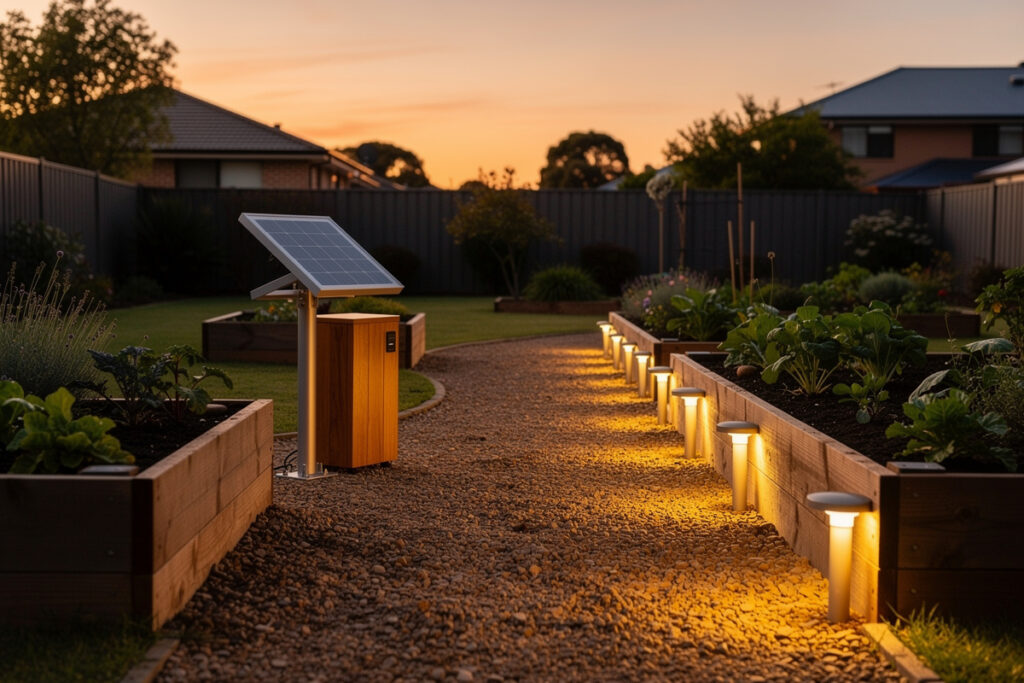
Off-grid garden lighting from a small battery bank turns a 4-zone garden into a dusk-to-dawn productive space without trenching mains power, paying utility hookup fees, or running an extension cord. The right battery for the job depends on what you are lighting: low-voltage path lights run all night on a 12V LiFePO4 brick that recharges from one 100W solar panel; greenhouse propagation lights need a 24V or 48V LiFePO4 bank with two panels and a charge controller. Total cost ranges from 90 USD for path lights to 750 USD for a greenhouse plus path setup.
This guide walks the battery sizing math for three lighting tiers, the panel and charge controller pairs that match each, and the wiring topology that keeps the system safe in wet outdoor conditions. The math assumes 25 USD per watt-hour for LiFePO4 at 2026 prices and 75% controller efficiency for an MPPT charge controller.
Why LiFePO4 Beats Lead-Acid for Garden Lighting
The choice between LiFePO4 (lithium iron phosphate) and lead-acid for outdoor lighting is no longer close. LiFePO4 cycles 3000-5000 times at 80% depth-of-discharge; lead-acid cycles 200-400 times at 50% DoD. For a garden lighting system that discharges nightly and recharges daily, lead-acid hits end-of-life in 14-24 months. LiFePO4 lasts 8-10 years.
The other deciding factor is cold tolerance. LiFePO4 holds usable capacity to -10°C; lead-acid loses 50% capacity at 0°C and may freeze and crack the case below -15°C. For a year-round garden lighting system in any climate that sees real winter, LiFePO4 is the only practical option. The detailed chemistry comparison lives on the best hybrid inverter for home solar guide which covers the same chemistry math at the residential scale.
Cost has converged. A 12V 100Ah LiFePO4 brick now retails for 270-320 USD; a comparable AGM lead-acid runs 180-220 USD. The 100 USD upfront premium pays back inside 18 months on cycle-life alone, and the system requires zero water-checking, terminal cleaning, or equalization charging. Set it and forget it.
Battery Sizing for Three Lighting Tiers
Tier 1 (path lights, dusk-to-dawn): 12 lights at 2W each = 24W draw, 12 hours = 288Wh per night. A 12V 30Ah LiFePO4 brick (360Wh) covers a single night with 25% reserve. Recharge requires one 100W panel for 4 hours of effective sun.
Tier 2 (path plus accent floodlights, 8 hours): 12 path lights plus 4 floodlights at 10W each = 64W, 8 hours = 512Wh per night. A 12V 50Ah LiFePO4 brick (640Wh) plus one 200W panel handles this with comfortable margin. Add a 30A MPPT charge controller for any pack above 30Ah.
| Lighting Tier | Total Watts | Hours/Night | Energy/Night | Battery | Solar Panel |
|---|---|---|---|---|---|
| Path lights only | 24W | 12 hr | 288 Wh | 12V 30Ah | 100W |
| Path + 4 floods | 64W | 8 hr | 512 Wh | 12V 50Ah | 200W |
| Greenhouse propagation | 120W | 14 hr | 1680 Wh | 24V 100Ah | 2x200W |
| Greenhouse + path | 144W | 14 hr | 1968 Wh | 24V 100Ah | 2x300W |
| Greenhouse + grow lights | 240W | 16 hr | 3840 Wh | 48V 100Ah | 3x400W |
Tier 3 (greenhouse propagation lights, 14 hours): a single 120W full-spectrum LED bar over a 4×6 ft seedling tray, running 14 hours per day. 1680Wh per day, requires a 24V 100Ah LiFePO4 bank (2400Wh) and 400W of solar with an MPPT controller. This is the threshold where you really need 24V or 48V — running 1.6 kWh through 12V wiring requires very thick cable that costs more than upgrading the system voltage.
Solar Panel Pairing and Controller Choice
One 100W panel produces roughly 400-500Wh per day in summer at 40° latitude with no shade. Winter production drops to 100-150Wh per day. Size the panel array for winter performance, not summer — a system that just barely covers a clear summer day fails by November and stays dead through March. The honest solar-to-load ratio for year-round operation is 4:1 (panel watts to lighting watts).
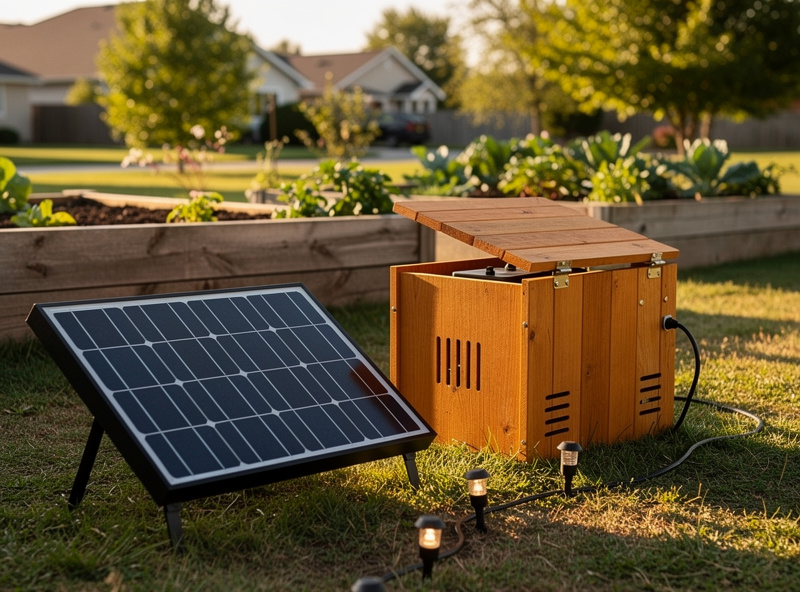
MPPT charge controllers extract 15-30% more energy from the panel than PWM controllers, especially in cold weather and when panels exceed battery voltage. For any system above 30W of panel, the cost difference between a 30A PWM (15 USD) and a 30A MPPT (45 USD) pays back inside one season. The selection criteria match the broader solar and battery integration guide — same logic, smaller scale.
Panel mounting decides longevity. A ground mount with a 30-degree tilt facing south works for most North American latitudes; the steel pole goes into a 60cm concrete base. Avoid roof mounting on small structures (shed roof, greenhouse) for systems under 200W — the cost of mounting hardware exceeds the panel cost, and shading from trees is harder to manage.
Wiring and Weatherproofing
The battery and charge controller live in a small wooden or plastic enclosure mounted to a north-facing fence or wall, away from direct sun (which reduces battery life). The enclosure is vented but not airtight — LiFePO4 does not off-gas like lead-acid, but a small vent prevents condensation. A 6×8 foot garden area needs about 30 feet of UV-rated 12 AWG cable plus weatherproof junctions.
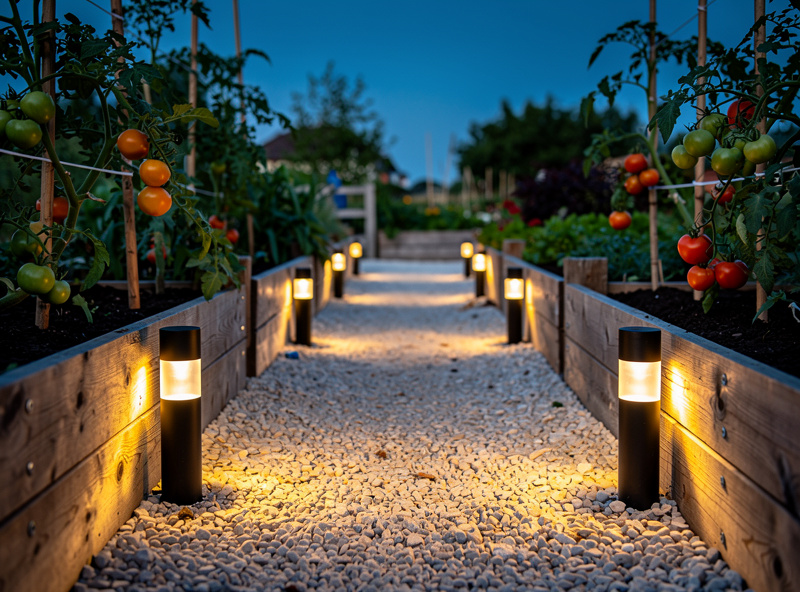
For path lights, low-voltage 12V landscape cable (12-2 or 14-2) buried 4-6 inches deep is the standard. Use IP67 weatherproof junction boxes at every connection — never twist-and-tape outdoor connections. The single most common failure in DIY garden lighting is a bad junction in damp soil; a 5 USD junction box prevents an annual debug-and-redo.
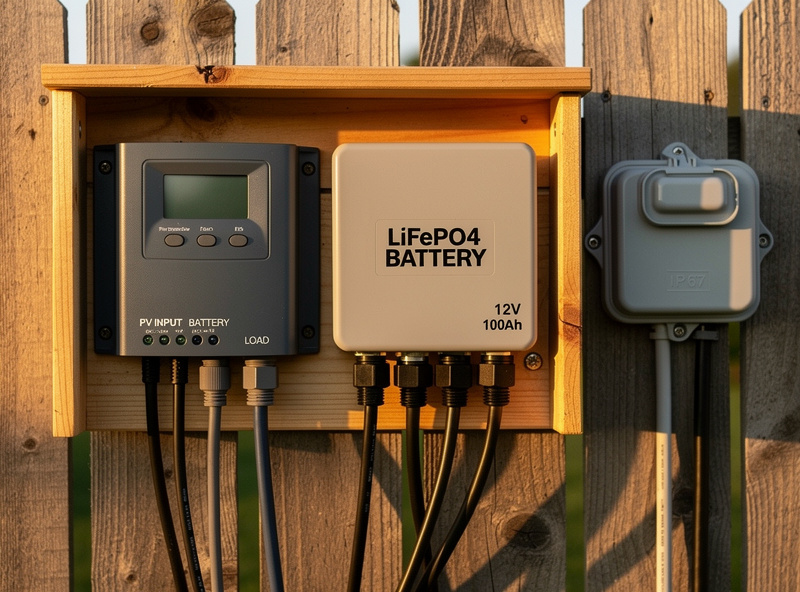
Greenhouse loads need GFCI protection on the 12V or 24V output side. While DC GFCIs are uncommon, the equivalent is a fused output with a low-current trip relay that disconnects the load if a fault to ground is detected. Bluesea Systems and Victron both make small marine-grade DC distribution panels that include this protection plus per-circuit fusing.
LED Choice for Path and Garden
2700K-3000K (warm white) for path lights matches incandescent landscape lighting and looks intentional next to a home; 4000K-5000K (cool white) reads as utility lighting and is fine for greenhouse propagation but should not be used for ornamental paths. Color temperature is the single biggest decider between lighting that looks “designed” versus “DIY.”
For grow lights, full-spectrum LED bars (400-700nm with 660nm red and 450nm blue peaks) at 100-150 PPFD reach the canopy from 12-18 inches above the seedling tray. Skip “blurple” cheap fixtures — they confuse plant growth measurement and look ugly. The specifics match the indoor seed-starting and bed-finishing requirements covered in the vertical vegetable garden guide on CityRooted, which lists the candle-power and lumen targets for each crop type.
Run a small DC dimmer in line with each grow light circuit. The 14-hour run time at full intensity is overkill for cool-season seedlings; dimming to 60% during the first 7 days of germination saves 40% of daily energy and produces sturdier plants. The dimming circuit pays back the bank by extending night-light runtime through cloudy weeks.
Frequently Asked Questions
What battery is best for off-grid garden lights?
LiFePO4 is the only practical choice in 2026. It cycles 3000-5000 times at 80 percent depth-of-discharge versus 200-400 times for lead-acid, holds capacity to -10 degrees Celsius, and pays back its 100 USD premium versus AGM inside 18 months on cycle life alone.
What size battery for a 12-light path system?
A 12V 30Ah LiFePO4 brick (360Wh) covers a 24W path-light load running dusk-to-dawn for 12 hours with 25 percent reserve. Recharge requires one 100W solar panel and 4 hours of effective sun. Size up to 50Ah if adding accent floodlights.
Can I run greenhouse grow lights on solar?
Yes, with a 24V or 48V LiFePO4 bank and 400-1200W of solar. A 120W full-spectrum LED bar running 14 hours daily uses 1.68 kWh per day, covered by a 24V 100Ah bank and two 200W panels with an MPPT charge controller.
How many solar panels for off-grid garden lighting?
Plan a 4:1 ratio of panel watts to lighting watts for year-round operation. A 64W lighting load needs 200W of solar; a 240W greenhouse load needs roughly 1000W. Sizing for summer alone produces a system that fails by November.
Do I need an MPPT charge controller?
For systems above 30W of panel, MPPT extracts 15-30 percent more energy than PWM, especially in cold weather. The cost difference between a 30A PWM (15 USD) and 30A MPPT (45 USD) pays back inside one season. PWM is fine only for tiny path-only systems.
Where should I mount the battery enclosure?
On a north-facing fence or wall, vented but not airtight, away from direct sun. Direct sun on the enclosure raises battery temperature and shortens calendar life. North-facing keeps the bank below 30 degrees Celsius year-round in most climates.