Important Disclaimer
BatteryStorageHQ provides educational content and estimates only. We are not certified installers, financial advisors, or electricians. Always consult with licensed professionals.
Integrating Solar Panels with Battery Storage
Solar energy and battery storage create a powerful combination for energy independence. The sun provides abundant free power during the day, while batteries store excess energy for use at night or during cloudy weather. Proper integration of these systems ensures maximum energy harvest, battery longevity, and reliable power delivery.
This guide covers every aspect of solar-battery integration, from system architecture decisions to component selection and installation best practices. Whether you are designing a small RV system or a whole-house off-grid installation, these principles ensure optimal performance.
System Architecture Fundamentals
DC-Coupled vs. AC-Coupled Systems
Solar-battery systems employ two primary architectures:
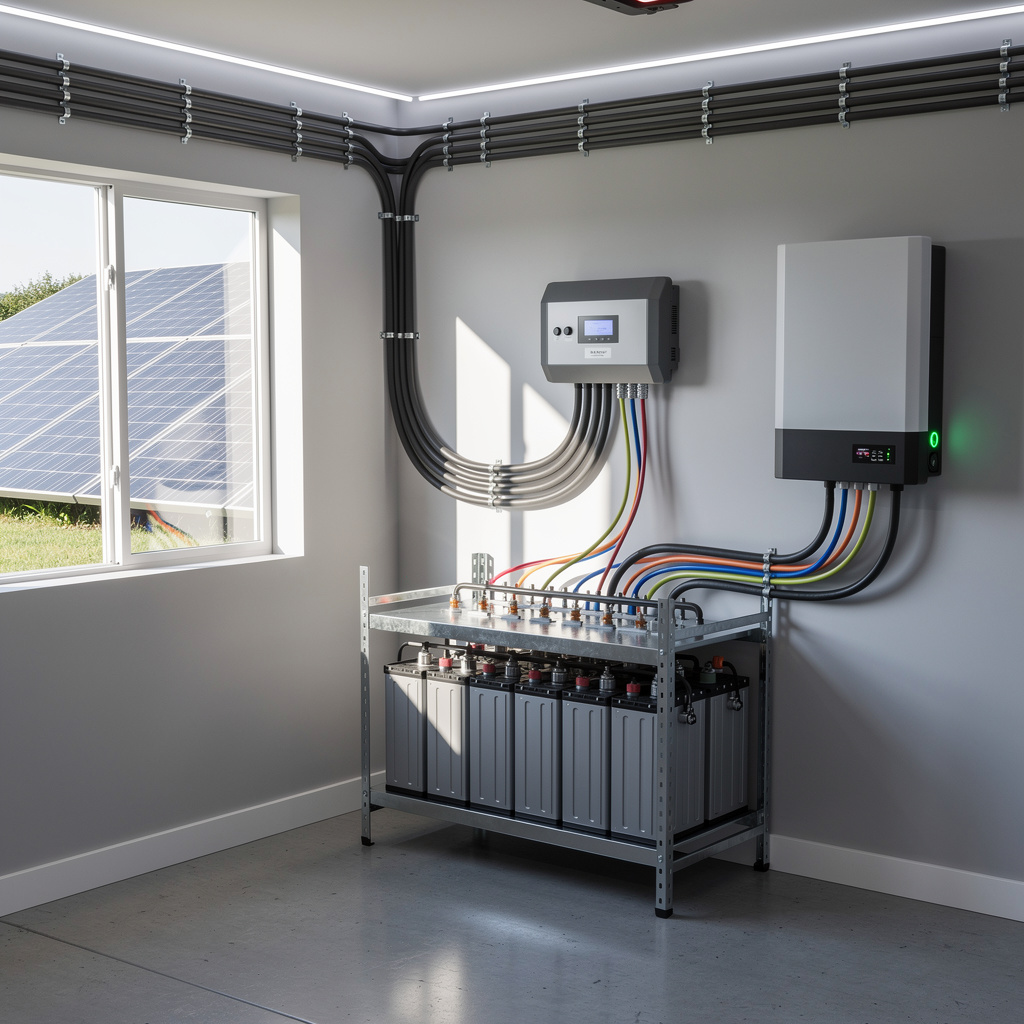
DC-Coupled Systems: Solar panels connect directly to a charge controller, which regulates charging current to the battery bank. DC power from batteries feeds an inverter for AC loads. This is the traditional off-grid approach, offering high efficiency and simple design.
Advantages of DC-coupled:
- Higher efficiency (5-10% better than AC-coupled)
- Simpler system with fewer components
- Batteries charge even if inverter fails
- Better for off-grid applications
AC-Coupled Systems: Solar panels connect to a grid-tied inverter producing AC power. A separate battery inverter charges batteries from AC. This approach works well for grid-tied systems with battery backup, and the same AC-coupled path lets you add a generator as a third source when solar falls short — the generator backup for solar guide covers auto-start wiring and the charge current limits that protect the bank during bulk charging from a generator.
Advantages of AC-coupled:
- Easier retrofit to existing solar installations
- Grid-tied inverters are often cheaper and more efficient
- Modular expansion
- Works with microinverter systems
For new off-grid installations, DC-coupled systems typically offer better value and performance.
System Voltage Selection
Your system voltage determines component compatibility and wiring requirements:
- 12V Systems: Simple, common in RVs and boats. Limited to about 1,000W loads. Requires thick cables for higher power.
- 24V Systems: Good balance for medium residential systems (1,000-3,000W). More efficient than 12V with manageable cable sizes.
- 48V Systems: Standard for larger residential and commercial systems (3,000W+). Reduced cable costs, higher efficiency, wider inverter selection.
Match your battery bank voltage to your charge controller and inverter specifications. Proper system sizing determines optimal voltage selection.
Solar Panel Selection and Configuration
Panel Types
Solar panels come in three main technologies:
Monocrystalline: Highest efficiency (17-22%), sleek appearance, better low-light performance, longer lifespan. Premium pricing but best overall value for limited roof space.
Polycrystalline: Slightly lower efficiency (15-17%), visible crystal structure, lower cost. Good for larger installations where space is not constrained.
Thin-Film: Lower efficiency (10-12%), flexible options available, better heat tolerance, lowest cost per watt. Suitable for ground mounts or non-traditional applications.
For residential battery systems, monocrystalline panels typically provide the best return on investment despite higher upfront costs.
Panel Specifications
Understand key panel ratings:
- Wattage (W): Power output under standard test conditions (STC)
- Voltage at Max Power (Vmp): Operating voltage for maximum power production
- Open Circuit Voltage (Voc): Voltage with no load (highest voltage panel produces)
- Current at Max Power (Imp): Operating current for maximum power
- Short Circuit Current (Isc): Maximum current panel can produce
- Temperature Coefficient: How voltage changes with temperature
Cold temperatures increase panel voltage. Size your series strings to stay within charge controller voltage limits at record low temperatures in your area.
Series vs. Parallel Panel Connections
Connect panels in series or parallel to match your charge controller:
Series Connections: Connect positive of one panel to negative of the next. Voltages add, current stays constant. Three 40V panels in series = 120V string at same current as single panel.
Advantages:
- Higher voltage reduces cable sizing requirements
- Better for long wire runs
- Matches high-voltage battery systems
Parallel Connections: Connect all positives together and all negatives together. Current adds, voltage stays constant. Three 40V panels in parallel = 40V at 3× current.
Advantages:
- Lower voltage safer for DIY installation
- Partial shading affects one panel less
- Simpler for small systems
Series-Parallel Combinations: Create strings of series panels, then parallel the strings. A common configuration for medium systems.
Example: Four panels in two strings of two panels each. If each panel is 40V, 10A, your array produces 80V at 20A.
Charge Controller Selection
MPPT vs. PWM Technology
Charge controllers regulate solar power flowing to batteries. Two technologies dominate the market:
Maximum Power Point Tracking (MPPT): Converts excess panel voltage into charging current. Increases energy harvest by 20-30% compared to PWM, especially in cold weather when panel voltage rises.
MPPT controllers continuously adjust to find the voltage/current combination that produces maximum power from your panels. This dynamic tracking maximizes energy harvest throughout the day as conditions change.
Advantages of MPPT:
- Higher efficiency (95-98%)
- Allows higher panel voltages (reducing cable costs)
- Better performance in partial shade
- Compensates for temperature variations
Pulse Width Modulation (PWM): Simple switching controller that connects panels directly to batteries when charging. Less expensive but lower efficiency, especially when panel voltage significantly exceeds battery voltage.
Advantages of PWM:
- Lower cost ($50-150 vs. $200-800+)
- Simple and reliable
- Adequate for small systems with well-matched panels
For battery storage systems over 400W or in variable climates, MPPT controllers justify their higher cost through increased energy harvest. Over years of operation, the additional energy produced often exceeds the price difference.
Sizing Your Charge Controller
Select a controller rated for your system requirements:
Voltage Specifications
- Maximum PV input voltage must exceed your highest expected panel voltage (cold weather Voc)
- Battery voltage must match your battery bank (12V, 24V, or 48V)
- Some controllers auto-detect battery voltage; others require manual selection
Current Rating
Controller amperage rating determines maximum solar array size:
Maximum Solar Watts = Controller Amps × Battery Voltage ÷ Efficiency Factor
For a 60A MPPT controller on a 48V system with 95% efficiency:
60A × 48V ÷ 0.95 = 3,032W maximum solar array
Always leave 20-25% margin. A 3,000W array is appropriate maximum for this controller.
Controller Features
Modern charge controllers offer valuable features:
- Multiple charging stages: Bulk, absorption, float charging for optimal battery health
- Battery temperature compensation: Adjusts charging voltage based on battery temperature
- Load control terminals: Automatically disconnect loads at low battery voltage
- Remote monitoring: Bluetooth or WiFi connectivity for smartphone apps
- Data logging: Tracks energy production and consumption
- Programmable charging profiles: Custom settings for different battery chemistries
Controllers like Victron Energy SmartSolar, Epever Tracer, and Renogy Rover offer excellent features for DIY systems. Professional installers often specify MidNite Solar, Outback Power, or Schneider Electric for larger installations.
Hybrid Inverter Systems
All-in-One Solutions
Hybrid inverters combine solar charge controller, battery inverter, and grid connection in one unit. These integrated systems simplify installation and reduce component count.
Benefits of hybrid inverters:
- Single device handles all power conversion
- Coordinated charging and discharging optimization
- Grid-tie and off-grid capability in one unit
- Simplified monitoring and control
- Often include built-in transfer switches
Popular hybrid inverter brands include Sol-Ark, EG4, Growatt, and Victron MultiPlus. These units range from 3,000W to 15,000W and support various battery voltages.
Inverter Sizing
Size your inverter for your maximum expected load plus safety margin:
- Calculate peak continuous load (all devices running simultaneously)
- Add 20-25% margin for future expansion
- Consider surge capacity for motor starting (refrigerators, pumps, air conditioners)
- Verify continuous and surge ratings meet your requirements
A home with 4,000W peak load needs a 5,000W inverter minimum, with surge capacity of 10,000W+ for motor starting.
Inverter Efficiency
Inverter efficiency affects system performance:
- High-quality inverters achieve 90-95% efficiency at moderate loads
- Efficiency drops at very low or very high loads
- Idle consumption (power used when no loads connected) matters for off-grid systems
- Look for inverters with <20W idle consumption for battery systems
Victron inverters are known for low idle consumption (8-15W) making them excellent for off-grid applications where every watt counts.
Wiring and Installation Best Practices
Cable Sizing
Proper cable sizing prevents voltage drop and overheating:
DC Cable Sizing: Between panels, charge controller, and batteries
- Size for maximum current with <3% voltage drop
- Use marine-grade or PV-rated wire for outdoor runs
- Protect cables in conduit or rated cable trays
- Use appropriately sized breakers or fuses at each connection point
AC Cable Sizing: Between inverter and loads
- Follow electrical code requirements
- Size for inverter rated output plus margin
- Use proper circuit protection
Common cable sizes:
- Panels to controller: 10-12 AWG for small systems, 8-10 AWG for larger
- Controller to battery: 4-6 AWG depending on current
- Battery to inverter: 1/0 AWG or larger for high-power inverters
Grounding and Bonding
Proper grounding protects against lightning and fault currents:
- Ground panel frames to earth
- Bond all metal enclosures
- Connect battery negative to ground at one point
- Use proper ground rods and connections
- Follow NEC or local electrical codes
Disconnects and Overcurrent Protection
Install proper protection throughout the system:
- DC disconnect between panels and charge controller
- DC disconnect between charge controller and batteries
- DC breaker or fuse between batteries and inverter
- AC breaker between inverter and loads
- Accessible emergency disconnects
Use DC-rated breakers and fuses. AC-rated devices may not properly extinguish DC arcs.
System Monitoring and Optimization
Charge Controller Monitoring
Modern charge controllers provide extensive data:
- PV voltage and current (solar production)
- Battery voltage and state of charge
- Charging stage (bulk, absorption, float)
- Daily energy harvest (kWh)
- Historical production data
Many units offer Bluetooth or WiFi connectivity with smartphone apps providing real-time monitoring.
Battery Management Integration
Your Battery Management System should integrate with charging sources:
- BMS can signal charge controllers to reduce or stop charging
- High cell voltages trigger charge termination
- Low temperatures may disable charging to prevent damage
- System-wide coordination prevents overcharging
Performance Optimization
Optimize your system for maximum harvest:
- Tilt angle: Angle panels toward sun (latitude ±15° depending on season)
- Azimuth: Face panels south (north in southern hemisphere) for maximum production
- Shade avoidance: Keep panels clear of shading from trees, buildings, or equipment
- Cleaning: Clean panels regularly (dust reduces output 5-20%)
- Charge settings: Program correct charging voltages for your battery chemistry
Use online tools like PVWatts (NREL) to estimate production for your specific location and system configuration.
Grid-Tied vs. Off-Grid Considerations
Off-Grid Systems
True off-grid systems must meet 100% of energy needs from solar and batteries:
- Oversize battery bank for multiple days of autonomy
- Include backup generator for extended cloudy periods
- Design for worst-case scenarios (longest cloudy stretch)
- Conservative load management
- Higher initial investment but complete independence
Review real-world off-grid projects for practical implementation insights.
Grid-Tied with Battery Backup
These systems combine solar production, grid power, and battery storage:
- Solar offsets grid consumption and reduces electric bills
- Batteries provide backup during outages
- Grid charges batteries when solar insufficient
- Excess solar can feed grid (with net metering)
- Lower battery requirements than off-grid
Grid-tied systems require specific inverter capabilities and often professional installation and permitting.
Time-of-Use Optimization
Some utility rates vary by time of day. Battery systems can optimize costs:
- Charge batteries during low-rate periods (night, weekends)
- Discharge during peak-rate periods
- Solar charging always preferred over grid charging
- Smart inverters automate this optimization
Troubleshooting Common Integration Issues
Underperforming Solar Array
If your system produces less than expected:
- Check for shading during different times of day
- Verify panel connections (loose connections reduce output)
- Clean panel surfaces
- Inspect for damaged panels or bypass diode failures
- Verify charge controller settings match battery voltage
- Check charge controller maximum power point tracking function
Premature Battery Failures
If batteries fail earlier than expected:
- Verify charging voltage settings (overcharging destroys batteries)
- Check temperature compensation settings
- Inspect for chronic undercharging (batteries never reaching full)
- Review depth of discharge (deep daily cycling shortens life)
- Implement proper maintenance routines
Inverter Shutdowns
If your inverter shuts down unexpectedly:
- Check battery voltage under load (voltage sag causes shutdown)
- Verify inverter surge capacity meets load requirements
- Inspect for loose DC connections causing voltage drop
- Check for overheating (inverters derate or shut down when hot)
- Review error codes in inverter documentation
Advanced Integration Features
Generator Auto-Start
Off-grid systems often integrate generators for backup:
- Inverters with generator auto-start capability
- Program low battery voltage triggers
- Automatic generator warm-up and cool-down cycles
- Silent operation priority (solar and batteries first)
Load Shedding
Smart systems prioritize critical loads:
- Automatic disconnection of non-essential loads at low battery
- Programmable load priorities
- Manual override capabilities
- Integration with smart home systems
Remote Monitoring
Modern systems offer comprehensive remote access:
- Cloud-based monitoring portals
- Smartphone apps for real-time data
- Automated alerts for system issues
- Historical data analysis
- Firmware updates and configuration changes remotely
Code Compliance and Permitting
Electrical Codes
Most jurisdictions require permits and inspections:
- NEC Article 690 covers solar PV systems
- Proper labeling required on all equipment
- Grounding and bonding per code requirements
- Accessible disconnects at appropriate locations
- Professional installation may be required for grid-tied systems
Building Codes
- Roof penetrations must be properly flashed
- Structural loads from panels require engineering review
- Setbacks from roof edges may be required
- Fire department access requirements (rapid shutdown systems)
Utility Interconnection
Grid-tied systems require utility approval:
- Interconnection agreements
- Net metering applications
- Inspections and witness tests
- Specific inverter requirements (UL 1741 SA for some utilities)
Contact your utility early in the planning process to understand requirements.
Conclusion
Integrating solar panels with battery storage creates a powerful system for energy independence and resilience. Success requires careful component selection, proper system architecture, and attention to installation details.
The key principles are matching your system voltage and capacity to your needs, selecting quality charge controllers and inverters rated for your application, and implementing proper wiring, protection, and monitoring. Safety considerations must guide every decision, from component selection to installation practices.
Whether you choose a simple DC-coupled off-grid system or a sophisticated grid-tied hybrid installation, the fundamentals remain the same. Understand your energy requirements, size components appropriately, and implement proper integration between solar, batteries, and loads.
As solar and battery technology continues advancing, integration becomes easier and more efficient. Modern systems offer unprecedented monitoring, optimization, and reliability. By following the guidance in this article, you create a system that harnesses the sun’s power effectively, stores energy safely, and delivers reliable power when you need it most.
Your solar-battery system represents an investment in energy independence that pays dividends for decades. Take time to plan properly, choose quality components, and install with care. The satisfaction of generating and storing your own power is matched only by the security of knowing you are prepared for whatever challenges the future brings.