Important Disclaimer
BatteryStorageHQ provides educational content and estimates only. We are not certified installers, financial advisors, or electricians. Always consult with licensed professionals.
An off-grid power system is designed in one direction only: loads first, then storage, then array, then inverter — never the other way around. Size the bank to your real daily watt-hours and your worst-month autonomy, and the panels and inverter fall out of the math. Get that order wrong and you buy a roof full of solar that still browns out the first time the well pump kicks.
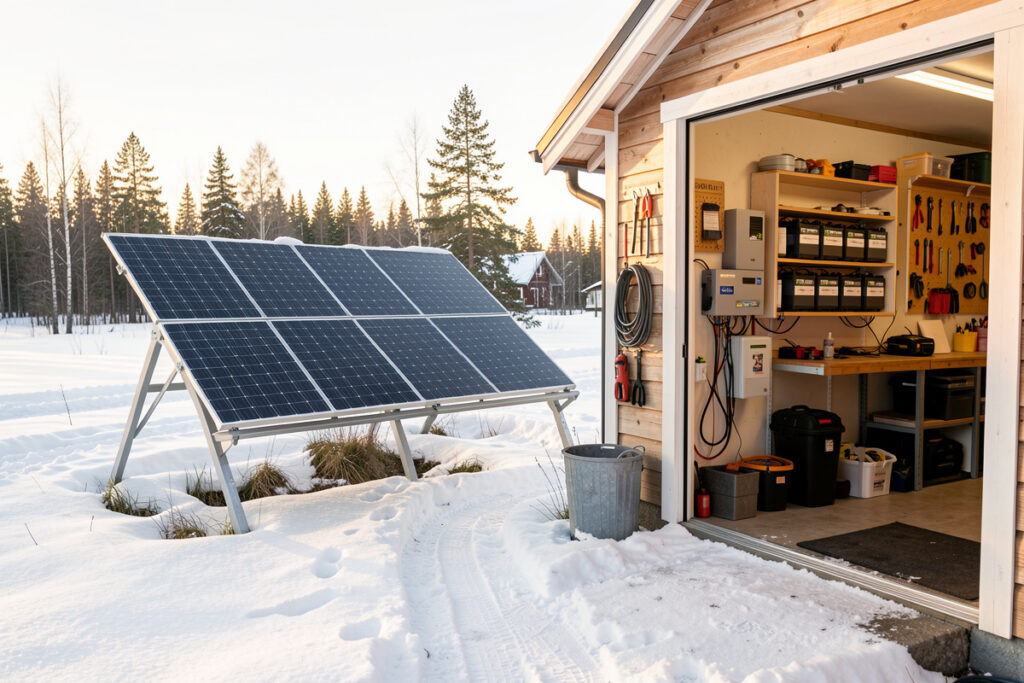
I build LiFePO4 banks from bare prismatic cells in Sweden and run my house on a small south-facing array, a 16S EVE LF280K bank, and a hybrid inverter — all watched through Home Assistant. This guide is the whole-system view: the sequence I follow, the math that drives each step, and the honest northern-latitude reality the brochures skip. It is the map; each section links to the deep-dive spoke that does the heavy lifting.
The Design Sequence: Why Order Decides Everything
Whole-system design fails when people start at the panel. They see a 400 W module, multiply by some hours, and back-fill a battery to match. That is backwards. The array is the last cheap variable; the loads are the fixed input you cannot wish away. The correct chain is loads → days of autonomy → usable kWh → array → inverter → architecture. Every downstream number is derived, not guessed.
The reason the order matters is compounding error. If your load estimate is 20% light, your bank is 20% small, your autonomy evaporates faster than planned, and the generator you swore you would never need runs every grey week in November. I have watched this exact failure on other people’s installs. The fix is never more panels. It is an honest load table built before anything is bought, which is why the first real step is a proper off-grid load calculation rather than a wishlist.
Step One: Build the Load Table, Not a Wishlist
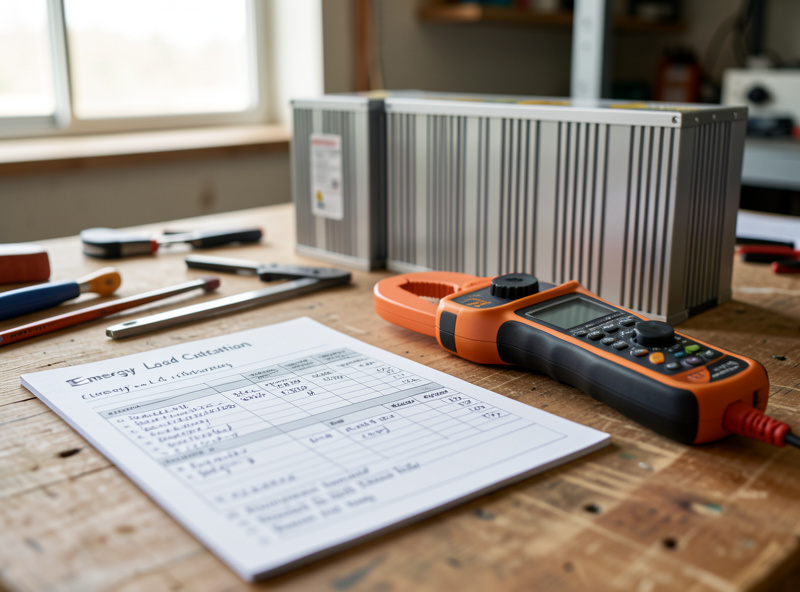
Your daily energy demand in watt-hours is the foundation of the entire system. A load table lists every device, its real running watts, its hours per day, and the product — and it accounts for the surge draw of motors that a spreadsheet of running watts hides. Until that table exists, nothing else can be sized honestly.
The mistake I see most is averaging. People write “fridge: 150 W” and call it done, ignoring that a compressor cycles, that a well pump pulls a locked-rotor surge several times its running figure, and that phantom loads on inverters and chargers run 24 hours. My own load table separates always-on loads (router, Home Assistant box, standby draws) from intermittent ones, because the always-on tier sets your overnight floor and the intermittent tier sets your inverter surge spec. The load calculation guide walks the full audit, and the companion battery sizing calculation guide turns that daily watt-hour number into a usable kWh target.
Step Two: Days of Autonomy — Sizing for the Quiet Days
Days of autonomy is how many days your bank can carry the loads with zero solar input. For a grid-tied backup system one day is often enough; for a genuinely off-grid site relying on northern winter sun, two to three usable days is the realistic floor, and that is after you account for depth-of-discharge limits. This single number, more than panel wattage, decides whether your lights stay on through a stalled grey week.
Here is where LFP chemistry changes the math. Because I can safely pull a LiFePO4 bank to 80–90% depth-of-discharge without the cycle-life penalty that punishes lead-acid, my usable capacity is far closer to nameplate than an old AGM bank ever was — a point the cycle-life versus DoD chart makes concrete. But autonomy is not free capacity; every extra day is more cells, more cost, and more bank to keep above freezing in winter. The days-of-autonomy sizing guide shows how to land on a number you can afford to build and keep warm.
There is a subtlety here that trips people up: autonomy and array size trade against each other. A bigger bank lets a smaller array catch up over several decent days; a bigger array lets a smaller bank ride a shorter dark spell. Neither extreme is free. In a northern winter the array can stall for a week regardless of size, so beyond a certain point only storage — or a generator — buys you real resilience. I size autonomy to the longest realistic no-sun stretch I am willing to cover from the bank alone, then hand the rest to the generator. Chasing a solar-only week of autonomy at my latitude is how people end up with a basement full of cells they cannot keep charged.
Step Three: Size the Array to the Worst Month, Not the Average
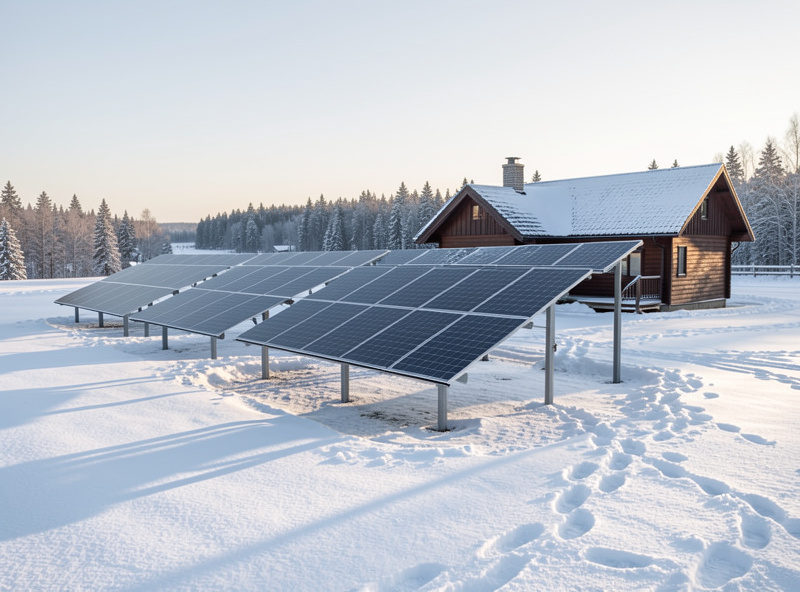
An off-grid array is sized by the worst production month, not the annual average. This is the rule sunbelt calculators quietly ignore and the reason my Swedish system carries panels that look absurdly oversized in July. In December my real output is a small fraction of nameplate; the array has to refill the bank on those days, not on the glorious ones.
Nameplate watts are a starting point, not a promise. Panel output collapses with low sun angle, short days, snow, and cloud, and the honest figure is watt-hours harvested per day in your worst month — a number I read straight out of my own Home Assistant logs rather than off a datasheet. The deep math for a fully off-grid array lives in the off-grid solar system design guide, and the brutal seasonal collapse is documented in solar panel winter output and northern-latitude solar sizing. One cold-weather wiring detail belongs here too: panel open-circuit voltage (Voc) rises as temperature drops, so a string sized at room temperature can overrun your charge controller’s maximum input on the coldest, brightest morning. Always size the string to the coldest expected Voc, not the summer figure.
Step Four: Size the Inverter to Surge, Not Just Running Watts
The inverter is sized by surge, not by the sum of your running watts. A motor — a well pump, a compressor, a power tool — draws a locked-rotor current several times its running figure for a fraction of a second at start. An inverter that comfortably carries the steady load can still collapse on that inrush, and the result is a brown-out exactly when the pump tries to start.
This is where low-frequency and high-frequency inverter designs diverge. A low-frequency (transformer-based) inverter like the Victron MultiPlus-II I run as my reliability benchmark rides through motor surge far better than a lightweight high-frequency unit of the same continuous rating; the transformer is heavy for a reason. I learned this the expensive way, browning out a cheaper unit the first time a hard workshop load fired. If your site has pumps or compressors, spec the inverter to their combined locked-rotor surge — the MultiPlus-II review and the hybrid inverter comparison cover how the surge ratings actually behave, and what a battery system can realistically power grounds it in real loads.
Step Five: The Generator Is Part of the System, Not an Admission of Failure
For a northern off-grid site, a generator is not a backup you bolt on later — it is a designed component that fills the winter gap the array physically cannot. The honest math at my latitude says oversizing the array to cover a worst-case December would mean a roof of panels idle eleven months of the year. A right-sized array plus a generator that AC-charges the bank during the darkest stretch is cheaper, smaller, and more reliable than a solar-only fantasy.
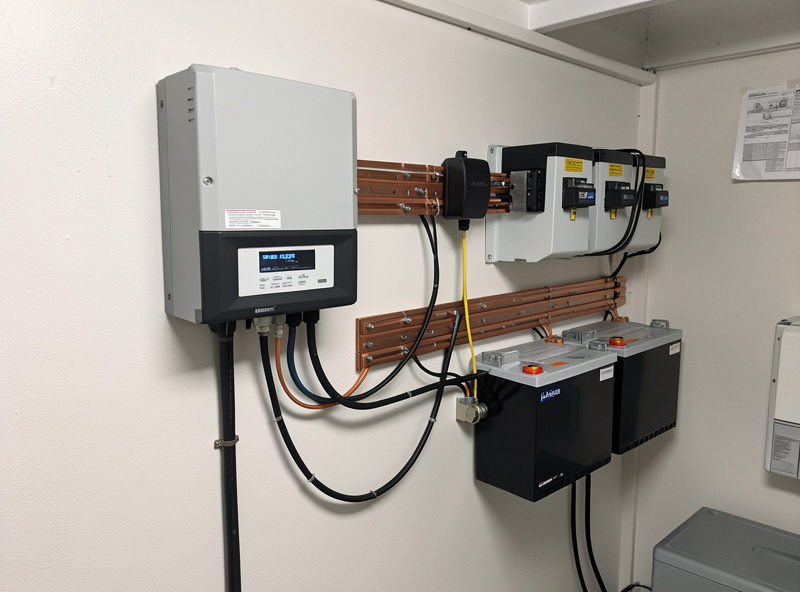
The integration is the part people botch. A generator feeding an off-grid system runs through the inverter’s AC-charge path, sized so the genset loads near its efficient output rather than idling rich, and ideally auto-starting on a low state-of-charge trigger. I treat the genset as a charger, not a direct-load source — it tops the bank and the bank carries the house. The generator integration guide covers the wiring and charge-profile detail, and generator backup for solar covers the winter-gap case specifically.
Step Six: Choose the Architecture Honestly — Off-Grid, Grid-Tie, or Hybrid
Most homes that call themselves off-grid are not, and that is usually the right call. True off-grid means you carry every kilowatt-hour yourself, including the worst week of the year, with a generator as the only safety net. Grid-tied-with-backup keeps the utility as your infinite generator and uses the bank for outages and load-shifting. A hybrid inverter does both, choosing the cheapest available source moment to moment.
I run a hybrid because it is the honest middle ground for a house: the bank and array carry the daily load, the grid covers the deep winter deficit instead of a roaring generator, and I keep autonomy through outages. Going fully off-grid is a defensible choice for a remote cabin with no service drop, but it is a far more expensive and demanding system than people assume. Decide this before you buy the inverter, because the architecture sets the wiring, the transfer scheme, and the bank size. The off-grid vs grid-tie vs hybrid comparison lays the three architectures side by side.
Comparing the Three System Architectures
The table below is the decision I make at the start of every design, before a single cell is ordered. Each architecture is a different answer to one question: what carries you through the worst week?
| Factor | True Off-Grid | Grid-Tied + Backup | Hybrid (Grid-Interactive) |
|---|---|---|---|
| Worst-week source | Generator only | Utility grid | Grid or generator |
| Bank size needed | Largest (full autonomy) | Smallest (outage cover) | Medium (daily cycling) |
| Array oversizing | Heavy (worst-month rule) | Optional | Moderate |
| Generator role | Essential, designed in | Optional | Optional winter top-up |
| Best fit | Remote cabin, no service drop | Suburban backup | Most homes with a meter |
| Relative cost | Highest | Lowest | Middle |
Site-Specific Systems: Cabins, RVs, Water, and Winter
The sequence above is universal, but the site changes the constraints. A remote cabin or an RV is a fully off-grid system in miniature — same loads-first math, smaller numbers, and a hard ceiling on space and weight that forces ruthless load discipline. The cabin and RV power system guide applies the whole-system method to mobile and remote builds, and the RV solar battery guide covers the vehicle specifics.
Water is the load people forget until the tap runs dry. Pumping is a surge-heavy, daily-budget load with its own design rules, and at a remote site it often runs straight off solar and the bank rather than a grid pump. The off-grid solar water pumping guide covers pump motor surge, DC versus AC pumps, and the daily water budget; if your pump is grid-backed, the well pump battery backup piece is the closer fit.
And winter is the stress test the whole system is designed around. At my latitude the system lives or dies on the worst-month numbers — the array collapse, the autonomy reserve, the generator top-up, and the rule you must never break: do not bulk-charge a LiFePO4 bank below freezing. The winter off-grid solar sizing guide ties the seasonal math together, and winter solar battery storage covers keeping the bank healthy through the cold.
Why LiFePO4 Won the Off-Grid Bank
Every system in this guide assumes a LiFePO4 (LFP) bank, and that is a settled opinion on my bench rather than a fashion. Compared with the lead-acid and AGM banks off-grid homes ran for decades, LFP delivers far more usable capacity per kilogram, tolerates daily deep discharge without the brutal cycle-life penalty, holds voltage flat across most of its discharge, and self-discharges slowly enough to sit through a quiet week without sulfating. A lead bank you could only safely pull to about half its rated capacity; an LFP bank gives you most of it, every day, for thousands of cycles.
The comparison that matters more in 2026 is LFP against the NMC chemistry inside most sealed consumer power walls. NMC packs more energy into less space, which is why electric cars use it, but its thermal failure mode is far more energetic and harder to arrest than LFP’s. For a stationary bank sitting in a workshop or a cabin where space is cheaper than peace of mind, LFP’s tamer thermal behavior is the right trade. Sodium-ion is the interesting new entrant — genuinely promising for cold tolerance and cost — but it is not yet where LFP is for energy density and proven field life, so I watch it rather than build with it. For a bank you assemble yourself and live beside, LFP remains the honest default, and the cycle-life versus depth-of-discharge data is why.
Building with bare prismatic cells rather than a sealed appliance is what unlocks the cost and the control. I top-balance every cell to the same voltage on a bench supply before the first series connection, compression-fixture the stack between end plates so the cells live under the pressure their datasheet assumes, and torque the busbars to spec so no joint runs hot. None of that is exotic; it is just the work the sealed-box reviewers never have to do — and the layer where most DIY failures actually originate.
The DC Side: Wiring, Fusing, and the Details That Bite
The DC side of an off-grid system is where the real hazards live, and it is the part casual builds treat most carelessly. A battery bank can deliver thousands of amps into a dead short, and unlike household AC, a DC arc does not have a zero-crossing to help it self-extinguish. That single fact dictates everything about how the bank is wired.
The non-negotiables: every conductor sized to its ampacity with margin, not to whatever cable was in the bin; a main DC overcurrent device — I use a Class-T fuse on the main bank because it can safely interrupt the enormous fault current an LFP bank can deliver — placed as close to the positive terminal as practical; and busbars and lugs torqued to the manufacturer’s figure with a real torque tool, because both a loose joint and an over-tightened one fail, just differently. A loose lug heats, oxidises, and eventually glows; the clamp meter on my bench has caught more than one warm joint before it became a problem.
Fuse the branch circuits too, not just the main, so a fault in one inverter or charge controller leg cannot pull the whole bank’s fault current. Size the charge controller’s input for the cold-weather Voc rise mentioned earlier. And keep the wiring serviceable — labelled, accessible, and documented — because the system you build today is one you will be troubleshooting in a dark January, and a tidy DC side is the difference between a ten-minute fix and an afternoon.
The Safety Layer That Holds It All Together
None of the sizing matters if the build is unsafe. An off-grid bank stores enormous energy at high DC current, and DC does not self-extinguish an arc the way household AC does. Every system I build gets a correctly rated DC fuse — a Class-T fuse on the main bank, sized to the bank’s fault current — busbars torqued to the manufacturer’s spec rather than gorilla-tightened, ventilation appropriate to the chemistry, and a BMS that is configured, not just connected.
LiFePO4 earns its place here because its thermal behavior is far more forgiving than the NMC chemistry in most consumer power walls, but forgiving is not foolproof. The BMS is your last line of defense against a single lagging cell, over-current, and — critically — charging below freezing, which plates lithium and permanently damages cells. I build every bank from bare cells, top-balanced and compression-fixtured, and commission the BMS deliberately. Safety here is authority, not a hedge: get the fusing, the torque, and the low-temperature charge cutoff exactly right, every time.
A Worked Example: Sizing a Small Cabin System End to End
Numbers make the sequence concrete, so here is a small off-grid cabin run through the whole chain the way I would on the bench. The point is not the exact figures for your site — it is watching each number force the next one. Start with loads, finish with the uncomfortable winter truth.
Loads. Say the load table totals 3,000 watt-hours a day: a few LED lights, a laptop, a small fridge cycling, phone and tool charging, and the standby draw of the inverter itself. That last item is real — an idling inverter and a router pull a steady overnight floor whether you use them or not, and over 24 hours that floor alone can be several hundred watt-hours. Three kilowatt-hours a day is the input every other number now obeys.
Storage. Pick two days of autonomy, because a single stalled grey day is common and you do not want the bank flat by breakfast. Two days of 3 kWh is 6 kWh of usable energy. Because LiFePO4 tolerates roughly 80% depth-of-discharge as a daily working window, the nominal bank must be 6 kWh divided by 0.8, or about 7.5 kWh. In the 51.2 V terms I build in, a single 16S string of 280 Ah cells is 14.3 kWh nominal — comfortably more than this cabin needs, which tells you a half-size bank of roughly 150 Ah at 51.2 V is the honest target. The math, not the catalogue, picked the bank.
Array. Now the seasonal reality bites. To refill 3 kWh in a good summer day at four or five effective peak-sun-hours, six hundred watts of panel is plenty. To refill the same 3 kWh on a deep-December day at my latitude — where real harvest can fall to a fraction of an effective peak-sun-hour — you would need several kilowatts of panel that then sit idle for eleven months. That is not engineering; that is denial. The honest answer is to size the array generously for the shoulder seasons and accept that the worst weeks need another source.
Generator and architecture. That other source is the generator, AC-charging the bank through the inverter during the darkest stretch, or — if a service drop exists — the grid doing the same job more quietly. This is the moment most “off-grid” dreams quietly become honest hybrid systems, and rightly so. The cabin example ends where every northern design ends: a right-sized bank, a shoulder-season array, and a designed-in winter top-up.
The Two Mistakes That Sink Most Off-Grid Builds
Across the systems I have built and the failed ones I have been asked to rescue, two mistakes account for the overwhelming majority of off-grid disappointment: oversized panels and an undersized inverter. They are opposite errors with the same root — sizing by gut instead of by the load table.
Oversized panels come from chasing the worst-winter day with solar alone. People bolt on kilowatt after kilowatt to cover December, end up with an array that clips and dumps energy all summer because the bank is already full by mid-morning, and still come up short in the dark. The array is the wrong lever for the winter gap; a generator or grid tie is the right one. Spend the panel money on a slightly bigger bank and a charger instead.
The undersized inverter is the quieter killer. The system runs beautifully until the moment a real motor load starts — the well pump, the table saw, the compressor — and the inverter cannot supply the locked-rotor surge, so it browns out or faults. Every device on the system blinks. The fix is not a bigger battery; it is an inverter specified to the combined surge of your motor loads, which is almost always a low-frequency design when pumps are in the picture. Size the inverter to the worst half-second, not the average watt.
Monitoring: One Dashboard for the Whole System
A system you cannot see is a system you cannot trust. From the first commissioning I run every part of mine into Home Assistant: per-cell voltage and the spread between cells, pack state-of-charge, daily PV harvest, instantaneous load, and inverter status. The spread between the highest and lowest cell is the single most useful number on the dashboard — a cell drifting away from its neighbours is the earliest warning of a balance problem or a tiring cell, long before the BMS trips.
Monitoring is also how you learn your own site. The worst-month harvest figure I keep quoting is not from a datasheet; it is the curve my own logs drew over successive winters. The same rule engine that watches the battery state-of-charge also watches the rest of the workshop — the curing-chamber humidity, the reservoir levels — so one dashboard tells me the whole homestead’s state at a glance. For an off-grid system, that visibility is not a luxury; it is the difference between catching a lagging cell on a Tuesday and finding a flat bank on a Saturday.
Putting the Whole System Together
Read the sequence once more as a checklist: build the load table, set your days of autonomy, size the array to the worst month, spec the inverter to surge, design the generator in, choose the architecture honestly, then adapt for your site and your winter. Each step constrains the next, and skipping one is how you end up with an expensive system that still leaves you in the dark. The spokes below are the detailed working for each step — start with loads, end with winter, and the rest is arithmetic.
Frequently Asked Questions
What is the correct order to design an off-grid power system?
Loads first, then days of autonomy, then usable battery capacity, then the solar array, then the inverter, then the system architecture. Every downstream number is derived from your real daily watt-hour demand, so an honest load table must come before anything is bought.
How many days of autonomy does an off-grid system need?
For a fully off-grid northern site relying on winter sun, two to three usable days is the realistic floor after depth-of-discharge limits. A grid-tied backup system often needs only one day because the grid is the real safety net. More autonomy means more cells, more cost, and more bank to keep above freezing.
Should I size the solar array to the average or the worst month?
Always the worst production month. Off-grid arrays must refill the bank on your darkest days, not your sunniest. At northern latitudes December output is a small fraction of nameplate, which is why off-grid arrays look heavily oversized in summer and why a generator usually fills the deep-winter gap more cheaply than extra panels.
Why does the inverter need to be sized for surge?
Motor loads like pumps and compressors draw a locked-rotor surge several times their running watts at startup. An inverter rated for the steady load can still brown out on that inrush. Low-frequency transformer-based inverters ride through surge far better than lightweight high-frequency units of the same continuous rating.
Is a generator a sign of a badly designed off-grid system?
No. For a northern off-grid site a generator is a designed component that fills the winter gap the array cannot physically cover. Oversizing an array to handle worst-case December means panels idle most of the year. A right-sized array plus a generator that AC-charges the bank is cheaper and more reliable than solar-only.
Can I charge a LiFePO4 off-grid bank in freezing weather?
You must not bulk-charge LiFePO4 below freezing because it plates lithium and permanently damages the cells. A properly configured BMS enforces a low-temperature charge cutoff, and winter builds keep the bank in a heated or insulated space. Discharging cold is far less harmful than charging cold.
Related Guides
This hub is the map; these are the working steps. Start with the off-grid load calculation guide, set your days of autonomy, design the generator integration, choose between off-grid, grid-tie, or hybrid, adapt for a cabin or RV, handle solar water pumping, and finish with winter off-grid sizing. For the deeper array math see off-grid solar system design and battery storage sizing.