Important Disclaimer
BatteryStorageHQ provides educational content and estimates only. We are not certified installers, financial advisors, or electricians. Always consult with licensed professionals.
The number that wrecks most northern solar builds is an average. People take their annual energy use, divide by an annual-average peak sun hours figure, size an array to match, and feel good about the math — right up until December, when that array makes a fraction of what the average promised and the bank slides toward empty. Sizing a solar array at high latitude is a fundamentally different problem from sizing one in the sunbelt, because you are not sizing to an average — you are sizing around a worst-case month that the average actively hides. Get the framing right and the arithmetic is straightforward. Get the framing wrong and no amount of careful calculation saves you.
This is the sizing-math half of the winter problem. The general mechanics of array sizing — watts, panels, kWh — live in my solar sizing calculator; here I am layering on the northern-latitude twist that changes which numbers you feed it. It is a core piece of the winter solar storage system.
Why the annual average is the enemy
An annual-average peak sun hours figure is a real number, and it is useless for sizing a system that has to carry its own winter. The reason is that at high latitude the seasonal spread is enormous: a summer month might deliver five or six PSH while a deep-winter month delivers well under one. The average sits somewhere in the middle, and a system sized to the middle is oversized for summer (when it spills energy it cannot use) and badly undersized for winter (when it starves). The average describes a year that never actually happens on any given day.
So the first decision in northern sizing is: what am I asking solar to carry, and in which month? There is no single answer; there is a spectrum, and choosing your point on it honestly is the whole job.
The three honest sizing targets
You pick one of these consciously, knowing the trade-off, rather than stumbling into an accidental one via the average.
Size to summer, accept a big winter gap. The array comfortably covers your loads spring through autumn and you lean hard on a backup (grid or generator) for the deep-winter weeks. This gives the smallest, cheapest, best-utilised array — it is not oversized for any season — and is usually the right answer when you have a grid connection or accept some generator runtime. I run close to this on my own roof.
Size to a shoulder month, partly cover winter. A middle path: the array is large enough to do meaningful work in spring and autumn and to take a real bite out of December, but still needs backup for the very darkest stretch. More glass, better winter autonomy, more summer spill.
Size to deep winter, chase near-autonomy. Sizing the array to cover your full load in the worst month means an enormous array that sits massively underused eight months of the year. At high latitude this is almost always the wrong call — the marginal panels you add to chase December give very little back and cost a fortune in glass and mounting. Past a sane ceiling, a generator is cheaper and more reliable than the next ten panels. I steer people away from this except in genuinely off-grid, no-generator-possible situations, which are rare.
The math, step by step
Once you have chosen your target month, the arithmetic is clean. Work in watt-hours per day.
- Nail down your daily load (Wh/day). Measure it, do not guess — the fridge, the lights, the pumps, the standby draws. This is the most-cheated number and the most important.
- Pick your design month’s PSH. Use local solar data for the month you chose as your target — December if you are chasing winter coverage, a shoulder month if that is your honest target.
- Apply a real derate. Knock the ideal figure down for system losses — wiring, controller, dirt, temperature, and the fact that you never capture the theoretical maximum. A meaningful derate is realistic, not pessimistic.
- Array size = daily load ÷ (design-month PSH × derate). That gives the array wattage that covers your load in your chosen month.
- Sanity-check against summer. Run the same array through a summer PSH. If the summer number is wildly more than you can use or store, you have sized to deep winter and should ask whether a smaller array plus backup is the better system.
The same logic feeds your storage sizing: the bank has to carry your load across the dark hours and any short no-sun stretches your array-plus-backup strategy expects it to bridge. Sizing the bank for days of autonomy that solar will never refill in winter is the storage-side version of the same average-driven mistake.
A worked feel for the numbers
Concrete shapes help. The table below is illustrative — your loads and your latitude’s PSH will differ — but it shows how dramatically the required array swings with the design month at high latitude for the same daily load.
| Design target | Design-month PSH (illustrative) | Relative array size for the same load | Backup needed? |
|---|---|---|---|
| Summer-sized | ~5 PSH | Baseline (smallest) | Yes — significant winter backup |
| Shoulder-sized | ~2.5 PSH | ~2× baseline | Yes — deep-winter backup |
| Deep-winter-sized | ~0.7 PSH | ~7× baseline | Little — but huge summer spill |
That roughly seven-fold swing in array size for the same load, purely from which month you design around, is the whole northern-sizing story in one table. It is also why “just add panels to fix winter” is a trap: the panels that close the last of the December gap are the most expensive and least-used in the entire system. Almost everyone is better served sizing nearer the summer or shoulder end and covering the floor with a generator or the grid.
Tilt and orientation change the winter number too
Sizing is not only about how many panels — it is about how well the panels you have catch the low winter sun, because that directly changes the effective PSH your array sees. Two levers matter most in winter, and both are free.
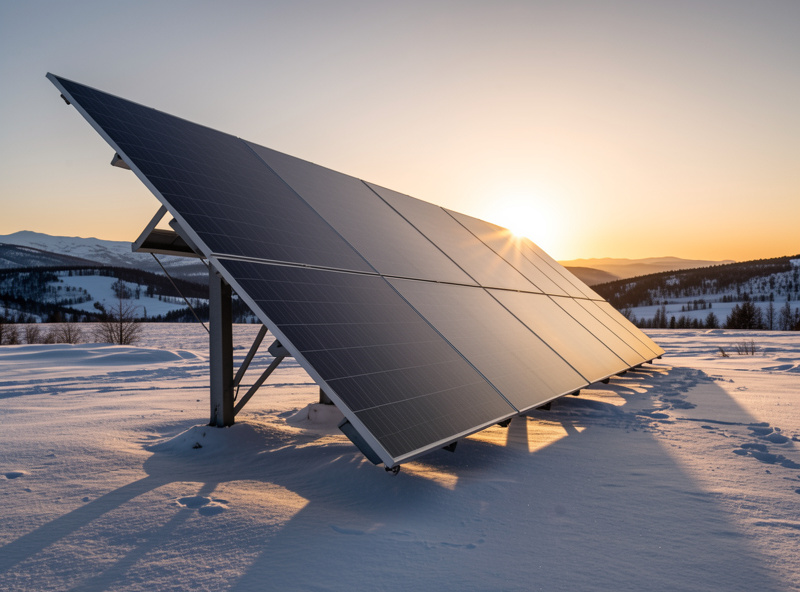
Tilt steeper for winter. A panel angled far steeper than the summer-optimal angle — approaching vertical at high latitude — meets the low winter sun more squarely and sheds snow instead of holding it. The same panel at a steep winter tilt effectively gains PSH in December against a shallow summer tilt, which is the cheapest “extra panel” you will ever get. If your mount is seasonally adjustable, the winter setting is doing real sizing work.
Orientation and shading. True south (in the northern hemisphere) matters more in winter than summer because the sun’s arc is so narrow — you cannot afford to waste any of the few hours on a poorly aimed array. And the low winter sun casts long shadows, so a tree line or roofline that never touched the array in July can shade it for the whole short winter day. Survey shading in December, not June, or your carefully sized array quietly loses hours you counted on.
The tools that make the math honest
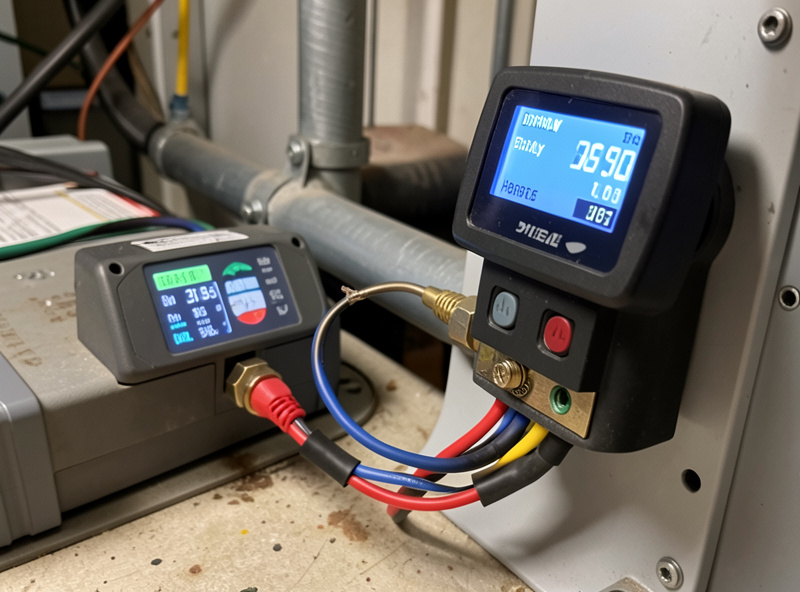
The whole exercise depends on two real measurements: your true daily load and your array’s true output. Both reward cheap metering over guesswork. An energy meter on your loads turns “about two kilowatt-hours, probably” into a real number, and a battery-monitor shunt on the system tells you what the array actually delivered versus what you modelled.
As an Amazon Associate I earn from qualifying purchases. These are the measuring tools I would genuinely use; they cost you nothing extra.
- Plug-in energy meter — measure real daily load so your sizing math starts from truth, not a guess.
- Battery-monitor shunt — see actual daily PV harvest and consumption to validate your modelled PSH and derate.
Frequently asked questions
How do I size a solar array for a northern climate?
Size around a chosen design month, not the annual average. Measure your true daily watt-hour load, pick the peak sun hours for your target month, apply a real-world derate for losses, and divide load by (PSH × derate) to get array wattage. At high latitude, sizing to the average leaves you oversized for summer and starved in winter.
Why can’t I just use the annual-average sun hours?
Because the seasonal spread at high latitude is enormous — a summer month may deliver five or six peak sun hours and a deep-winter month under one. An array sized to the middle value spills energy in summer and cannot keep up in winter. The average describes a year that never happens on any given day.
Should I size my array to cover deep winter?
Usually not. Sizing to the worst month means an array several times larger than summer-sizing for the same load, sitting massively underused most of the year. The marginal panels that chase the last of the December gap give very little back. Past a sane ceiling, a generator or grid backup is cheaper and more reliable than more glass.
Does panel tilt affect how I size for winter?
Yes. A steep winter tilt meets the low sun more squarely and sheds snow, effectively raising the peak sun hours your array sees in December — a free gain against a shallow summer tilt. Steep tilt, true-south orientation, and avoiding winter shadows all improve the effective PSH you should design around.
How does winter sizing affect my battery bank?
The bank has to bridge the dark hours and any short no-sun stretches your array-plus-backup strategy expects it to cover. Sizing the bank for many days of autonomy that solar will never refill in winter is the storage-side version of the average-driven mistake — pair realistic storage with a backup source instead.