Important Disclaimer
BatteryStorageHQ provides educational content and estimates only. We are not certified installers, financial advisors, or electricians. Always consult with licensed professionals.
Every glossy solar brochure I have ever read was photographed in July. The array glints, the inverter screen shows a fat production number, and the implication is that the panels just keep doing that all year. They do not. I run a small south-facing array and a 16S LiFePO4 bank built from EVE LF280K prismatics at home in Sweden, monitored through Home Assistant, and the single most useful thing I can tell anyone north of about 45 degrees latitude is this: the system that comfortably covers your loads in May can collapse to a tenth of that output in December, and almost nothing in the off-the-shelf marketing prepares you for it.
This guide is the map of that gap. Not the chemistry of why a cold lithium cell behaves the way it does in isolation — I cover the broad performance picture in my deep dive on LiFePO4 cold-weather performance — but the system-level problem: production that falls off a cliff, charge controllers that have to handle higher string voltage in the cold, a BMS that will (correctly) refuse to charge a freezing pack, and the engineering you do so the whole thing keeps your fridge running through a dark, sub-zero January. It is solar production, system winterizing, and honest sizing math for a real northern winter.
The winter problem in one number: peak sun hours
Forget nameplate watts for a moment. The figure that actually governs your daily harvest is peak sun hours (PSH) — the equivalent number of hours per day your location delivers 1,000 W/m². It bundles together day length, sun angle, and typical cloud cover into one daily multiplier, and it is brutally seasonal at high latitude.
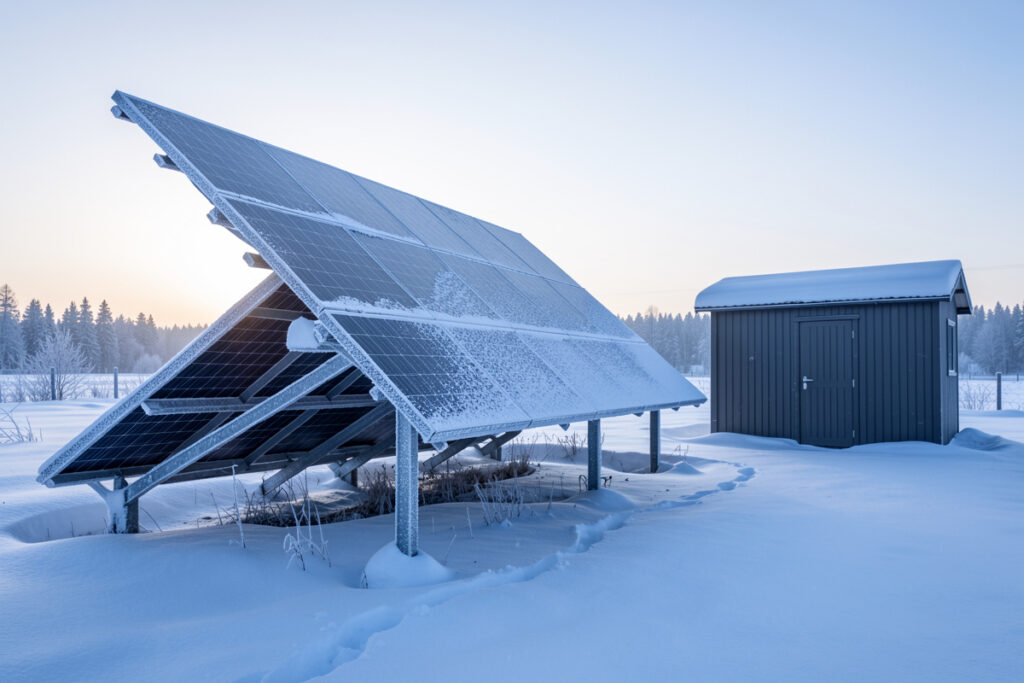
On my own roof the contrast is stark. A clear June day behaves like roughly 5 to 6 PSH; a typical overcast December day around my latitude behaves like well under 1 PSH, and a genuinely grey, low-sun stretch can sit closer to 0.3. That is not a 30% seasonal dip. That is the array doing perhaps an eighth to a tenth of its summer work, on the days you most want heat and light. A 400 W panel that hands me ~2 kWh on a good June day might give back 200 to 300 Wh in deep December — and that is before snow on the glass.
I unpack exactly how that collapse plays out, hour by hour, in the dedicated spoke on solar production through the winter months. The headline for planning purposes: you cannot size a northern off-grid system on an annual average. The average is a lie that papers over a December that, on its own, can starve a bank sized for the yearly mean.
It helps to see why PSH falls so much harder than day length alone would suggest. Three effects compound. First, the days are simply shorter — at high latitude a December day might offer six or seven hours of any daylight at all. Second, the sun never climbs high; a low solar elevation means the light passes through far more atmosphere and strikes the panel at a glancing angle, so even the midday peak is weak. Third, the season that brings short days also brings persistent low cloud, so many of those few weak hours are diffuse rather than direct. Multiply three reductions together and you get the eighth-to-a-tenth figure that shocks people the first winter. None of the three is a fault you can fix with better gear — they are geometry and weather.
This is also why I am allergic to the “your panels will pay for themselves” framing when it is applied to a northern off-grid build. The economics that work in a sunbelt grid-tie do not transfer to a 60°-north stored-solar system that has to carry its own December. I am not against solar — I run it and rely on it eight months of the year — I am against sizing it on a fantasy. Get the winter math honest first; the rest of the system follows from it.
Four things that change when the temperature drops
Across the banks, inverters, and controllers I have run through real Nordic winters, the cold rewrites four parts of the system at once. Treat them as a checklist; each has its own spoke below.
- Production drops far below nameplate. Short days, low sun angle, snow, and cloud stack up. This is the headline gap and the hardest to engineer around — there is no setting that conjures photons.
- String voltage rises as the panels get colder. Counter-intuitively, a cold panel produces more voltage than its rated open-circuit figure. On a freezing clear morning your string Voc can climb 10% or more above the spec sheet — enough to over-volt a charge controller that was sized to nameplate. This is a genuine wiring-margin safety issue, not trivia.
- The BMS will refuse to charge a frozen pack. Charging a LiFePO4 cell below roughly 0°C plates lithium metal onto the anode — permanent, dangerous damage. A correctly configured BMS blocks charge current below a temperature cutoff. That is the BMS doing its job, but it means your panels can be making power while the bank flatly declines to accept it. The exact cutoff temperatures, how to adjust them on common JK and Daly boards, and what to do when the threshold is wrong are covered in the BMS charge temperature cutoff guide.
- Capacity sags and self-discharge shifts. A cold cell delivers less usable capacity and accepts charge more slowly. The pack is not broken; it is cold, and the numbers move.
The cluster, mapped to the jobs
I have split the winter problem into the seven jobs you actually have to do. Each links out to a full guide; together they are the complete northern-latitude playbook.
1. Understand the production collapse
Before you spend a krona on more panels or a bigger bank, you have to internalise how little the array does in December. The winter solar production picture — Wh/day reality, snow shading, and why two clear hours at a low angle is not the same as two summer hours — is the foundation everything else rests on.
2. Size for the gap, not the average
Northern array sizing is its own discipline. You are not sizing to your annual energy use; you are sizing to bridge the worst realistic stretch of low production, then deciding honestly how much of December you can actually cover with panels versus another source. The general sizing calculator gets you the baseline numbers, and the broader off-grid system design picture frames the trade-offs; the winter-specific math is where the northern reality bites. For a full worked example of how latitude and panel count interact at high-latitude sites, the northern latitude solar sizing guide walks through the numbers panel by panel.. Panel choice feeds into it too — the efficiency gap between monocrystalline and polycrystalline panels matters more when every winter watt counts. For the actual production drop by latitude, angle, and temperature coefficient, the solar panel winter output guide breaks down the numbers month-by-month so you can size storage for the real trough, not the annual average.
3. Set the BMS charge-temperature cutoff correctly
This is the safety-critical settings job. Get the low-temperature charge cutoff and its hysteresis right and the bank protects itself; get it wrong and you either damage cells or nuisance-trip yourself out of charging on a perfectly safe morning. It pairs directly with my BMS fundamentals guide.
4. Heat the pack so it can actually charge
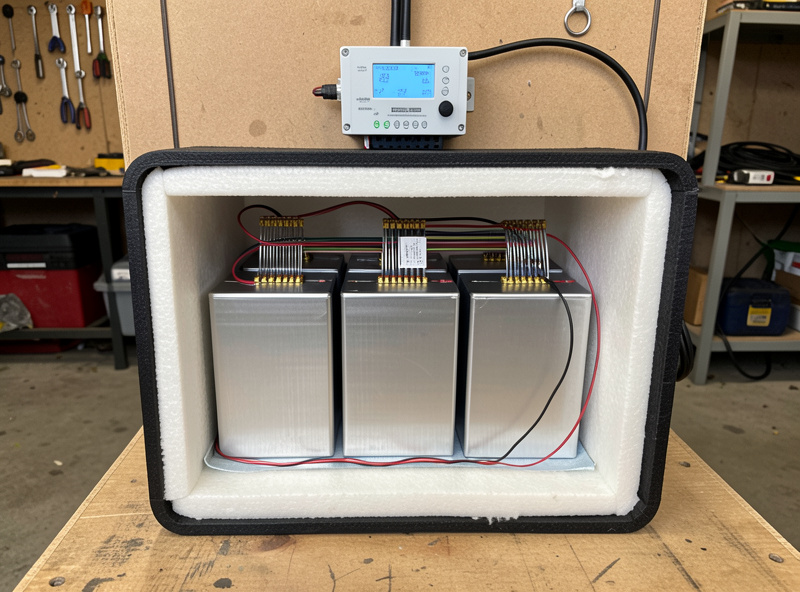
If the bank lives anywhere it can drop below freezing, the answer is usually a thermostatically controlled heating pad under or around the cells, drawing a trickle of the bank’s own energy to keep it in the safe charge window. Choosing and wiring one correctly is a small project with real safety stakes — the full guide on LiFePO4 heating pads covers pad sizing, thermostat wiring, and safe placement around prismatic cells..
5. Respect cold Voc rise in the wiring
The over-voltage trap catches more DIY builders than any other cold-weather gotcha. You design your string length and pick your controller against the coldest expected temperature, not nameplate, and you keep a margin. Skip it and a January cold-snap morning can push a controller past its rated input. It is also a big reason a proper MPPT controller beats a PWM one on a cold, high-voltage string, and why your mounting and tilt choices are part of the electrical design, not just mechanics.
6. Plan the generator fill-in
Honest northern systems are not 100% solar in winter; they are solar plus a backup that covers the gap. Integrating a generator cleanly — what it charges, through what, and how it hands off — turns a system that browns out in January into one that simply keeps running. For the wiring and sizing decisions involved, the generator backup for solar guide covers auto-start thresholds, transfer switch sizing, and the charge current limits that protect the battery bank during bulk charging from a generator.
7. Winterize the physical install
Outdoor versus garage siting, insulation, condensation, snow management, and keeping connectors and the inverter happy through freeze-thaw cycles. The complete winterize home battery system guide covers every physical step in detail. The chemistry can be perfect and a badly sited install will still let you down.
The two cold-weather settings that actually protect the bank
Of everything on the list, two items are settings-and-wiring decisions rather than “buy more hardware” decisions, and both carry real safety stakes. They are worth understanding at the system level here, even though each gets a full spoke.
Why charging a freezing LiFePO4 cell is the rule people break
LiFePO4 is wonderfully tolerant chemistry — and the reasons it won home storage over NMC are exactly the reasons it shrugs off most of winter. It discharges happily well below freezing, just with reduced capacity. The asymmetry that catches people is on the charge side. Pushing charge current into a cell that sits below roughly 0°C drives lithium to plate as metal on the anode instead of intercalating properly. That plating is permanent: it eats capacity, and the dendrites it can form are a genuine internal-short and fire risk down the line. There is no “just a little” exception that a careful builder relies on. The rule is simply: no charging below freezing.
The clean way to enforce it is a temperature sensor on the cells feeding a BMS configured with a charge-temperature cutoff — typically blocking charge below about 0°C and re-enabling a few degrees above, so it does not chatter on and off around the threshold. The subtlety, which trips up people who set it once and forget it, is that the cutoff must be on the cells, not the air, and discharge should remain permitted well below the charge cutoff. Get this wrong in the conservative direction and you merely lose some winter charging you could have had; get it wrong in the dangerous direction and you slowly destroy the pack. I treat it as non-negotiable and verify it every autumn.
Why a cold panel can over-volt your controller
Solar panels have a negative voltage temperature coefficient: the colder the cell, the higher its open-circuit voltage. The spec sheet’s Voc is measured at 25°C, but a clear, still, sub-zero morning can leave your panels far colder than that, and the string voltage climbs accordingly — often more than 10% above nameplate at genuinely cold temperatures. If you sized your string length and chose your charge controller against the 25°C number, a January cold snap can present the controller with a voltage above its maximum input rating. At best that shuts the controller down; at worst it damages it.
The fix is design discipline, not a gadget: compute worst-case string Voc using the panel’s voltage temperature coefficient and the coldest temperature your site realistically sees, then keep the result comfortably under the controller’s maximum input — I keep a margin rather than sneaking up to the limit. This is exactly the kind of wiring-margin safety the brochures never mention, and it is the most common reason a northern DIY string mysteriously stops harvesting on the coldest mornings.
Where solar honestly stops in a northern winter
This is the part the brochures will never tell you, and it is the most important thing in this guide. At high latitude, solar does not carry a meaningful load through the darkest weeks on its own. The math is simply against it: when your array is doing an eighth of its summer work for days at a stretch, no realistic panel count fully closes the gap without an absurd amount of glass that then sits useless all summer.
The same brutal math is why a sealed off-grid fantasy collapses at high latitude, and why even purpose-built off-grid setups like an off-grid coop or outbuilding need honest winter sizing. The honest northern architecture is therefore solar plus storage plus a backup source — grid, generator, or both. Solar does the heavy lifting spring through autumn, storage rides you through nights and short gaps, and the backup covers the deep-winter weeks where the sun has effectively quit. Anyone selling you “energy independence” from panels alone at 60° north is selling you a summer photograph. I would rather you size the gap correctly and sleep through January than discover the shortfall when the fridge goes warm.
How I run mine through a Nordic winter
For concreteness, here is the shape of my own setup and what each part does once the cold sets in. The bank itself is a DIY LiFePO4 build from bare prismatic cells, top-balanced on the bench before assembly — none of this is exotic; it is the honest middle ground a careful builder lands on. If you are starting from zero, the beginner’s guide to battery storage and the chemistry overview are the right first reads.
| System element | Summer role | Winter behaviour / mitigation |
|---|---|---|
| South-facing array | Covers loads, fills the bank daily | Output collapses to a fraction; steeper winter tilt sheds snow and catches the low sun better |
| MPPT charge controller | Harvests at nameplate-ish | Sized against cold Voc, not rated Voc, so a freezing-morning voltage spike stays in spec |
| 16S LiFePO4 bank | Daily cycling, deep usable DoD | Heating pad + BMS low-temp cutoff keep charging safe; capacity sags but cells stay protected |
| BMS | Balancing, protection | Charge-temperature cutoff blocks charge below ~0°C; discharge still permitted colder |
| Backup source | Idle | Generator (or grid) fills the deep-December gap solar cannot |
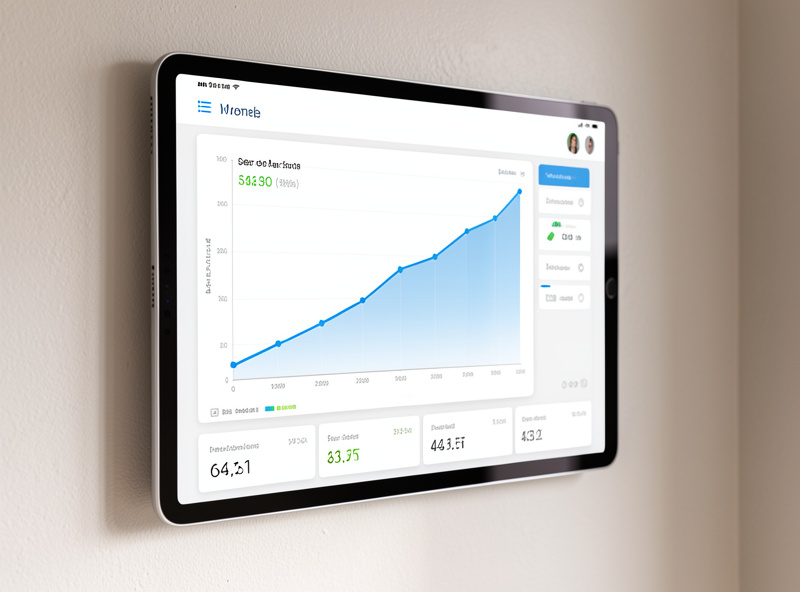
| Home Assistant | Logs PV, SoC, loads | Same rule engine watches cell temps and triggers the heating pad — one dashboard for the whole house |
That last line is the polymath crossover I lean on constantly: the same Home Assistant rule engine that watches battery state-of-charge and cell temperature also watches the curing-chamber humidity and the hydro reservoir. One dashboard, every system that matters, and a cold-pack alert that fires before the BMS ever has to — the same smart inverter monitoring approach I use year-round, just with cold-weather rules layered on.
The honest northern architecture, in detail
If solar alone cannot carry the darkest weeks, the design question becomes: what fills the gap, and how cleanly does it hand off? There are three honest answers, and which one fits depends on whether you have a grid connection.
Grid-tied with battery backup is the easiest and, for most northern homes, the right one. A capable hybrid inverter makes it seamless. Solar and storage do the daily work; the grid quietly tops the bank when a dark stretch outruns the panels, and you have configured the system to draw from the grid only when SoC falls below a floor you choose. You get the resilience of storage and the bottomless backstop of the grid without ever pretending to be off-grid. I am blunt about this with people: most “off-grid” homes are not, and grid-tied-with-backup is the honest middle ground, not a compromise to be ashamed of.
Off-grid with a generator is for sites with no grid at all. Here the generator is not an embarrassment — it is a designed component. The cleanest integration runs the generator into the inverter/charger’s AC input so it charges the bank through the same controlled charge profile your solar uses, rather than bolting on a separate dumb charger. You decide the trigger (an SoC floor, or a schedule for the worst weeks), size the generator to comfortably charge the bank in a reasonable run rather than to power the house directly, and you accept that for a few weeks of the year the genset does real work. Sized right, it runs rarely and briefly; sized as an afterthought, it runs constantly and you resent it.
Solar plus an oversized bank and disciplined loads — the “ride it out” approach — only works at the margins and only with brutal honesty about consumption. You can stretch a few extra dark days by carrying more storage and cutting loads to the essentials, but storage is expensive and a bank sized to carry weeks of December with no input is almost always less sensible than a modest generator. I have run the numbers on my own loads more than once, and at my latitude the generator wins every time for the deep-winter weeks.
Whichever you choose, the principle holds: design the hand-off, do not leave it to chance. A system that browns out at 3 a.m. in January because nobody decided what happens when the panels have made nothing for four days is a system that was sized on a summer photograph.
Winterizing the physical install
The electrical design can be flawless and a careless physical install will still let you down when it is minus fifteen and blowing snow. The bank, the inverter, and the connectors all care about where they live.
Bank siting is the big one. A bank in a heated space barely needs to think about the charge-temperature cutoff; a bank in an unheated garage or an outdoor enclosure absolutely does, which is why the heating-pad question is really a siting question in disguise. If the cells can go below freezing, you either heat them or you lose winter charging — there is no third option. Insulating the enclosure helps the heating pad do less work, but insulation alone cannot add heat; it only slows the loss.
Condensation and freeze-thaw quietly destroy more cold installs than outright cold does. An enclosure that warms during the day and chills at night breathes moist air in and condenses it on cold metal — busbars, terminals, the inverter’s internals. A little controlled ventilation, or keeping the enclosure consistently above the dew point, beats a sealed box that sweats. Snow management on the array matters too: a steep winter tilt sheds most of it, but a flat panel under a few centimetres of snow makes exactly zero watts, and you will not always be home to sweep it.
The inverter dislikes the cold less than the bank but still wants to live somewhere that does not swing wildly. Mount it where it stays dry, give it the clearance its manual asks for, and remember that a low-frequency unit’s surge headroom — the thing that actually matters when the welder or a well pump fires — is unaffected by cold, but its display and electronics still prefer not to be iced.
The mistakes I see northern builders make
After enough winters and enough rebuilds, the failure patterns rhyme. Here are the ones that cost people the most.
- Sizing on the annual average. The single biggest one. A system sized to your yearly mean energy use will sail through eight months and starve in two. Size the gap, then decide consciously how to fill the rest.
- Throwing panels at a December that geometry has already closed. Past a point, adding glass to chase deep-winter output gives almost nothing back — those panels then sit useless all summer. There is a sane ceiling, and beyond it a backup source is cheaper and more reliable than another array.
- Ignoring cold Voc. Designing the string against nameplate voltage instead of cold worst-case. The controller survives summer fine, then trips or dies on the first hard frost.
- Letting the bank charge while frozen. No low-temperature cutoff, or a cutoff set on the wrong sensor. The pack quietly loses capacity over a winter and nobody understands why come spring.
- Flat-mounting the array. A shallow tilt that is fine for summer holds snow and misses the low winter sun entirely. A steeper winter angle harvests more and self-clears.
- Pretending the generator is optional. Treating a backup source as a failure of the solar dream rather than a designed-in part of an honest northern system. It is the part that lets you sleep in January.
- Forgetting the install itself. Perfect electrical design undone by condensation in an unheated enclosure, a connector packed with ice, or an inverter sulking in the cold.
A realistic winter checklist
- Recompute on December, not the annual average. Find your worst-realistic PSH and size the gap from there.
- Tilt steeper for winter. A steeper angle catches the low sun and sheds snow; near-vertical is not crazy at high latitude.
- Verify cold Voc against your controller’s max input. Use your coldest expected temperature and the panel’s voltage temperature coefficient; keep a margin.
- Confirm the BMS low-temp charge cutoff is enabled and sane. Block charge below ~0°C with a few degrees of hysteresis so it does not chatter.
- Heat the pack if it can freeze. Thermostatic pad, sized to the bank, drawing the bank’s own trickle.
- Have a real backup. Generator or grid for the deep weeks; do not pretend panels alone will carry January.
- Winterize the install. Site, insulate, manage condensation and snow, keep connectors dry.
Work through the seven spokes in order and you end up with a system that is honest about its limits and rock-solid within them — one that treats a dark Swedish January as a solved engineering problem rather than an annual surprise. That, not a summer production screenshot, is what a northern storage system is actually for.