Important Disclaimer
BatteryStorageHQ provides educational content and estimates only. We are not certified installers, financial advisors, or electricians. Always consult with licensed professionals.
This solar panel guide for home battery storage is written from the roof down, not the brochure out. In a real northern-latitude install, a south-facing array that nameplates at 6 kW will hand you barely 1 kWh on a flat December day and over 30 kWh in June. Panels are the cheapest part of a storage system and the part people obsess over for the wrong reasons. The numbers that actually decide whether your battery bank stays charged are array orientation, cold-weather voltage, and how the panels talk to the charge controller.
I run a modest south-facing array in Sweden feeding a 16S LiFePO4 bank through a hybrid inverter, all logged in Home Assistant. I have watched the same string behave like two different products across a year: a gentle trickle in January, a firehose in May. Everything below is built around that reality. If you came here expecting “solar pays for itself in five years,” this is the wrong guide — this is about getting electrons into the bank reliably, in the seasons that actually stress the system.
Why Panels Are the Easy Part (and the Battery Is the Hard Part)
Panels are commodity glass. A modern 410 W monocrystalline module costs a fraction per watt of what it did a decade ago, carries a 25-year production warranty, and degrades roughly 0.4–0.5% per year. The panel is rarely what fails. The expensive, opinionated decisions live downstream: the hybrid inverter, the battery chemistry, and the charge controller that ties panels and battery together.
That ordering matters because people spend weeks agonising over panel brand and then bolt it to a budget PWM controller that throws away a third of the harvest on a cold morning. The mental model I use: the array is a faucet, the battery is the bucket, the charge controller is the valve. A bigger faucet does nothing if the valve is wrong or the bucket is full by noon. Size the bank first against your real loads — my battery sizing walkthrough covers that math — then size the array to refill it in the worst month you actually care about.
The Five Panel Specs That Actually Matter
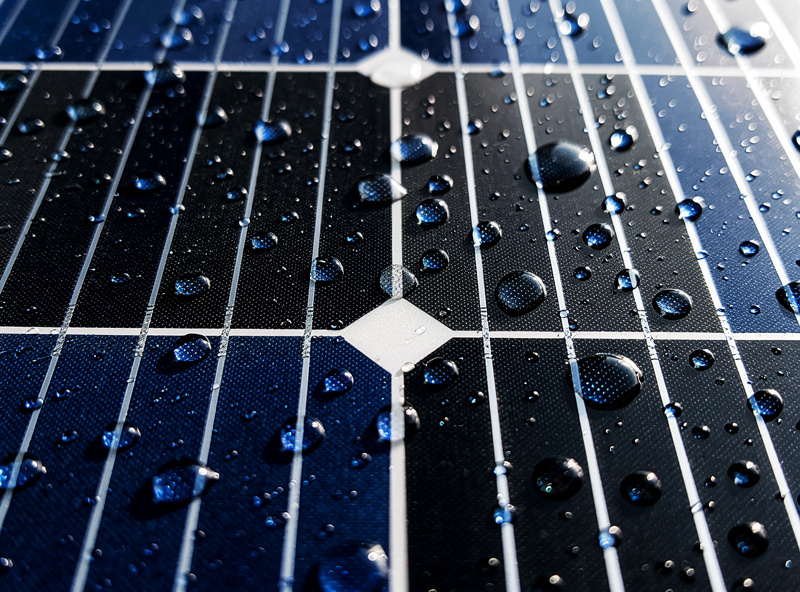
Forget the marketing efficiency percentage for a moment. For a battery-coupled system, five datasheet lines decide everything: Voc (open-circuit voltage), Vmp (voltage at max power), Imp (current at max power), the temperature coefficient of Voc, and the module’s power tolerance. Efficiency only tells you how much roof a given wattage eats — it does not tell you whether the string will fry your charge controller on a cold morning.
Voc is the spec that quietly destroys equipment. US installs are required to size string voltage to the coldest expected temperature under NEC 690.7 (Maximum Voltage), applying the cold-temperature correction factors in Table 690.7(A). A panel rated 49.5 V Voc at 25°C does not stay at 49.5 V. On a clear −10°C Swedish morning the open-circuit voltage climbs, because silicon Voc rises as temperature falls — typically around −0.27% to −0.30% per °C. String six of those in series and you can blow past a 150 V controller limit before the sun is even warm. This single mechanic is why I keep harping on cold-weather margin, and it is covered in depth in the MPPT vs PWM breakdown.
The temperature coefficient of power (typically around −0.34%/°C) cuts the other way and is the good news of cold climates: a panel at −5°C in bright sun actually produces above nameplate. The cruel part is that those cold bright days are short and rare in midwinter, so the seasonal average still collapses. I have logged single February hours over nameplate and whole December days under 5% of it.
Quick panel-spec comparison
| Spec | What it tells you | Why it matters for storage | Typical value (residential mono) |
|---|---|---|---|
| Voc (open-circuit V) | Max string voltage with no load | Sets controller voltage limit; rises in cold | 37–50 V per panel |
| Vmp (max-power V) | Operating voltage under load | Determines MPPT vs battery voltage headroom | 31–42 V per panel |
| Imp (max-power A) | Operating current | Drives wire gauge and controller current rating | 9–14 A per panel |
| Temp coeff. of Voc | Voltage rise per °C drop | Cold-climate over-voltage risk | −0.27 to −0.30 %/°C |
| Power tolerance | Spread around nameplate watts | Honest harvest vs paper rating | 0 to +5 W (positive only on good panels) |
Monocrystalline vs Polycrystalline: A Settled Argument
For a new home install in 2026 this is barely a decision: buy monocrystalline. Mono panels run 20–22% efficient versus roughly 15–17% for the polycrystalline modules that are now mostly cleared old stock. Mono also holds up better in low light and high heat, which matters at both ends of a Nordic year. The only time poly still makes sense is genuinely free or near-free salvage panels where roof space is unlimited and budget is zero.
The real fork is not mono-vs-poly anymore — it is PERC vs newer N-type (TOPCon and heterojunction) cells, which trade a small price premium for lower temperature coefficients and better degradation curves. I unpack the full chemistry-and-cost picture, including why the poly era is effectively over, in the dedicated mono vs poly comparison. For most readers: pick a reputable mono module and move your energy to sizing and mounting.
Sizing the Array Against the Battery, Not the Roof
The most common DIY mistake I see is sizing the array to fill the roof and the second most common is sizing it to a sunny-month spreadsheet. Neither approach survives contact with December. The correct method works backwards from load: establish your real daily kWh draw, decide how many days of autonomy the battery covers, then size the array to recharge that bank in your design month’s sun-hours.
A worked sketch: a workshop pulling 8 kWh/day, in a December that delivers maybe 1 peak-sun-hour, needs roughly 8 kW of array just to break even on the worst days — which is absurd and uneconomic. So you do not design for December break-even up north; you design for grid-tied-with-backup and accept the winter shortfall, or you oversize panels and undersize expectations. Working through that honest math is exactly what the solar panel sizing calculator is for, and it pairs with the deeper battery sizing guide.
Two universal rules I will die on: oversize the array relative to the controller’s nameplate (panels rarely hit STC, so a healthy oversize harvests more shoulder-season energy), and never undersize the inverter — surge, not average load, is what browns a system out when the welder or sauna heater fires.
Mounting: Angle, Orientation, and the Snow Problem
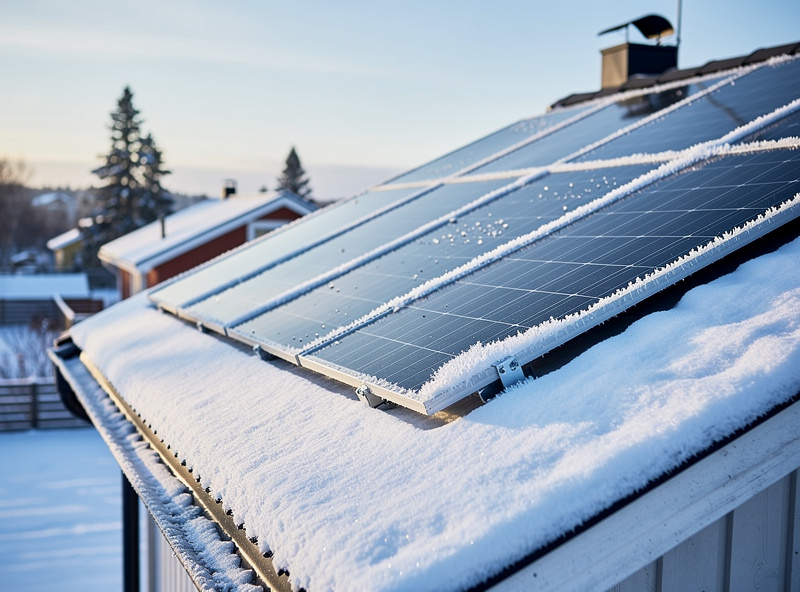
Mounting is where free energy is won or thrown away. Orientation and tilt set the annual yield curve; in the northern hemisphere, true south is the baseline and steeper tilts (closer to your latitude plus 10–15°) shift production toward winter and shed snow faster. A panel buried under snow makes zero watts, so in snow country a steeper, smoother array earns its keep every storm.
The three honest options are roof mounts (cheapest, fixed angle), ground mounts (best access, ideal tilt, more steel and permitting), and adjustable/seasonal tilt (manual labour twice a year for a real winter gain). Each has a wind-load and corrosion story that determines hardware grade. I cover rail systems, flashing, ground-mount footings, and the fastener-corrosion mistakes that cause leaks in the solar panel mounting systems guide. Whatever you choose, the structural load path — not the panel — is the part that has to survive 25 winters.
Charge Controllers: MPPT vs PWM
This is the single highest-leverage component decision after the battery itself. A PWM controller drags the panel down to battery voltage and discards the difference; an MPPT controller converts that excess voltage into extra charging current, recovering 20–30% more harvest on a cold, high-voltage string. For any modern high-Voc panel feeding a 48 V LiFePO4 bank, MPPT is not optional.
The only place PWM survives is a tiny, voltage-matched 12 V system with a cheap panel where the controller cost difference matters more than the lost harvest. I keep one cheap PWM unit on the bench purely to demonstrate why it loses on a cold string. The full numbers, wiring, and the Voc-margin trap are in the MPPT vs PWM guide, and the controller has to be matched to LiFePO4 charge behaviour in the cold — including the hard rule against charging below freezing.
Choosing Panel Brands Without Getting Burned
Panel brand matters less than the bankability of the warranty behind it. Reputable modules are tested to IEC 61215 (Terrestrial PV modules – Design qualification and type approval), the thermal-cycling and damp-heat regime that separates a panel that holds its warranty from one that delaminates early. A 25-year production warranty is worthless if the manufacturer is gone in year eight. I weight Tier-1 manufacturers, real-world degradation data, and connector quality (MC4 compatibility and genuine vs clone connectors cause more field failures than the cells do) over headline efficiency. The brand-by-brand breakdown — who is genuinely Tier-1, where the value plays are, and what to avoid in the gray import market — lives in the best solar panel brands comparison.
One honest monetization note for readers: full panels are usually bought direct from local distributors or installers, not Amazon, and shipping glass is expensive — so I will never wave you at a fake “buy this panel” button. The accessories that genuinely live on Amazon (the MPPT controller, MC4 connectors, mounting rail, DC fuses, and monitoring shunts) are where I point, because that is where the honest links are.
Series, Parallel, and the Cold-Voltage Margin
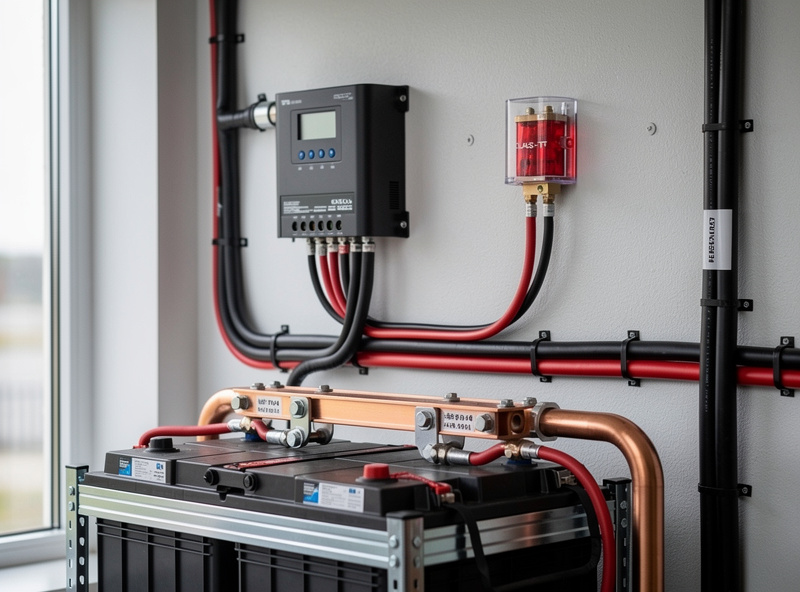
How you wire the string is a safety decision, not just a performance one. Series wiring adds voltage (good for MPPT efficiency and thinner wire) but multiplies the cold-Voc risk; parallel wiring adds current (good for partial shade tolerance) but demands fatter cable and per-string fusing. The right answer is usually a series-parallel compromise that keeps cold-morning Voc comfortably under the controller’s absolute maximum with margin to spare.
My rule of thumb: take the panel’s Voc, add the cold-temperature rise for your coldest expected morning, multiply by the number in series, and make sure that worst-case number sits at least 10% under the controller’s max input voltage. Skip that arithmetic and you eventually meet it the expensive way. Proper DC fusing and a Class-T fuse on the battery side are part of the same safety story I cover in the storage safety guide.
Off-Grid vs Grid-Tied-With-Backup
Most “off-grid” homes are not actually off-grid, and that is fine — grid-tied-with-backup is the honest middle ground for the vast majority of people. True off-grid means designing for the worst week of the worst month with no utility safety net, which up north means a brutally oversized array, a generator, or accepting that January is a rationing month. If you genuinely want to design a standalone system, work through the off-grid solar design guide with clear eyes about the winter gap.
The same battery bank that runs an off-grid cabin also backs the polymath workshop here — the welder, the curing chambers, the sauna pre-heat — and the surge math is identical: size the inverter to the hard motor loads, not the average. One Home Assistant rule engine watches battery state-of-charge, daily PV, and load on a single dashboard, which is how I know exactly when the array stops keeping up each autumn.
What a Year of Logs Actually Looks Like
Marketing talks in annual kWh totals because the annual number hides the brutal seasonal swing. My Home Assistant logs tell the honest story: peak summer days where the array tops the bank by mid-morning and then spends the afternoon with nowhere to put the excess, and deep-winter weeks where three cloudy days in a row never fully recharge it. The annual average is a fiction nobody actually lives in.
The shape that matters is the production curve, not the total. From a fixed south-facing roof at my latitude, the rough monthly pattern runs something like this: December and January at perhaps 5–10% of summer output, February and November climbing, a steep ramp through March and April, then a broad May-to-August plateau where curtailment (wasted excess) becomes the real problem. The design consequence is blunt — if you size for the summer plateau you are throwing away half the panels’ potential nine months of the year, and if you size for December you are bankrupt. You size for the shoulder seasons and treat the two extremes as separate problems: summer is a dump-load and curtailment question, winter is a grid-or-generator question.
This is also why I distrust any solar calculator that spits out a single annual figure and calls it a day. The useful output is twelve monthly numbers against your twelve monthly loads, which is the approach the sizing method walks through. A system that looks perfect on the annual average can still leave you dark for the exact six weeks you most needed it.
Bifacial, Half-Cut, and Other Features Worth (or Not Worth) Paying For
Panel datasheets are now crowded with features that range from genuinely useful to pure spec-sheet theatre. Half-cut cells are worth having and effectively standard — splitting the cells halves the internal current and resistive losses and improves partial-shade behaviour, with no downside. PERC and N-type (TOPCon) coatings are likewise a real, if incremental, gain in low light and temperature performance.
Bifacial panels, which harvest reflected light off their back face, are the feature most oversold for residential roofs. On a flush roof mount with a dark surface behind them, the rear-side gain is negligible — you are paying for albedo that does not exist two inches from a shingle. Where bifacial genuinely earns its premium is a ground mount over snow, gravel, or a white membrane, exactly the high-albedo surfaces a northern install might have in winter. So the honest answer is conditional: bifacial on a tilted ground mount over snow, yes; bifacial flush-mounted on a roof, save your money and buy more conventional watts instead. As always, spend the marginal dollar where the mounting geometry actually lets the feature work.
Tying It All Together
A storage-first solar system is a chain: panels → charge controller (or hybrid inverter’s built-in MPPT) → battery bank → inverter → loads. Get the chemistry right (LiFePO4 vs NMC), build or buy the bank correctly (DIY bank build or a prebuilt), and the panels become the simple, reliable faucet they should be. If you are starting from zero, the beginner’s guide to battery storage sets the foundation before you climb on the roof.
Solar panels are not the magic in a home energy system — they are the easy, cheap, reliable part. The skill is in the design margins: cold voltage, honest winter sizing, surge-rated inverters, and a charge controller that does not throw harvest away. Get those right and the array quietly does its job for a quarter-century.
Frequently Asked Questions
How many solar panels do I need for a home battery system?
Work backwards from load, not roof size. A home using 10 kWh per day needs enough array to recharge the bank in your worst design month. Up north that often means 8 to 12 panels of 400 W each, oversized to cover poor winter sun-hours.
Are monocrystalline or polycrystalline panels better for home storage?
Monocrystalline, almost always. Mono runs 20 to 22 percent efficient versus 15 to 17 percent for poly, performs better in low light and heat, and is now similarly priced. Poly only makes sense for free salvage panels with unlimited roof space.
Do solar panels work in winter and cold climates?
Yes, and cold actually raises panel voltage and efficiency on bright days. The problem is short daylight, not cold. A Nordic December can deliver under one peak-sun-hour, so winter production collapses to a fraction of summer despite the cold-weather voltage bonus.
Do I need an MPPT or PWM charge controller?
MPPT for any modern high-voltage panel feeding a 48 V LiFePO4 bank. MPPT recovers 20 to 30 percent more harvest from a cold, high-voltage string. PWM only suits a small, voltage-matched 12 V system where controller cost outweighs lost energy.
Why does panel Voc matter for cold weather?
Open-circuit voltage rises as temperature drops, roughly 0.27 to 0.30 percent per degree C. On a cold morning a series string can exceed your charge controller’s voltage limit and damage it. Always size strings with at least 10 percent cold-Voc margin.
Can I buy complete solar panels on Amazon?
You can, but full panels are usually cheaper direct from local distributors or installers because shipping glass is costly. Amazon is where the accessories genuinely live: MPPT controllers, MC4 connectors, mounting rail, DC fuses, and monitoring shunts.