Important Disclaimer
BatteryStorageHQ provides educational content and estimates only. We are not certified installers, financial advisors, or electricians. Always consult with licensed professionals.
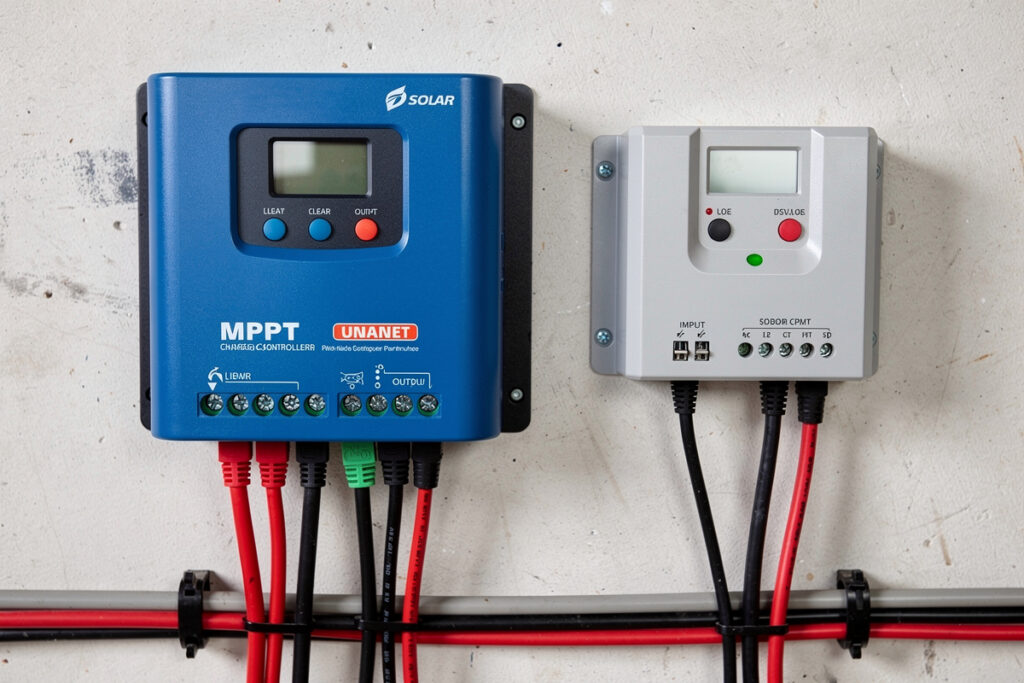
MPPT versus PWM is the highest-leverage cheap decision in a solar charge system, and for any modern panel feeding a 48 V LiFePO4 bank the answer is MPPT, full stop. An MPPT controller recovers 20–30% more harvest than PWM from a cold, high-voltage string because it converts excess panel voltage into extra charging current instead of throwing it away. PWM only makes sense in one narrow case: a small, voltage-matched 12 V system where the controller’s lower cost outweighs the lost energy.
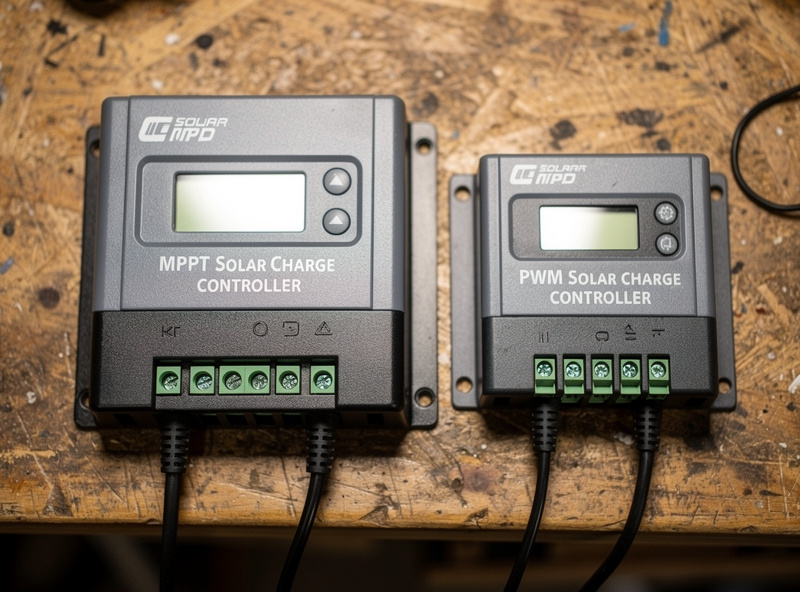
I keep a cheap PWM unit on the bench purely as a teaching prop — to show people on a cold morning exactly how much current it leaves on the table next to an MPPT running the same panel. The difference is not subtle. This is the charge-controller chapter behind the broader home solar panel guide, and it is the component that decides whether your panels’ potential actually reaches the bank.
How PWM Actually Works
A PWM (Pulse Width Modulation) controller is essentially a fast switch between the panel and the battery. It connects them directly and pulses the connection on and off to taper the charge, which forces the panel to operate at the battery’s voltage rather than at the panel’s own most-efficient point. That sounds harmless until you look at the voltages. A “12 V” panel actually wants to operate around 18 V (its Vmp), but a PWM controller drags it down to maybe 13–14 V to match the battery — and that voltage difference is pure wasted power.
Power is volts times amps. If the panel could deliver its current at 18 V but PWM forces it to 13.6 V, you lose roughly a quarter of the available watts before they ever reach the battery. PWM also requires the panel’s nominal voltage to roughly match the battery’s, which is why it only works with old-style “12 V” or “24 V” panels, not modern high-voltage grid-tie modules with a 40 V Vmp. Feed a modern panel into a PWM controller for a 12 V battery and the mismatch is catastrophic.
How MPPT Recovers the Difference
An MPPT (Maximum Power Point Tracking) controller is a smart DC-to-DC converter. It lets the panel operate at its own ideal voltage and current — its maximum power point — then converts that high-voltage, lower-current input into the low-voltage, higher-current output the battery wants. Energy that PWM would waste as a voltage gap is instead transformed into extra charging amps. That conversion is where the 20–30% gain comes from, and it is largest exactly when the panel voltage is highest.
And panel voltage is highest when it is cold. On a clear −10 °C morning, panel Voc and Vmp climb well above their rated values, widening the gap between panel voltage and battery voltage — which is precisely the gap MPPT harvests and PWM discards. So MPPT’s advantage is biggest in the cold, dark shoulder seasons when a battery system is most starved, which is why I treat it as mandatory at northern latitudes and pair it with the right cold-weather LiFePO4 charge behaviour.
The Harvest Difference in Real Numbers
Put numbers on it. Say a 400 W panel is delivering its rated current at a Vmp of 38 V on a cold bright morning, into a 48 V nominal battery sitting at 52 V. A PWM controller cannot even use that panel — the voltages do not match. An MPPT controller takes the panel’s ~38 V input, tracks the max power point, and steps it to deliver charging current at 52 V. In a 12 V matched scenario where PWM can function, the same panel run on MPPT typically delivers 20–30% more daily watt-hours into the bank, and the margin grows on cold, partly cloudy days where the panel voltage swings high.
Across a year that 20–30% is the difference between an array that just keeps up in the shoulder seasons and one that falls behind — exactly the margin the sizing calculator is fighting for. Buying a slightly smaller MPPT-fed array often beats a larger PWM-fed one on both cost and harvest. A quality MPPT charge controller with Bluetooth monitoring is the unit I point people to for any serious bank.
The Cold-Voltage Trap That Kills Controllers
MPPT’s superpower comes with a hard rule: respect the controller’s maximum input voltage. Because Voc rises as temperature falls (about −0.27 to −0.30% per °C), a string that reads a safe 145 V at room temperature can climb past a 150 V controller limit on a cold morning — and over-voltage destroys the controller instantly. This is the single most common way DIY builders blow up an MPPT.
The fix is arithmetic, not luck. Take the panel’s rated Voc, add the cold-temperature rise for your coldest expected morning, multiply by the number of panels in series, and keep that worst-case figure at least 10% under the controller’s max input voltage. Design the string with margin and the controller lives for decades; skip the cold-Voc math and you meet the limit the expensive way. This is the same margin discipline that runs through panel selection and string wiring.
Sizing and Choosing the Controller
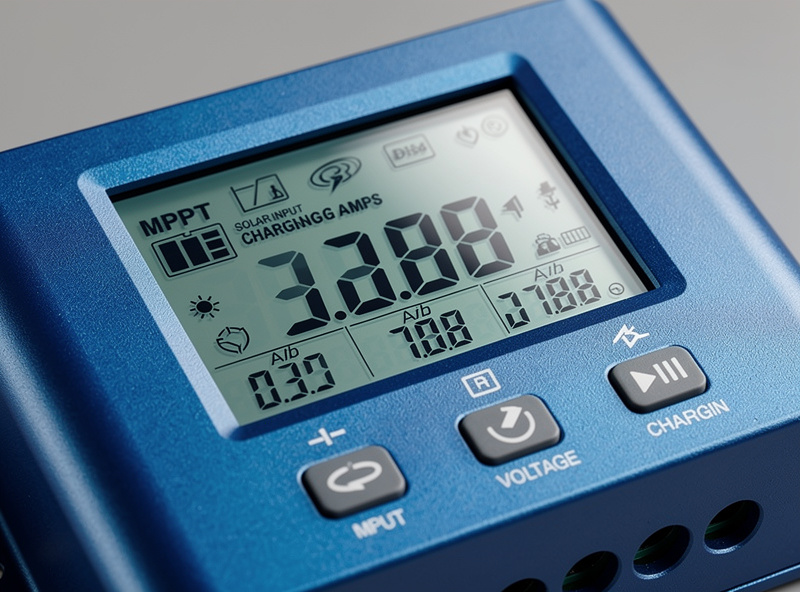
Size an MPPT controller by its output current rating and its maximum input voltage and power. The output current must comfortably handle your array’s potential charging current into the battery; the input window must accommodate your string’s cold-Voc ceiling and your array’s total watts. Slight array oversizing relative to the controller’s rated output is normal and beneficial — the controller simply clips at its limit on the rare full-sun peak, while harvesting more in the cloudy hours where you are below nameplate anyway.
For features, I value a proper LiFePO4 charge profile (correct absorption and float, the ability to disable float, and a low-temperature charge cutoff), genuine Bluetooth or networked monitoring, and a brand with real firmware support. A battery monitor shunt alongside it closes the loop so you actually see what the controller is harvesting. The controller is also the device that must honour the rule against charging LFP below freezing — covered in the integration guide.
When PWM Is Still Fine
I am not a PWM absolutist. For a tiny, cheap, voltage-matched system — a single 12 V panel trickle-charging a small 12 V battery for a gate opener, a trail camera, or a shed light — a PWM controller is cheaper, simpler, and the lost few watt-hours are irrelevant. The crossover is roughly: if the system is small, the panel is a true 12 V/18 V Vmp type, and the budget genuinely matters more than the harvest, PWM is fine. For anything you are relying on, anything 24 V or 48 V, or anything using modern high-voltage panels, MPPT every time.
MPPT vs PWM at a glance
| Factor | MPPT | PWM |
|---|---|---|
| How it works | DC-DC converts excess voltage to current | Switches panel directly to battery |
| Typical harvest gain | +20–30% vs PWM | Baseline |
| Panel compatibility | High-voltage grid-tie panels OK | Voltage-matched panels only |
| Best system size | Any serious / 24V–48V bank | Small 12V matched only |
| Cold-climate advantage | Largest (high panel voltage) | None |
| Cost | Higher | Lower |
My Verdict
For any home battery system worth the name, buy MPPT. The 20–30% harvest gain pays for the controller many times over, the advantage is biggest in exactly the cold, dark conditions a northern system struggles with, and modern high-voltage panels demand it anyway. Keep PWM in your mind only for trivial, voltage-matched 12 V trickle jobs. And whichever you choose, do the cold-Voc arithmetic before you wire the string — that is the calculation that protects the controller you just bought.
Frequently Asked Questions
Is MPPT really better than PWM?
Yes, for any serious system. An MPPT controller recovers 20 to 30 percent more harvest than PWM by converting excess panel voltage into charging current instead of wasting it. The advantage is largest on cold, high-voltage mornings, which is exactly when a battery system needs the energy most.
When should I use a PWM charge controller?
Only for small, cheap, voltage-matched 12 V systems, like a gate opener, trail camera, or shed light using a true 12 V panel. There the lower controller cost outweighs the few lost watt-hours. For anything 24 V or 48 V, or modern high-voltage panels, use MPPT.
Can I use a modern solar panel with a PWM controller?
Not effectively. PWM forces the panel to operate at battery voltage, so it needs a voltage-matched panel. Modern high-voltage grid-tie panels with a 40 V max-power voltage are mismatched to a 12 V battery, wasting most of their output. Those panels require an MPPT controller.
Why can cold weather destroy an MPPT controller?
Panel open-circuit voltage rises as temperature falls, roughly 0.27 to 0.30 percent per degree C. A series string safe at room temperature can exceed the controller’s maximum input voltage on a cold morning, instantly destroying it. Always keep cold-weather string voltage at least 10 percent under the limit.
How do I size an MPPT charge controller?
Match the output current rating to your array’s potential charging current, and ensure the maximum input voltage covers your string’s cold open-circuit voltage. Mild array oversizing is fine; the controller clips at peak sun while harvesting more in cloudy hours when you are below nameplate.
Does MPPT help more in winter?
Yes. MPPT’s gain comes from converting the gap between high panel voltage and lower battery voltage into charging current, and that gap is widest when panels are cold and their voltage climbs. So MPPT delivers its biggest advantage in the cold, dark shoulder seasons when harvest is scarcest.