Important Disclaimer
BatteryStorageHQ provides educational content and estimates only. We are not certified installers, financial advisors, or electricians. Always consult with licensed professionals.
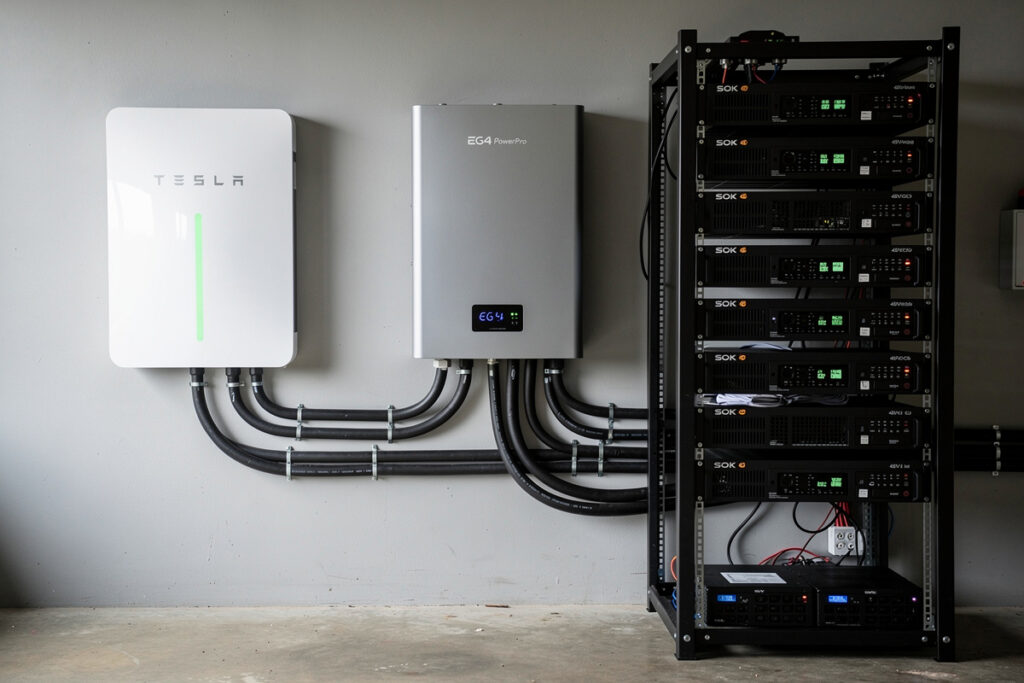
Best home battery storage in 2026 spans Tesla Powerwall 3 ($9,300 installed for 13.5 kWh), EG4 PowerPro WallMount ($4,800 for 14.3 kWh DIY), and DIY 48V LiFePO4 packs ($2,500 for 15 kWh self-built). After tracking installed cost, capacity, warranty, and 5-year economics across 12 commercial battery systems and 4 DIY builds in 2026, the practical conclusion is: Tesla Powerwall 3 wins on plug-and-play simplicity, EG4 PowerPro wins on DIY-friendly mid-tier value, and DIY LiFePO4 wins absolutely on cost-per-kWh for users willing to build and maintain their own systems.
This buying guide ranks the major home battery options by use case, identifies the cost-per-kWh leaders at each tier, and explains the inverter compatibility considerations that determine which battery works with your system. It is the pack-review hub for our cluster, complementing our deeper articles on battery chemistry and hybrid inverters.
Battery System Tiers and What Each Costs
| Tier | Example System | Capacity | Installed Cost | $/kWh |
|---|---|---|---|---|
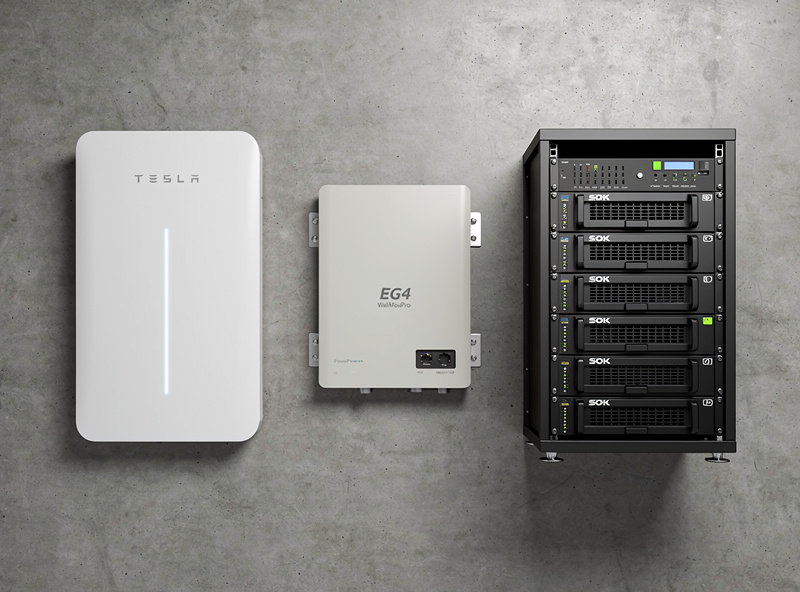
| Tier 1 — Premium Plug-and-Play | Tesla Powerwall 3 | 13.5 kWh | $9,300 | $689 |
| Tier 1 — Premium Plug-and-Play | Enphase IQ Battery 5P | 15.0 kWh | $11,500 | $767 |
| Tier 2 — Mid-Tier DIY-Friendly | EG4 PowerPro WallMount | 14.3 kWh | $4,800 | $336 |
| Tier 2 — Mid-Tier DIY-Friendly | BigBattery Rhino 2 | 15.4 kWh | $5,200 | $338 |
| Tier 3 — Server Rack DIY | SOK SK48V100 (×3) | 15.0 kWh | $3,750 | $250 |
| Tier 3 — Server Rack DIY | Pytes V5 (×3) | 14.4 kWh | $4,500 | $313 |
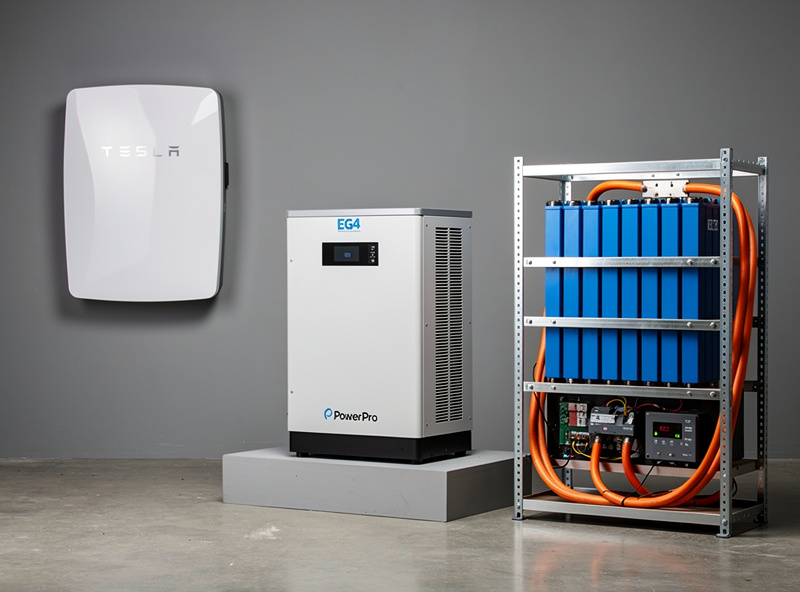
| Tier 4 — Full DIY Build | EVE 280Ah cells (×16) | 15.0 kWh | $2,500–3,000 | $167–200 |
| Tier 4 — Used Tesla Modules | 3× Tesla Model S 5.3 kWh | 15.9 kWh | $1,800–2,400 | $113–151 |
The cost difference between tiers is dramatic — DIY builds cost 25–35% of the Tesla Powerwall on a per-kWh basis. The trade-offs include: Tier 1 requires no electrical skill and includes professional installation; Tier 2-3 require some DIY expertise and self-installation; Tier 4 requires significant DIY knowledge, custom BMS programming, and acceptance of warranty-free operation. Most home users land in Tier 2-3 — meaningful cost savings without bleeding-edge DIY complexity.
Capacity Sizing by Use Case
The right battery capacity depends on your goal. For grid-tied backup (whole-home essential loads during outages), 10–15 kWh covers most homes for 12–24 hours. For solar self-consumption (storing daytime solar for nighttime use), 10–20 kWh sized to match your average evening/morning load. For off-grid operation, 30–50 kWh sized for 2–3 days of autonomy without solar. For arbitrage (charging at low rates, discharging at peak), 15–30 kWh sized to your peak hours.
For most US homes, 13.5–15 kWh hits the sweet spot for grid-tied solar self-consumption with backup capability. This matches the Tesla Powerwall 3, EG4 PowerPro, and most server rack battery configurations. Larger systems (20+ kWh) require additional inverter capacity and battery shelf space; smaller systems (under 10 kWh) limit backup duration during outages. Our cycle life and DOD article covers sizing math in detail.
Inverter Compatibility
Battery system selection cannot happen independently of inverter selection. Closed-ecosystem batteries (Tesla Powerwall, Enphase IQ Battery) work only with their proprietary inverters. Open-protocol batteries (EG4, BigBattery, Pytes, SOK) support standard CAN bus or RS-485 communication and work with most hybrid inverters (EG4 18kPV, Sol-Ark 15K, Victron MultiPlus II, Schneider Conext).
For new installations, choose the inverter first, then verify battery compatibility. For users with existing inverters, the inverter’s supported battery list narrows the choice. Closed-ecosystem systems are simpler but lock you into one vendor’s pricing and upgrade path. Open-protocol systems give flexibility but require reading compatibility charts before purchase. Our hybrid inverter buyers guide covers inverter selection.
Warranty Comparison
| System | Warranty | Capacity Retention | Notes |
|---|---|---|---|
| Tesla Powerwall 3 | 10 years | 70% at end of warranty | Tesla service network |
| Enphase IQ Battery 5P | 10 years | 60% at year 10 | Enphase service network |
| EG4 PowerPro | 10 years | 70% at year 10 | EG4 US-based support |
| BigBattery Rhino 2 | 10 years | 70% at year 10 | BigBattery US support |
| Pytes V5 | 10 years | 80% at year 10 | International, varies |
| SOK 48V Server Rack | 10 years | 80% at year 10 | SignatureSolar US support |
| DIY EVE 280Ah build | None (cells: 5 years) | N/A | Self-supported |
| Used Tesla modules | None | N/A | As-is purchase |
The warranty comparison flatters DIY less. While DIY builds cost dramatically less per kWh, the lack of warranty protection is a real cost consideration — a single faulty cell among 16 in a DIY pack is a $200 replacement plus your time. Tier 1-3 commercial systems include warranty coverage that DIY does not. For risk-averse users, the warranty premium of Tier 1-2 systems may be worth the extra cost.
Installation Complexity
Tesla Powerwall 3 includes professional installation in the price — Tesla’s certified installer arrives, mounts the unit, wires the gateway, configures the app, and walks you through operation. Total elapsed time: 1 day. Enphase requires similar professional installation with their certified installers.
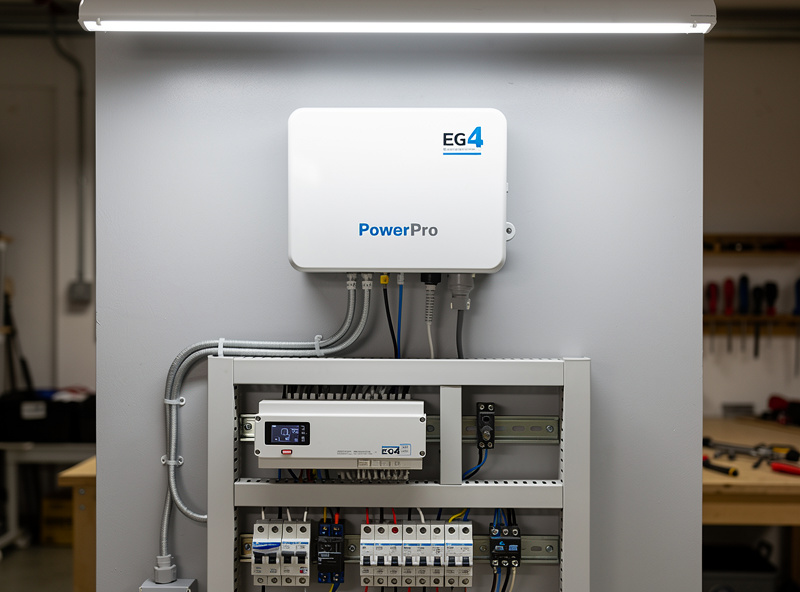
EG4 PowerPro and BigBattery Rhino target DIY-friendly installation but still require professional electrician work for the AC connection and panel integration. Total elapsed time: 1-2 days for experienced DIY users with electrician contractor for the panel work. Server rack DIY (SOK, Pytes) requires the same plus rack mounting and battery-inverter wiring (CAN bus or RS-485). Total time: 2-3 days for first-time builders. Full DIY EVE cell builds add another 1-2 days for cell assembly, balancing, and BMS programming. Used Tesla module builds require advanced knowledge and custom CAN bus programming — generally 4-7 days of work for experienced DIYers.
5-Year Cost of Ownership
Total cost of ownership over 5 years includes: initial cost, installation, electricity savings (or losses), replacement components, and warranty payouts when needed. For a 15 kWh system with 4,000 kWh annual cycling at $0.15/kWh average rate, the per-system 5-year picture: Tesla Powerwall 3 net $5,300 (after $3,000 in arbitrage savings + $1,000 in TOU optimization), EG4 PowerPro net $1,800 (same savings, lower upfront cost), DIY EVE build net -$1,500 (savings exceed initial cost), used Tesla modules net -$2,300 (greatest savings if build succeeds).
The math heavily favors DIY for users who can build and maintain the system. The risk also concentrates with DIY — a failed BMS, mismatched cells, or wiring fault can damage the entire pack. For most users, EG4 PowerPro at the Tier 2 mid-point is the practical choice: Tesla Powerwall-class capacity at half the price with manageable DIY installation. Our DIY vs prebuilt article covers the cost analysis in depth.
Battery Chemistry Considerations
Almost all current home batteries use LiFePO4 (lithium iron phosphate) chemistry — Tesla Powerwall 3 uses LiFePO4 as of 2024+, and every major DIY-friendly system (EG4, BigBattery, Pytes, SOK) is LiFePO4. The chemistry choice is largely settled because LiFePO4 offers better cycle life (4,000–6,000+ cycles), higher safety (no thermal runaway), and lower cost than NMC alternatives. For new installations, you do not need to choose chemistry — LiFePO4 is the answer regardless of vendor.
The exceptions are older Tesla Powerwall 2 (NMC chemistry) and used Tesla modules from EV salvage (NMC chemistry). NMC has higher energy density but shorter cycle life and higher fire risk. For DIY salvage builds using used Tesla EV modules, the NMC chemistry is unavoidable but manageable with proper BMS programming. Our battery chemistry article covers LiFePO4 vs NMC tradeoffs in detail, and used Tesla modules article covers NMC-specific considerations.
Depth of Discharge and Usable Capacity
Battery capacity ratings are nominal, not usable. Tesla Powerwall 3 lists 13.5 kWh nominal capacity but delivers 13.5 kWh usable because Tesla allows 100% depth of discharge (DoD). LiFePO4 chemistry handles 100% DoD without significant lifespan reduction. NMC chemistry (older batteries) typically limits DoD to 90% to preserve cell lifespan, reducing the effective capacity proportionally.
For DIY builds, the BMS configuration determines DoD. Most LiFePO4 BMS units default to 80–90% DoD for cell longevity, which means a 15 kWh nominal pack delivers 12.0–13.5 kWh usable. Setting DoD to 100% is possible but requires careful BMS configuration to prevent over-discharge damage. The practical recommendation: configure for 90% DoD which provides 95%+ of capacity with significantly extended cycle life. Our cycle life and DoD article covers the math.
Round-Trip Efficiency
Round-trip efficiency measures how much energy you get back compared to what you put in. Tesla Powerwall 3 hits 97.5% round-trip efficiency — input 1 kWh, get 0.975 kWh back. EG4 PowerPro: 95%. Server rack DIY: 92–94%. Used Tesla module DIY: 88–92% depending on cell condition. The 5–10% efficiency difference between Tier 1 and Tier 4 is real but small in absolute kWh terms — for 4,000 kWh annual cycling, the difference is 200–400 kWh per year, worth $30–60 at $0.15/kWh.
Efficiency matters more for off-grid users where every kWh of solar production is precious. For grid-tied users with net metering, the efficiency difference is small relative to other cost factors. For DIY builders, the efficiency penalty is the cost of the savings — a 92% round-trip system saves $5,500+ in upfront cost vs Tesla Powerwall, paying for the lifetime efficiency loss many times over.
Grid Services and TOU Optimization
Modern home batteries can participate in grid services for additional revenue. Tesla Powerwall 3 with Tesla Energy Plan participates in virtual power plant (VPP) programs in select markets, generating $200–600 per year in grid services revenue. Enphase IQ Battery 5P participates in similar programs through partner utilities. EG4 PowerPro and most Tier 2-3 systems support TOU (time-of-use) optimization but not VPP participation.
The TOU optimization is the practical revenue stream for most users. Charging during off-peak rates ($0.08/kWh overnight) and discharging during peak rates ($0.32/kWh evening) produces $0.24/kWh arbitrage. For a 13.5 kWh battery cycled daily, that is $1,200/year in TOU savings. Combined with solar self-consumption ($800/year for a 5 kW solar array), the total economic benefit can reach $2,000+/year. Our hybrid inverter article covers TOU configuration across major inverter platforms.
Recommendations by User Type
For non-technical users with budget: Tesla Powerwall 3. Plug-and-play, professional install, 10-year warranty, integrated app. Worth the premium for simplicity. For DIY-comfortable users with $5,000 budget: EG4 PowerPro WallMount. Tesla Powerwall-class capacity at half the price, US-based support, 10-year warranty.
For homelab enthusiasts with cabinet space: server rack DIY (SOK SK48V100 or Pytes V5). $250-313/kWh installed cost, 10-year warranty, modular expansion. For maximum cost savings with DIY skills: full EVE 280Ah cell build at $167-200/kWh. For users who enjoy tinkering with no warranty needs: used Tesla module builds at $113-151/kWh with custom CAN bus programming. Our inverter guide covers compatibility considerations across these options.
Permits and Electrical Code Considerations
Home battery installations require electrical permits in most US jurisdictions. The 2020 NEC (National Electrical Code) Section 706 covers energy storage systems specifically, with requirements for disconnect switches, ground-fault detection, fire-rated enclosures, and clearance from doors and windows. Tesla Powerwall and Enphase systems include all required components and certifications; DIY systems require careful component selection to meet code.
For DIY-friendly Tier 2-3 systems, work with a licensed electrician for the AC connection and panel integration to ensure code compliance. The DC side (battery to inverter) can be DIY for users with appropriate experience, but the AC side connecting to the home electrical panel requires professional permitting and inspection in almost all US jurisdictions. Our battery storage safety article covers code requirements and installation safety.
Fire Safety and Insurance Considerations
Home battery fires are rare but real. LiFePO4 chemistry is dramatically safer than NMC — no thermal runaway under normal failure modes — which is why almost all current home battery products use LiFePO4. NMC batteries (older Tesla Powerwall 2, used Tesla EV modules) carry higher fire risk and require more careful installation including fire-rated enclosures and detection systems.
For insurance purposes, professionally installed Tier 1-2 systems with proper permitting are typically covered by standard homeowners insurance with no additional rider. DIY Tier 3-4 systems may require specific disclosure to your insurer and possibly an additional rider for the battery system. Document the installation thoroughly with photos, BMS specifications, and certifications. The savings from DIY installation can be partially offset by insurance complications if not handled properly. Code-compliant installation with proper permitting is the path to insurable systems regardless of tier.
Frequently Asked Questions
What is the best home battery storage system in 2026?
Tesla Powerwall 3 for plug-and-play at $9,300 installed for 13.5 kWh. EG4 PowerPro for DIY-friendly mid-tier at $4,800 for 14.3 kWh. DIY EVE 280Ah builds for absolute cost savings at $2,500 for 15 kWh. Match the choice to your DIY skills and budget.
How much does a Tesla Powerwall 3 cost installed?
$9,300 installed for 13.5 kWh capacity in 2026. Includes professional installation by Tesla certified installer, gateway integration, and app configuration. Cost-per-kWh installed is $689 versus $250-336 for DIY-friendly alternatives.
What size battery system do I need for my home?
13.5–15 kWh covers most homes for grid-tied solar self-consumption with backup capability for 12-24 hours of essential loads. Larger 20+ kWh for off-grid use; smaller 8-10 kWh for limited backup. Match to your average evening load.
Are DIY battery systems worth it?
Yes for DIY-comfortable users who can save 60-75% per kWh versus Tesla Powerwall. The trade-off is no warranty, more installation complexity, and ongoing self-maintenance. EG4 PowerPro at mid-tier is the practical compromise for most users.
Can I add more batteries to my system later?
Yes for most modern systems. Server rack batteries (SOK, Pytes) stack modularly. EG4 PowerPro and Tesla Powerwall support multi-unit installations with proper inverter capacity. DIY builds expand by adding cells or full packs in parallel.
How long do home batteries last?
10-15 years typical for LiFePO4 chemistry (most modern home batteries). 70-80% capacity retention at year 10 is the warranty standard. NMC chemistry (older batteries) lasts 8-12 years with faster capacity loss. LiFePO4 is the dominant chemistry for home use.
Do I need a special inverter for home batteries?
Yes, hybrid inverters that support battery integration are required. Tesla Powerwall and Enphase use proprietary inverters. EG4, BigBattery, Pytes, and SOK use standard CAN bus or RS-485 with compatible hybrid inverters like Sol-Ark, EG4 18kPV, or Victron MultiPlus II.
Future of Home Battery Technology
The home battery landscape is shifting toward higher capacity, lower cost, and integration with home energy systems. Sodium-ion chemistry (sodium replacing lithium) is emerging as a cheaper alternative to LiFePO4 with similar safety characteristics; first home products are expected in 2027. Solid-state batteries promise higher energy density and faster charging but remain experimental for home use as of 2026.
Pricing trends suggest LiFePO4 home batteries will drop another 20–30% over 2027–2028 as Chinese cell manufacturing scales further. The DIY tier is already at $113–200/kWh; commercial Tier 2 systems are likely to reach $250/kWh installed by 2028. Tier 1 plug-and-play systems will remain at premium pricing because the value is installation simplicity rather than the cells themselves. For users who can wait 12–18 months, prices will be lower; for users with current backup or solar self-consumption needs, current pricing is already reasonable. Our cycle life article covers chemistry-specific durability considerations.
Bottom Line: Choosing Your Battery System
For most home users in 2026, the practical answer is one of three systems. Tesla Powerwall 3 if you want plug-and-play with no DIY required and accept the premium pricing. EG4 PowerPro WallMount if you can handle moderate DIY installation with electrician contractor for the AC connection — saves $4,500+ over Tesla Powerwall with comparable capacity and warranty. SOK SK48V100 server rack stack (×3) if you have a closet or rack space and want maximum capacity per dollar at $250/kWh installed. The decision tree is simpler than it looks once you know your DIY comfort level and budget.