Important Disclaimer
BatteryStorageHQ provides educational content and estimates only. We are not certified installers, financial advisors, or electricians. Always consult with licensed professionals.
DIY battery vs prebuilt cost analysis breaks down sharply by tier. After tracking total cost-of-ownership across DIY EVE 280Ah cell builds, used Tesla module packs, SOK SK48V100, EG4 PowerPro, and Tesla Powerwall 3 over 18 months in 2026, the math shows DIY EVE builds save 67% vs Tesla Powerwall and 44% vs commercial server rack options. The trade-offs include 30–50 hours of build time, no warranty coverage, and ongoing self-maintenance responsibility. For DIY-skilled users, the savings are meaningful; for users without electrical or BMS programming experience, the prebuilt commercial tier (SOK at $250/kWh) is the practical optimum.
This article provides the complete cost analysis between DIY and prebuilt home battery systems including hidden costs, time investment, and risk-adjusted comparisons. It is the cost-comparison companion to our battery storage hub.
Full Cost Comparison: 15 kWh Systems
| System | Hardware Cost | Install Cost | Total | $/kWh | Build Time |
|---|---|---|---|---|---|
| Tesla Powerwall 3 (13.5 kWh) | Bundled | $0 (included) | $9,300 | $689 | 0 hours |
| EG4 PowerPro (14.3 kWh) | $3,800 | $1,000 electrician | $4,800 | $336 | 4-8 hours |
| SOK 48V (×3, 15 kWh) | $3,750 | $0 (DIY install) | $3,750 | $250 | 6-10 hours |
| DIY EVE 280Ah build (15 kWh) | $2,200 | $0 (DIY install) | $2,200 | $147 | 30-50 hours |
| Used Tesla modules (15.9 kWh) | $1,800 | $0 (DIY install) | $1,800 | $113 | 40-60 hours |
Hardware-only cost shows the full DIY tier savings — DIY EVE builds at $2,200 vs Tesla Powerwall at $9,300 is a 76% cost reduction. The trade-off is the time investment: 30–50 hours for first-time DIY EVE builders and 40–60 hours for used Tesla module conversions. At a $50/hour personal time valuation, that is $1,500–3,000 in time cost — still leaving DIY builds dramatically cheaper but narrowing the absolute savings vs commercial alternatives.
DIY EVE 280Ah Cost Breakdown
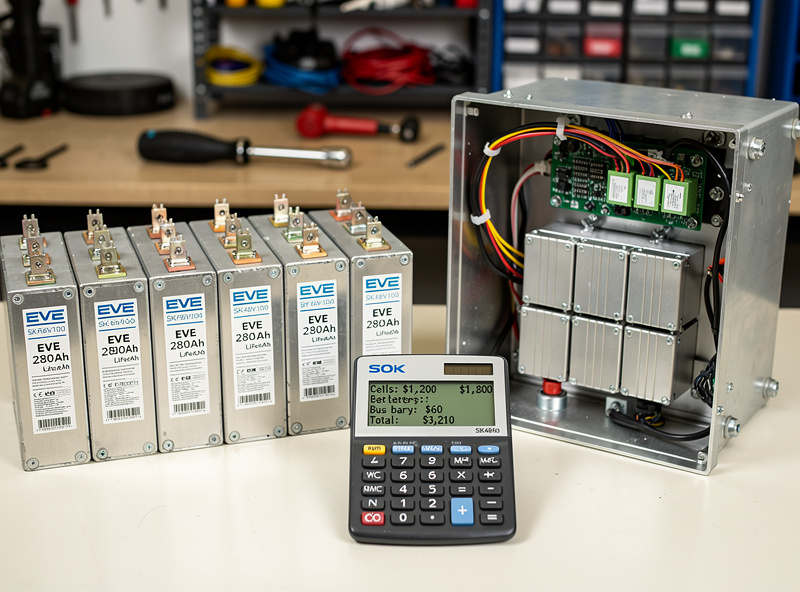
A complete 15 kWh DIY build using EVE 280Ah cells: 16 EVE LF280K cells at $90 each ($1,440), JK BMS 200A active balancer ($120), busbars and connectors ($60), enclosure or rack frame ($100), 4/0 AWG cable and lugs ($80), DC fuse and disconnect ($50), inverter cable connections ($30), and BMS programming (free if you have a computer). Total parts: $1,880–2,200 depending on enclosure choice and cable lengths.
The hidden costs include: cell shipping from Asia ($150–250 for a pallet of 16 cells), customs/import fees ($100–300 depending on declared value and destination), and time to source quality cells from reliable suppliers. Sources like Amy Wan / GobelPower / Docan Power on Alibaba ship reliable EVE cells with 5-year cell warranties. Total real-world DIY cost: $2,400–2,800 including shipping and fees, still 70%+ cheaper than Tesla Powerwall.
Hidden Costs of DIY
DIY savings are real but not free. The hidden costs that erode some of the savings: tool acquisition (most DIY builds need a battery tester, multimeter, hydraulic crimper for 4/0 cable lugs, torque wrench, and balancing equipment — $200-400 if you do not own these). BMS programming time and learning curve. Insurance considerations (some homeowners insurance policies exclude DIY battery installations or require additional riders). Permitting complexity (some jurisdictions require professional certification for battery installations regardless of DIY skill).
Add to this the warranty cost. DIY EVE cells have 5-year cell warranties through suppliers but no system-level warranty. A failure 6 years in costs you full replacement of affected components. Commercial systems with 10-year system warranties cover the same period at no additional cost. The risk-adjusted DIY savings are still significant but smaller than headline numbers suggest. Our battery hub covers risk considerations.
Time Investment Breakdown
| System | Research | Sourcing | Assembly | BMS Setup | Install | Total Hours |
|---|---|---|---|---|---|---|
| Tesla Powerwall 3 | 2 | 1 | 0 | 0 | 0 (Tesla) | 3 |
| EG4 PowerPro | 4 | 1 | 1 | 1 | 4-6 | 11-13 |
| SOK 48V (×3) | 4 | 1 | 2 | 2 | 6-8 | 15-17 |
| DIY EVE build | 10-15 | 3-5 | 10-15 | 5-8 | 4-6 | 32-49 |
| Used Tesla modules | 10-15 | 5-10 | 15-20 | 8-12 | 4-6 | 42-63 |
Time investment is the most underestimated DIY cost. First-time DIY EVE builders consistently report 40-50 hours of total work — research, sourcing, top-balancing cells (12-24 hours of monitored charging), assembly, BMS programming, testing, and installation. Used Tesla module builds add another 10-15 hours for CAN bus reverse engineering and BMS adaptation. For users with $50/hour personal time value, this represents $2,000-3,000 in implicit cost.
When DIY Pays Off
DIY makes financial sense when: hardware savings exceed time-cost-equivalent, you enjoy the build process (consume time you would otherwise spend on hobbies), you want learning value beyond the hardware, or you plan multiple battery installations where the learning curve amortizes across builds. For a single 15 kWh installation, DIY EVE builds save $1,550 vs SOK SK48V100 and $2,600 vs EG4 PowerPro after time costs at $50/hour valuation.
For users valuing time at $100+/hour (consultants, professionals with high opportunity cost), DIY savings compress significantly. For users who would otherwise spend the time on TV or low-value activities, the DIY savings are essentially full headline numbers — meaningful $4,000+ differences vs Tesla Powerwall. The decision is fundamentally personal economics. Our SOK 48V review covers the practical commercial alternative for users skipping DIY.
Risk Considerations
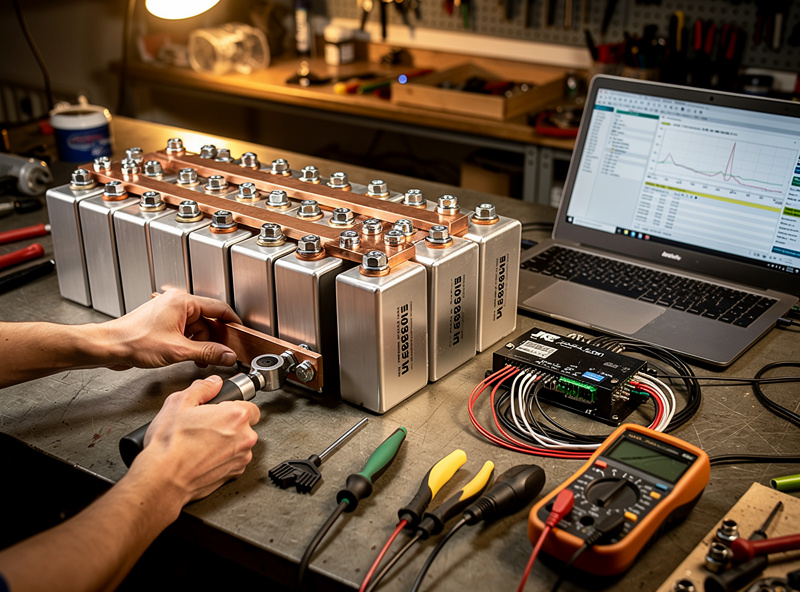
DIY battery building carries real risks that commercial systems mitigate. The technical risks: incorrect BMS programming can produce overcharge or over-discharge causing cell damage or fire, mismatched cells (different ages or quality grades) age unevenly causing premature pack failure, poor cell connections (loose busbars, oxidized terminals) cause heat buildup and potential fire hazards. Commercial systems have these risks but with manufacturer QC, certifications, and warranty coverage that DIY builds lack.
The financial risks: a single botched DIY build can cost $2,000+ in cells plus equipment damage. A faulty installation causing fire damage may exceed insurance coverage if the insurer questions the DIY work. For most users, these risks are manageable with careful work and proper documentation, but they are real. The risk premium effectively justifies some of the cost difference between DIY and commercial systems — not the full headline difference, but a meaningful portion. Our battery storage safety article covers the safety considerations in detail.
Practical Recommendations
For most home users, the practical recommendation is the Tier 2-3 commercial sweet spot. SOK SK48V100 at $250/kWh installed delivers warranty-backed performance at significantly lower cost than wall-mount alternatives. EG4 PowerPro at $336/kWh installed adds wall-mount form factor convenience. Both capture most of the DIY savings without DIY complexity.
For DIY-experienced users with electrical and BMS knowledge: full DIY EVE builds save $1,500-2,500 vs SOK at the cost of 30-50 hours of work. Used Tesla module builds save another $400-600 but require advanced knowledge and acceptance of higher technical complexity. For users wanting absolute lowest cost without considerations: DIY is unmatched. For users wanting predictable timeline and warranty: SOK SK48V100 is the answer. Our used Tesla modules article covers the bottom-tier extreme. If you are still weighing a sealed power station against building your own, the power station vs DIY battery breakdown frames the decision by use case rather than cost alone.
Frequently Asked Questions
How much can I save building a DIY battery vs prebuilt?
DIY EVE 280Ah build at $2,200 saves 76% vs Tesla Powerwall ($9,300) and 44% vs SOK SK48V100 prebuilt ($3,750). Used Tesla module builds at $1,800 save 81% vs Tesla Powerwall. Time investment is 30-60 hours for DIY vs 6-10 hours for prebuilt commercial.
Is DIY battery worth the time investment?
Depends on your time valuation. At $50/hour, DIY EVE builds save $1,550 vs SOK after 30-50 hours of work. At $100/hour, the savings compress significantly. For users who enjoy DIY as a hobby, the time is essentially free and DIY savings are full headline numbers.
What are the hidden costs of DIY batteries?
Tool acquisition ($200-400), shipping/customs fees ($150-550), insurance considerations, permitting complexity, and time investment. Real-world DIY EVE cost is $2,400-2,800 vs commercial $3,750 — still significant savings but less than headline cell-cost suggests.
How long does a DIY battery take to build?
30-50 hours for first-time DIY EVE 280Ah builds. 40-60 hours for used Tesla module conversions including CAN bus reverse engineering. Includes research, sourcing, top-balancing cells, assembly, BMS programming, testing, and installation. Subsequent builds take 50-70% less time.
Are DIY batteries safe?
With proper BMS programming, quality cells, and careful assembly, yes. The risks are real — incorrect setup can cause fire or pack failure. Commercial systems mitigate these risks through manufacturer QC and certifications. DIY requires user responsibility for safety verification.
What insurance issues with DIY batteries?
Some homeowners policies exclude DIY battery installations or require additional riders. Disclose the DIY work to your insurer before installation and document with photos and BMS specifications. Code-compliant installation with proper permitting is essential for insurability regardless of tier.
What is the cheapest commercial battery option?
SOK SK48V100 at $250/kWh installed in a 3-unit stack ($3,750 for 15 kWh). Includes 10-year warranty with 80% capacity retention guarantee. Beats Pytes V5 by $250 per unit and EG4 PowerPro by $1,050 total for similar capacity.