Important Disclaimer
BatteryStorageHQ provides educational content and estimates only. We are not certified installers, financial advisors, or electricians. Always consult with licensed professionals.
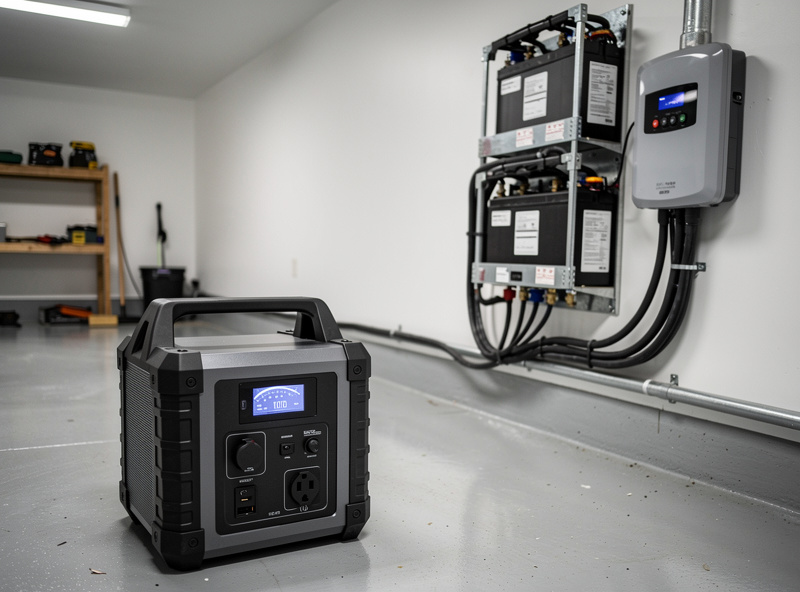
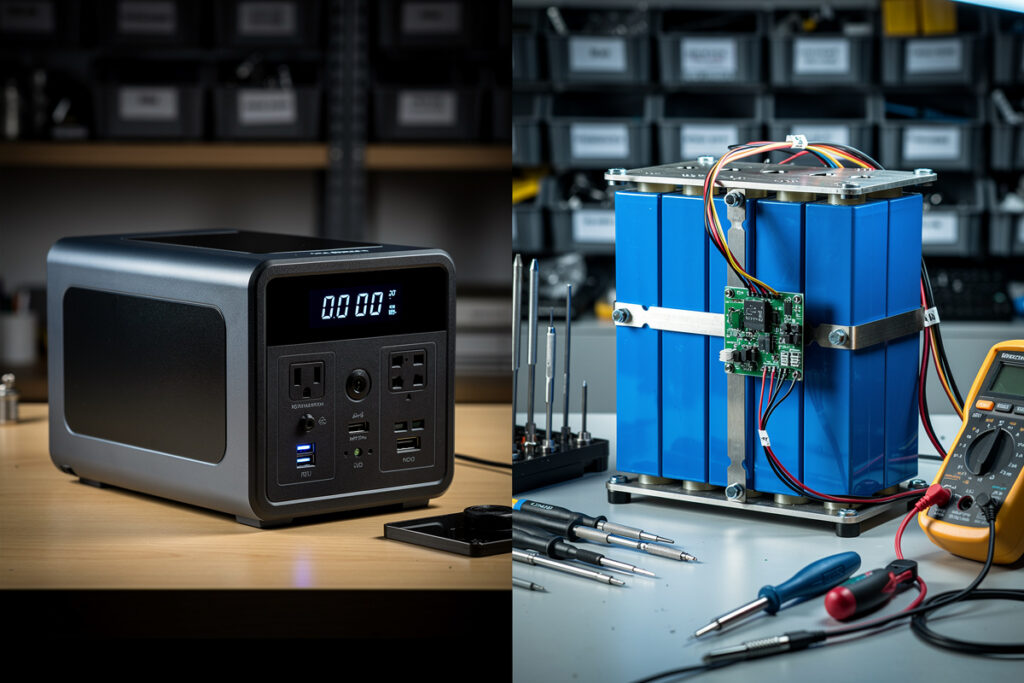
Buy a portable power station when you need plug-and-play convenience under about 3–5 kWh, when you rent or cannot wire DC, or when portability is the point. Build a DIY LiFePO4 bank when the system will be permanent, when you need more than a few kWh, or when you want to choose the inverter and surge rating yourself. Below the crossover the power station’s convenience premium is reasonable; above it, the cost-per-kWh gap makes building the obvious call. The decision is convenience versus control, and your real answer falls out of three questions, not a spec sheet.
I live on the DIY side — a 16S LiFePO4 bank I top-balanced on the bench, compression-fixtured, and tuned by hand — but I recommend power stations constantly, because most people’s needs sit squarely in the tier where a sealed box is the smarter buy. The point is not which is better in the abstract; it is which solves your specific problem. Here is how to tell which one you are.
Question One: How Much Capacity Do You Need?
Capacity is the cleanest dividing line. Under roughly 3 kWh, a power station is almost always the right choice — the integration is worth the markup and you avoid every wiring and fusing decision. Between 3 and 5 kWh you are in the gray zone, where expandable stations and DIY banks overlap on price. Above 5 kWh, building wins decisively: stacking expansion modules on a power station costs far more per kWh than a DIY bank, and the gap only widens as you scale.
The reason is structural. A power station bundles inverter, BMS, and cells into one sealed unit, and the expansion packs you bolt on later carry that same premium per kWh. A DIY bank lets you add raw cells at cell prices. The detailed numbers behind this crossover are in the DIY battery vs prebuilt cost analysis, and the sizing method tells you which side of the line your real loads put you on.
Question Two: Permanent or Portable?
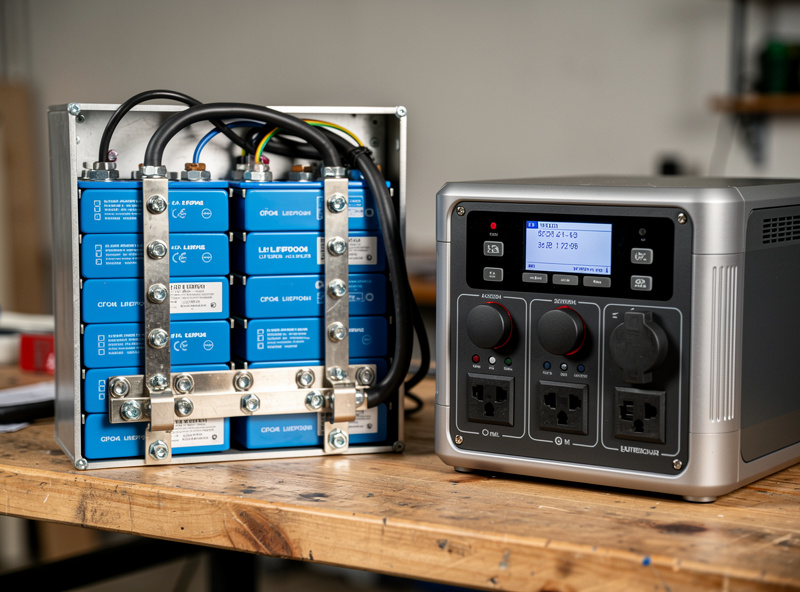
If the system needs to move — to a campsite, a van, a job site, or a different room during an outage — a power station is built for exactly that, with a handle, a sealed case, and no exposed terminals. If the system will live bolted to a wall or sitting in a utility room for a decade, that portability buys you nothing, and a DIY bank’s superior cost-per-kWh and tunability take over.
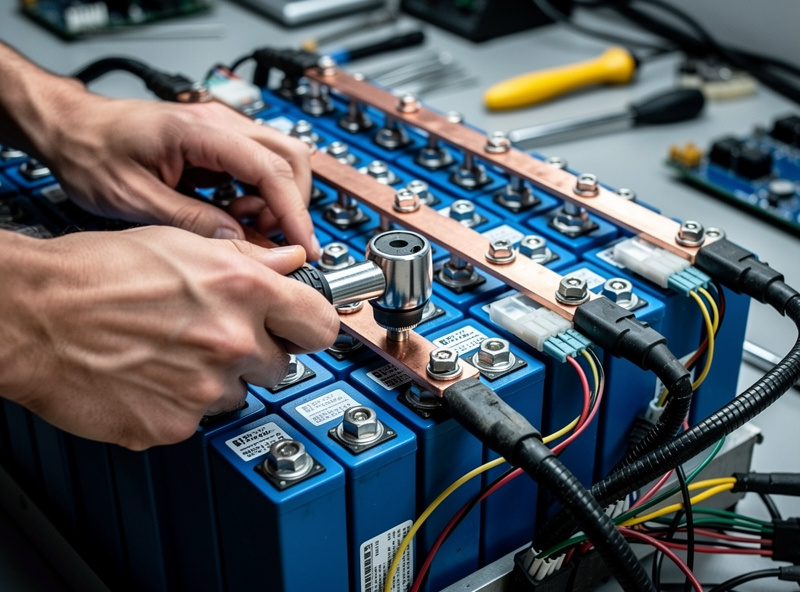
Permanence also changes the safety calculus in DIY’s favor. A fixed install lets you do DC fusing, ventilation, and busbar torque properly once and forget them, which is most of what makes a home-built bank safe. A portable unit that gets handled, dropped, and stored in heat benefits from the sealed engineering and built-in protection a power station provides. The full safety picture for a built system is in the battery storage safety guide.
Question Three: Do You Want to Tune It?
This is the question that splits hobbyists from everyone else. A DIY bank lets you choose the cells, the BMS, and the inverter, and tune the charge profile, the protection windows, and the surge rating to your exact loads. When the workshop fires up or a well pump cycles, the inverter I picked by hand handles the surge because I sized it for that. A power station made those choices for you and locked them.
For most people, not having to tune anything is a feature, not a loss — they want a box that works, not a project. For a builder who enjoys the control and the math, the sealed appliance feels like a cage. Be honest about which you are. If you have never wanted to know your absorption voltage, buy the station. If you already do, you are probably building anyway. The DIY LiFePO4 build guide shows what the control path actually involves, top-balancing and all.
The Honest Cost Truth
A DIY bank almost always wins on raw cost per kWh, especially above a few kWh — but that headline ignores the value of your time and the cost of mistakes. A power station has no commissioning, no risk of a top-balance you skipped, no chance of a nuisance-tripping BMS you configured wrong. The premium you pay is partly for components and partly for never making the expensive beginner errors I made years ago: the puffed cell, the browned-out inverter, the lagging cell that tripped on charge.
So the true comparison is not just dollars per kWh. It is dollars per kWh plus your hours plus your risk tolerance. For a small, portable, occasional-use need, the station’s all-in cost is genuinely competitive once you value your time honestly. For a large permanent install, the DIY savings are real enough to dwarf the time cost. A modest LiFePO4 power station covers the convenience path; serious builders start instead with quality grade-A prismatic cells and a proper BMS.
The Hybrid Answer Most People Land On
Plenty of people end up with both, and that is not a failure of decision-making — it is the right answer for two different jobs. A portable power station handles camping, travel, and grab-and-go outage backup, while a permanent DIY bank handles whole-home or workshop backup wired to a transfer switch. The portable unit goes where you go; the fixed bank carries the heavy, stationary loads. Each does what the other does poorly.
If you are starting out, buy the power station first — it solves the immediate, portable need with zero learning curve — and build the bank later if and when your stationary loads justify it. That sequence lets you learn the chemistry and the math on a forgiving sealed unit before you commit to bare cells. The portable power station guide and the selection guide cover the first purchase; the build guide covers the second.
Frequently Asked Questions
Is a power station or a DIY battery cheaper?
A DIY LiFePO4 bank almost always wins on raw cost per kWh, especially above a few kWh, because you add cells at cell prices rather than buying premium expansion modules. But the power station saves your time and eliminates commissioning mistakes, which has real value.
When should I build a battery instead of buying a power station?
When the system is permanent, when you need more than roughly 3 to 5 kWh, or when you want to tune the inverter, BMS, and surge rating yourself. Below that threshold, a power station’s convenience premium is reasonable and usually the smarter buy.
Is a DIY battery bank safe compared to a power station?
A DIY bank is safe when built correctly with proper DC fusing, ventilation, and busbar torque, done once on a permanent install. A power station’s sealed engineering and built-in protection suit a portable unit that gets handled, dropped, and stored in heat.
Can a power station do whole-home backup?
Only the largest expandable units approach it, and at a steep cost per kWh. For genuine whole-home backup including a well pump or furnace blower, a permanent DIY LiFePO4 bank on a transfer switch beats a portable station on both cost and capability.
Should I buy a power station first and build later?
For most beginners, yes. A power station solves the immediate portable need with no learning curve and lets you learn chemistry and sizing on a forgiving sealed unit. Build a permanent bank later if your stationary loads grow to justify it.
Do power stations and DIY banks use the same chemistry?
Current quality versions of both use LiFePO4, which survives roughly 3,000 to 5,000 cycles and is far more thermally stable than NMC. The difference is integration and tunability, not the underlying cell chemistry in modern units.