Important Disclaimer
BatteryStorageHQ provides educational content and estimates only. We are not certified installers, financial advisors, or electricians. Always consult with licensed professionals.
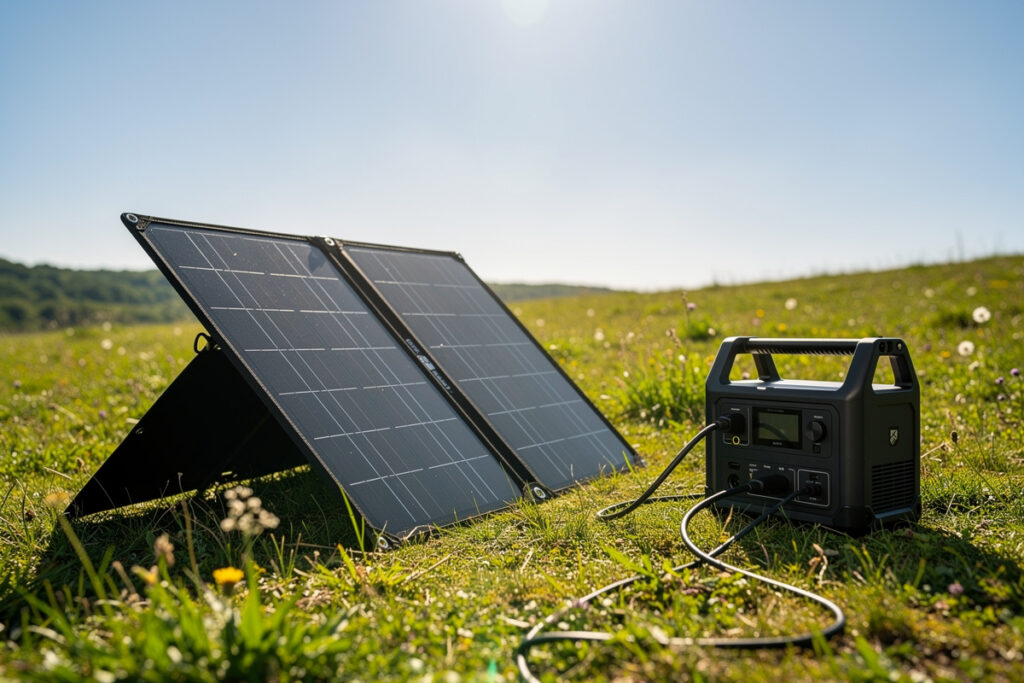
To pair portable solar panels with a power station, the one number that must match is voltage: the panel string’s open-circuit voltage (Voc) has to fall inside the station’s solar input window, and you must leave headroom because cold weather pushes Voc up by roughly 0.27–0.30% per degree Celsius below the panel’s rating. Get the voltage window right and almost any quality folding panel works; get it wrong and the station either refuses the input or, in the cold, sees an over-voltage that shuts it down. Wattage determines how fast you recharge; voltage determines whether it charges at all.
This is the same wiring-margin discipline I apply to my own array, where a cold, high-Voc string is a real over-voltage risk, not a footnote. Manufacturers sell “matched” panel-and-station bundles for a reason — they have done the voltage matching for you — but you can pair panels yourself once you understand the window. Here is how to match panels to a station without bricking the input or wasting harvest.
Match the Voltage Window First
Every power station’s solar input has a maximum input voltage and a working voltage range printed in its spec sheet. The panels you connect — whether one panel or several wired in series — must produce an open-circuit voltage that stays under that maximum at all times, including the coldest morning you will ever use them. Wire panels in series and their voltages add; wire them in parallel and their currents add while voltage stays flat. For most station inputs, a single folding panel or two in series lands in the right window.
The cold-weather trap catches people who only check the summer numbers. A panel rated at, say, 22 V open-circuit at 25°C climbs measurably as the temperature drops — that 0.27–0.30% per degree adds up fast on a clear, freezing morning, exactly when the sun is otherwise ideal. Always keep your worst-case cold Voc at least 10% under the station’s maximum input. The same physics drives charge-controller selection in fixed arrays, covered in the MPPT vs PWM breakdown.
Folding, Rigid, and Flexible Panels
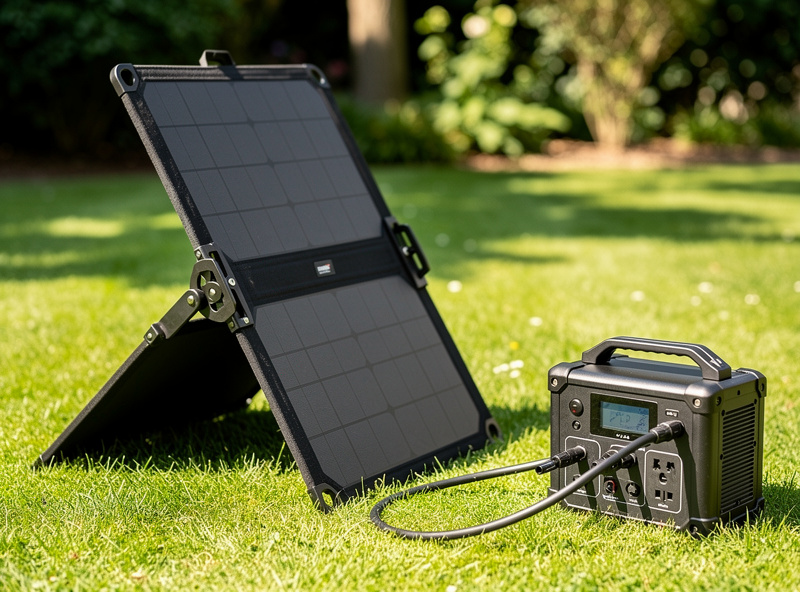
Portable solar comes in three practical forms, and the right one depends on how you carry and deploy it. Folding suitcase panels are the default for power-station pairing: they pack flat, include a kickstand and the right output connector, and deploy in seconds. Rigid panels cost less per watt and last longer but are bulky to transport. Flexible panels are light and curve onto a van roof but generally deliver less harvest per watt and shorter service life.
For most station owners, a folding panel in the 100–220 W range is the sweet spot — enough to meaningfully recover a mid-size unit in a day of good sun, still portable enough to actually use. A quality 200W folding solar panel is the natural match for a 1,000–2,000 Wh station. Confirm it terminates in the connector your station expects, or that an adapter exists — an MC4-to-station adapter cable bridges most standard panels to most station inputs.
Be Honest About Real Harvest
A 200 W panel does not deliver 200 Wh every hour. Real-world harvest is throttled by sun angle, temperature, haze, panel orientation, and the simple fact that nameplate ratings are measured under ideal lab conditions you will rarely meet. Plan on a meaningful fraction of nameplate in good conditions, and far less on cloudy days or at northern latitudes in winter, where my own array drops under one peak-sun-hour on a bad December day.
That reality has a practical consequence: solar is a recovery and extension tool, not an instant refill. For outage prep you charge from the wall first and let solar stretch the runtime; for off-grid use you size the panel to your daily energy deficit, not to a heroic single-day refill. The watt-hour arithmetic to find that deficit is in the sizing method, and the broader fixed-array sizing math is in the solar sizing calculator guide.
Panel Types Compared for Station Pairing
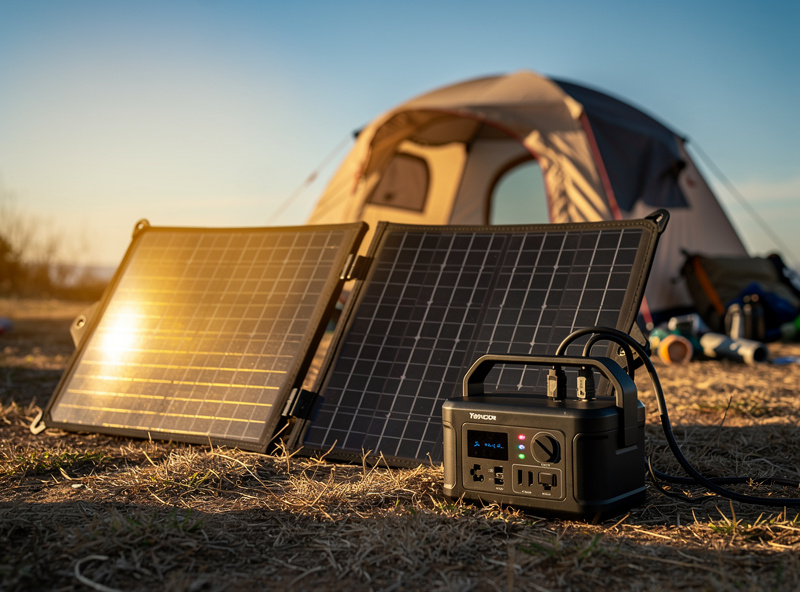
This table maps the three portable panel formats against the trade-offs that matter when pairing with a station.
| Panel Type | Portability | Harvest per Watt | Durability | Best For |
|---|---|---|---|---|
| Folding suitcase | Excellent | High (mono cells) | Good | Most station owners |
| Rigid framed | Poor (bulky) | High | Excellent | Fixed or semi-permanent use |
| Flexible | Excellent (light) | Lower | Shorter life | Van roofs, curved surfaces |
Orientation and Angle Matter More Than Wattage
The single biggest harvest lever most people ignore is aiming. A 100 W panel pointed squarely at the sun out-produces a 200 W panel lying flat or shaded at the edges. Folding panels include a kickstand precisely so you can tilt them toward the sun, and on a portable setup you can re-aim them every couple of hours to track the sun across the sky — something a roof-mounted array cannot do. That manual tracking can claw back a substantial fraction of a day’s harvest for free.
Two practical rules follow. First, even partial shade on one cell drags down the whole panel disproportionately, so keep the entire surface in clear sun — a single overhanging branch costs you more than its shadow suggests. Second, tilt the panel so it faces the sun’s elevation, which at northern latitudes in winter means a steep, almost-vertical angle, not the gentle summer tilt. The angle-and-latitude logic that governs fixed arrays applies just as much to a folding panel you set down each morning, and it is covered in the mounting and tilt guide.
How Much Panel to Buy
Size the panel to your daily energy deficit, not to a fantasy of refilling the whole station in one afternoon. If you are extending an outage kit, a 100–200 W panel meaningfully stretches runtime. If you are running off-grid in a van and pulling, say, 1,000 Wh a day, you want enough panel to replace that in your realistic local sun hours — which in good summer conditions might be a 200–400 W array, and in northern winter could be far more or simply impractical to cover with solar alone.
Match the panel to both the station’s input ceiling and your honest consumption. Buying more panel than the station’s input can accept just wastes the surplus, while buying too little leaves you slowly losing ground over a multi-day trip. For a typical 1,000–2,000 Wh station used for camping and outage extension, a single high-quality folding panel covers most needs; a 100W monocrystalline folding panel is a sensible entry point you can pair or expand later.
Series vs Parallel and the Connector Question
If one panel does not reach the station’s working voltage or you want more wattage, you wire multiple panels — and the choice between series and parallel decides what the station sees. Series adds the voltages (watch the cold-Voc ceiling); parallel adds the currents while keeping voltage flat (watch the input’s maximum current). Most station inputs prefer a moderate voltage, so two panels in series is common, but always re-check the cold-weather Voc math before committing to series.
Connectors are the other gotcha. Most third-party panels use standard MC4 terminations, while stations use a variety of proprietary input ports, so an adapter is often required. Match the connector, respect the voltage and current limits, and a folding panel turns any solar-capable station into a genuine off-grid recovery source. For the full buying framework around the station itself, see the portable power station guide and the selection guide.
Weather, Storage, and Cable Losses
Folding panels are built for outdoor deployment, but they are not all equally weatherproof. Check the ingress rating: the panel face is usually fine in rain, but the junction box and connectors are the vulnerable points, and a brief shower is different from leaving a panel out in a downpour overnight. When you are done for the day, fold it, wipe the surface, and store it dry — dust and grime on the cells quietly cost you a few percent of harvest every session if you never clean them.
Cable length is the other silent loss. The longer and thinner the extension cable between the panel and the station, the more voltage you drop to resistance before it ever reaches the input — which on a low-voltage portable run can shave off meaningful watts. Keep the run as short as practical and use an adequately thick cable; if you must place the panel far from the station to chase sun, accept that some harvest is lost in the wire. None of this is exotic — it is the same wiring-margin thinking that governs a permanent install, just scaled to a panel you set on the grass.
Further Reading
If you are still choosing the station, start with the portable power station guide and the how-to-pick guide. To get the recharge math right, work through the sizing method and the MPPT vs PWM breakdown. And to understand why mono cells dominate folding panels, the monocrystalline vs polycrystalline comparison covers the cell-type trade in full.