Important Disclaimer
BatteryStorageHQ provides educational content and estimates only. We are not certified installers, financial advisors, or electricians. Always consult with licensed professionals.
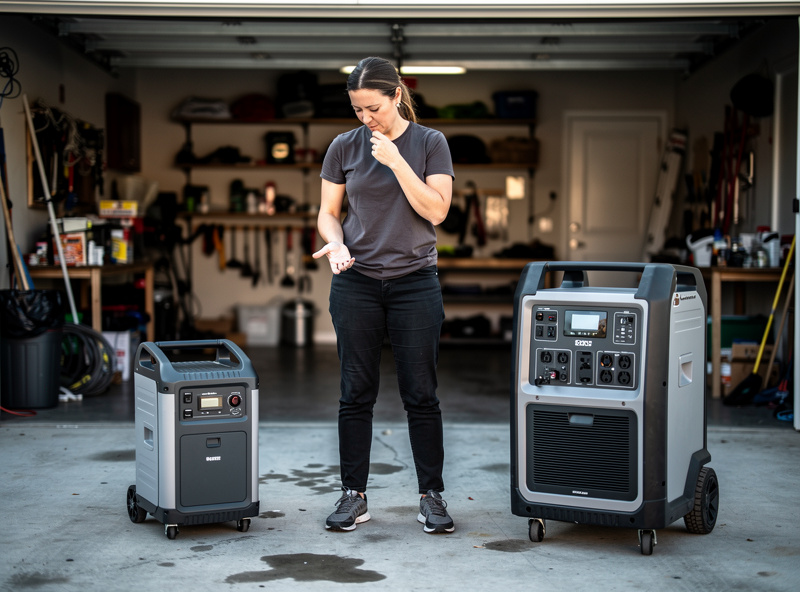
To size a portable power station, list every device you plan to run, multiply each one’s watts by the hours you will use it, total those watt-hours, then add 10–15% for inverter losses and divide by about 0.85 to account for usable capacity. That number is your minimum capacity. Separately, check that the station’s continuous output exceeds your largest single device and that its surge rating is roughly double that, so motors actually start. Capacity tells you how long; output and surge tell you what runs at all.
This is the same arithmetic I run before specifying any bank on my own bench, just scaled down to a sealed box. It is not complicated, but skipping it is why people buy a unit twice the size they need or a unit that trips the moment the fridge kicks on. Here is the method, step by step, with the two mistakes that catch almost everyone.
Step One: List Loads and Run Hours
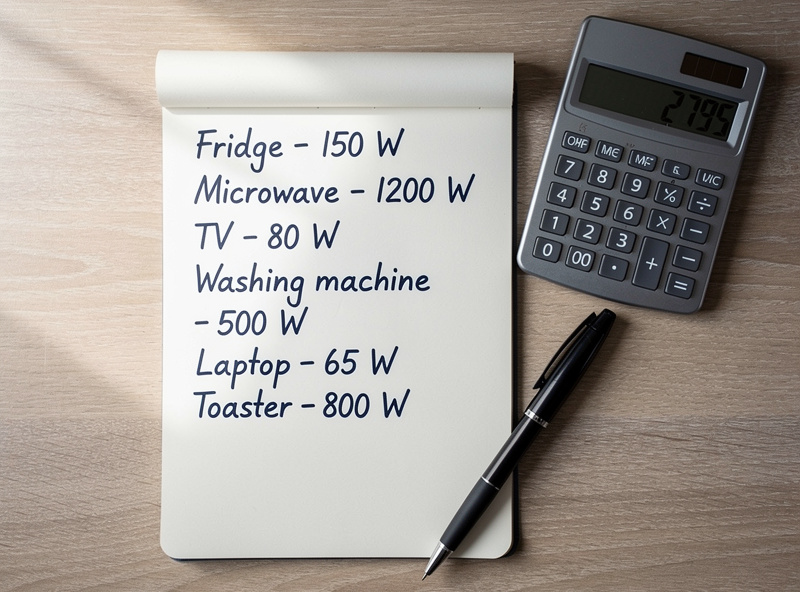
Write down every device and its running wattage, then estimate the hours per day you will actually run each. A phone charger is a few watts; LED lights are 5–15 W each; a CPAP runs 30–60 W; a modern fridge averages 80–150 W running but cycles on and off. Multiply watts by hours for each device, then sum. That total, in watt-hours, is your raw energy demand before any margins.
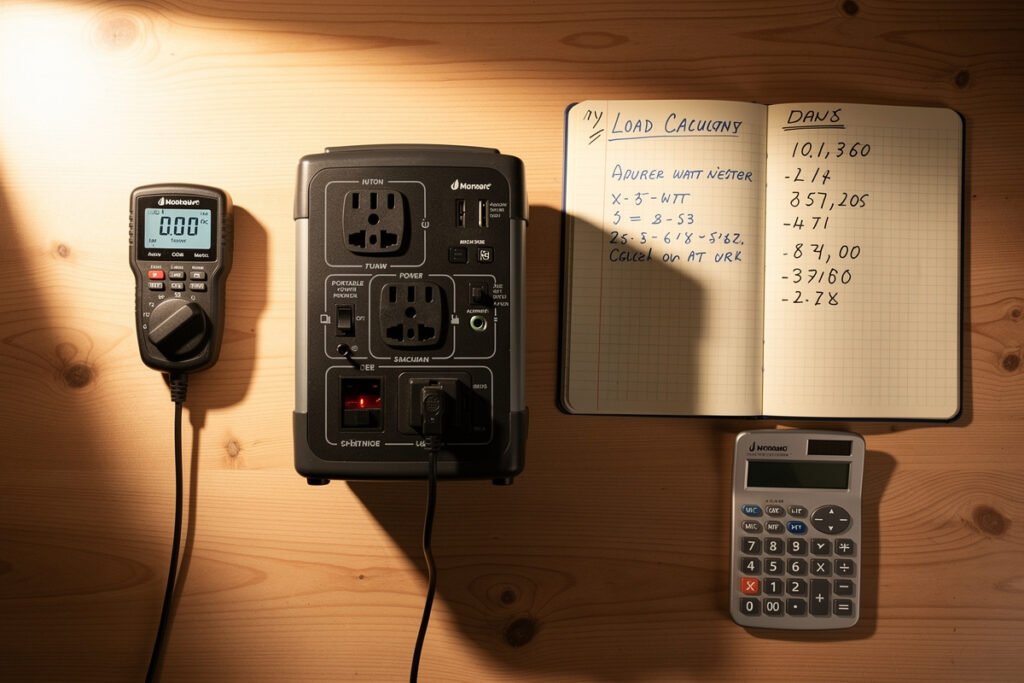
The common error here is summing peak draws as if everything runs at once continuously. A fridge rated at 150 W does not consume 150 W every minute — it duty-cycles, typically pulling 1–2 kWh across a full day. Use realistic daily energy, not nameplate watts multiplied by 24, or you will dramatically oversize. The single best way to stop guessing is to measure: a cheap plug-in watt meter reads each device’s real running and idle draw so your math starts from measured numbers, not datasheet optimism. The same honest-energy discipline underpins the broader whole-home battery sizing guide for permanent installs; this article scales it to a portable unit.
Step Two: Add Margins for Real Capacity
Nameplate watt-hours are not deliverable watt-hours. Inverter conversion losses and the BMS low-voltage cutoff mean a LiFePO4 station hands you roughly 85–90% of its label. So take your energy demand, add 10–15% for inverter inefficiency, then divide by 0.85 to find the nameplate capacity you must buy. A 600 Wh demand becomes roughly 690 Wh after losses, then about 810 Wh of nameplate — so you shop for a 1,000 Wh unit, not a 600 Wh one.
That derating gap is exactly why the watt-hour number on the box always looks generous next to what you measure at the outlet. It is physics, not deception, but you must plan for it. The relationship between usable capacity, depth of discharge, and cycle life — and why running a LiFePO4 unit to 80–90% depth is fine while doing the same to NMC is not — is laid out in the cycle life vs depth-of-discharge chart.
Step Three: Size Output and Surge, Not Just Capacity
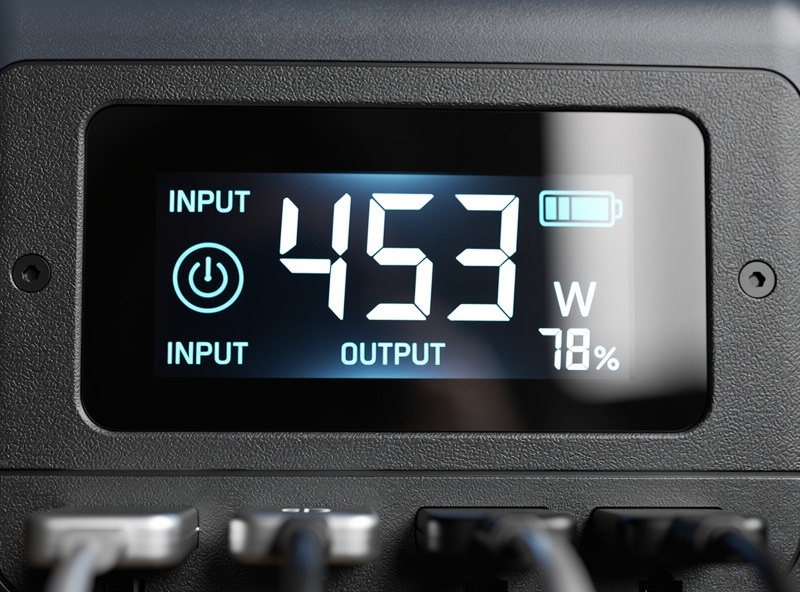
Capacity is only half the spec. The inverter’s continuous output must exceed your largest single load, and the surge rating must cover startup inrush. Motors — fridge compressors, pumps, power tools — draw four to seven times their running watts for a fraction of a second at startup, the locked-rotor amperage. A 150 W fridge can inrush past 1,000 W. A station rated 1,000 W continuous but only 1,200 W surge may refuse to start it.
This is the single most common sizing failure, because buyers shop on watt-hours and never read the surge line. Rule of thumb: pick a unit whose surge rating is at least double its continuous rating if any motor load is in your plan. Output quality matters too — sensitive electronics and many motors want pure sine, not modified sine, a distinction the pure sine vs modified sine guide covers in full.
Three Worked Examples
Numbers make the method concrete. These three scenarios cover the most common real-world buys and show how the same arithmetic lands you in different size tiers.
| Scenario | Daily Energy | After Margins | Output / Surge Need | Tier to Buy |
|---|---|---|---|---|
| Weekend camping (phone, lights, CPAP, fan) | ~400 Wh | ~540 Wh | 300 W / 600 W | 500–1,000 Wh |
| Short outage (fridge + lights + router) | ~1,500 Wh | ~2,000 Wh | 1,000 W / 2,000 W | 2,000 Wh+ |
| Van life (fridge, lights, laptop, fan, water pump) | ~1,200 Wh | ~1,600 Wh | 1,500 W / 3,000 W | 1,500–2,000 Wh |
Notice the outage case needs more capacity than the van case despite a shorter list — the fridge’s full-day duty cycle dominates. And both need surge headroom the camping case does not. Tier selection always falls out of the arithmetic, never the other way around.
How Much Headroom to Buy
Buy the capacity your math demands plus one tier of headroom — no more. Oversizing wastes money and weight on a box that lives in a closet, and undersizing the inverter for the one motor that matters leaves you stranded. The right answer is almost always a smaller, lighter unit than instinct suggests, paired with enough surge to start whatever you actually own.
If your honest math keeps pushing you past 3–5 kWh, stop and reconsider the form factor: at that scale, stacking expansion modules costs more per kWh than a DIY LiFePO4 bank, and a permanent install usually serves you better than a portable one. The selection guide and the portable power station guide tie the sizing math to the buying decision.
Frequently Asked Questions
How do I calculate what size power station I need?
List each device’s running watts, multiply by hours used, sum the watt-hours, add 10 to 15 percent for inverter losses, then divide by 0.85 for usable capacity. Separately confirm continuous output exceeds your largest device and surge is roughly double that.
How much usable capacity does a power station really have?
Roughly 85 to 90 percent of the nameplate watt-hours for a LiFePO4 unit, after inverter losses and the BMS cutoff. A 1,000 Wh station delivers about 850 to 900 Wh to your devices, so always size against the derated figure.
Why does surge rating matter for sizing?
Motors inrush to four to seven times their running watts at startup. A unit with enough capacity but a thin surge rating trips when a fridge or pump starts. Pick a surge rating at least double the continuous rating if you run any motor.
How long will a 1000Wh station run a fridge?
A 1,000 Wh LiFePO4 station delivers about 850 to 900 usable Wh. A fridge using 1 to 2 kWh per day runs roughly 10 to 18 hours on that, depending on duty cycle and ambient temperature, provided the surge rating starts the compressor.
Is it better to oversize or undersize a power station?
Buy your calculated capacity plus one tier of headroom, no more. Oversizing wastes money and weight; undersizing the inverter for a motor load leaves you stranded. The right unit is usually smaller than instinct suggests but has ample surge.