Important Disclaimer
BatteryStorageHQ provides educational content and estimates only. We are not certified installers, financial advisors, or electricians. Always consult with licensed professionals.
For outage backup, the right portable power station is a LiFePO4 unit sized to carry your critical loads — usually a fridge, a few lights, internet, and phone charging — through the length of outage you actually experience, with enough surge to start the fridge compressor. For most homes that means a 2,000 Wh or larger unit with a surge rating roughly double its continuous output. Capacity decides how long you last; surge decides whether the fridge ever starts.
I treat backup the way I treat the bank that keeps my workshop running when the grid sags: identify the loads that genuinely matter, size for the worst realistic outage, and never confuse the watt-hour number with the spec that decides whether your hardware actually runs. A power station is a legitimate, no-wiring backup for renters and anyone who wants grab-and-go resilience — here is how to plan one honestly.
Decide Your Critical Loads First
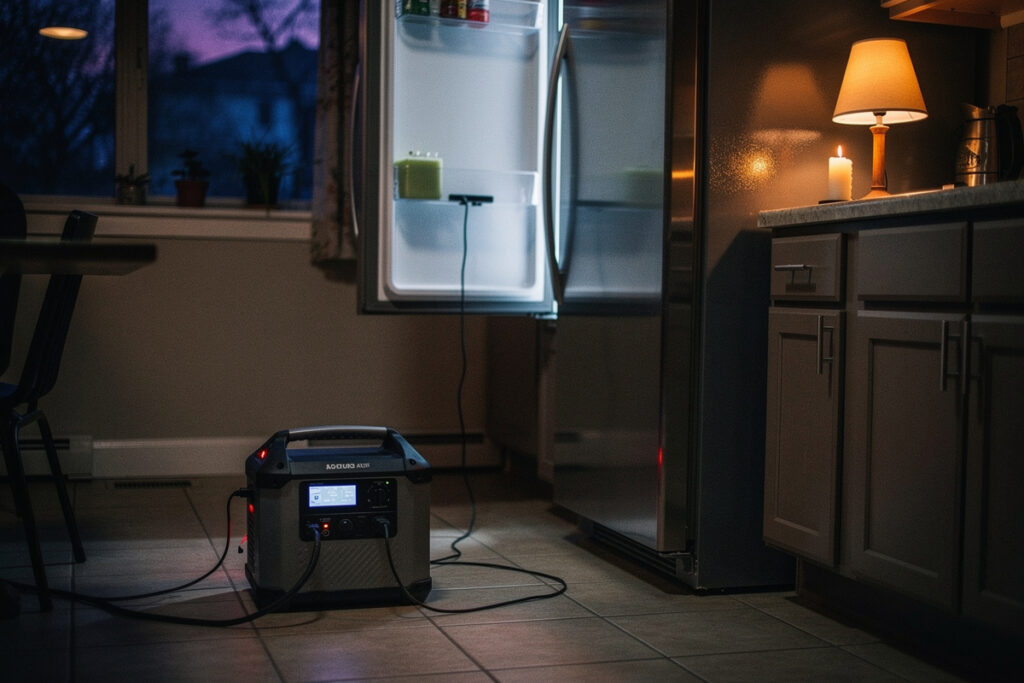
Outage planning starts with a brutal triage: what genuinely must stay on. For most households that is the refrigerator, a few LED lights, a phone or two, and the internet router and modem. Medical devices like a CPAP or oxygen concentrator move to the top of the list when present. Everything else — the oven, the dryer, the air conditioner — is a want, not a need, during a blackout.
This triage is the whole game, because the fridge dominates the energy budget. A modern refrigerator uses roughly 1–2 kWh per day once you account for its duty cycle, so a two-day outage keeping just the fridge and lights alive needs a unit in the 2,000–4,000 Wh range. Run the watt-hour arithmetic from the sizing method on your real critical list, not on everything you own.
Surge: The Spec That Starts the Fridge
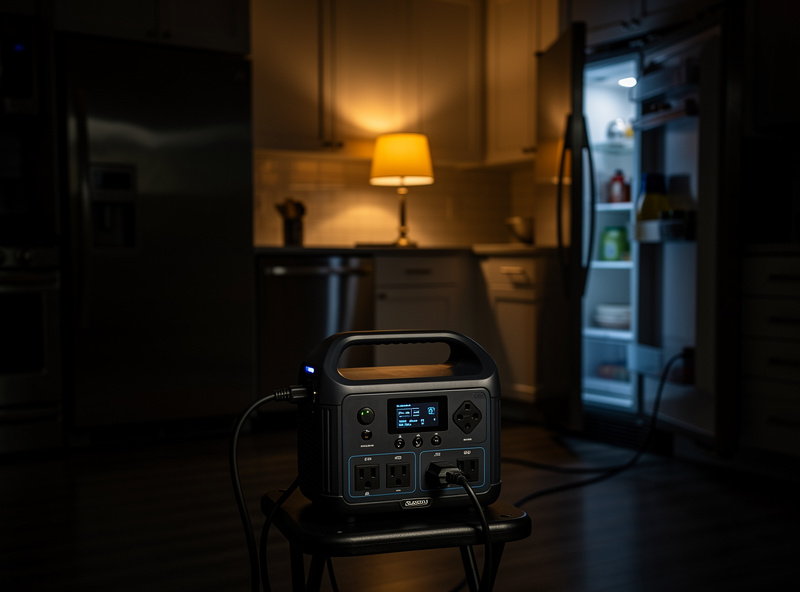
The most common outage-backup failure is a unit that has plenty of capacity but cannot start the fridge. A compressor inrushes to four to seven times its running watts for a fraction of a second — the locked-rotor amperage — so a fridge that runs at 150 W can demand over 1,000 W at startup. A station rated 1,800 W continuous but only 2,000 W surge can trip the instant the compressor kicks in alongside other loads.
For outage use, demand a surge rating of at least double the continuous rating. This is non-negotiable if a refrigerator, a sump pump, or a furnace blower is on your critical list. A unit with a generous surge margin protects you from the brownout that defeats the whole backup plan. A high-surge 2,000 Wh power station is the realistic floor for fridge-and-lights backup.
Recharge: Top Up Before, Not During
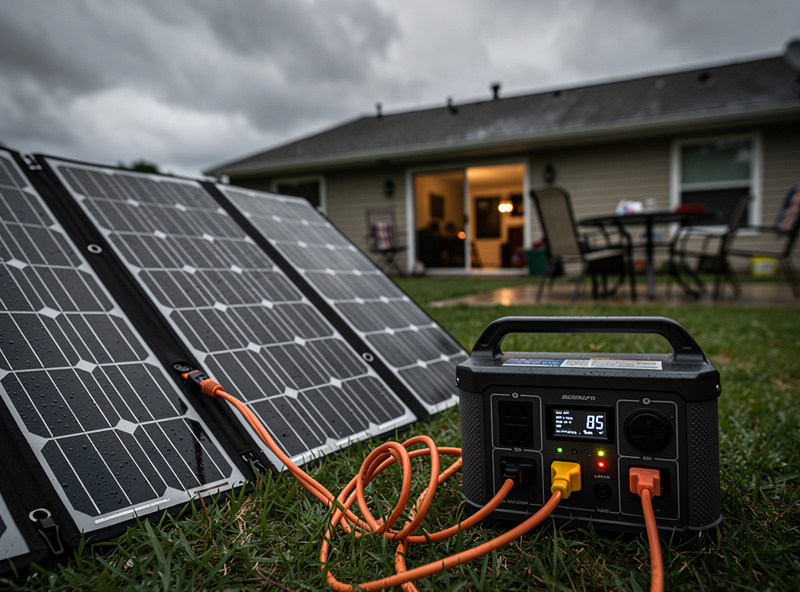
The honest truth about recharging during an outage is that you should have done it before. AC fast-charging matters more than solar for outage prep, because you refill the unit from the wall before the storm arrives. Solar is the long-tail backup for multi-day events, and it is slower than people expect — a 200 W panel does not deliver 200 Wh per hour, and at northern latitudes in winter the harvest collapses well below nameplate.
If you want solar as a recovery option, check that the station has a built-in MPPT controller and match your panel string’s voltage to its input window. An MPPT controller recovers 20–30% more than the cheap PWM units in bargain stations, per the MPPT vs PWM breakdown. A 200W folding solar panel turns the unit into a recovery source once the voltages line up, but treat it as the slow backup, not the primary plan.
Sizing by Outage Length
Match the unit to the outage you actually face. A few-hour flicker is a different problem than a multi-day storm event, and buying for the rare worst case wastes money on a box that mostly sits idle.
| Outage Type | Critical Loads | Capacity Target | Key Spec |
|---|---|---|---|
| Brief (hours) | Internet, lights, phones | 500–1,000 Wh | Pure sine output |
| Overnight | Fridge, lights, router | 1,500–2,000 Wh | Surge ≥ 2× continuous |
| Two-day storm | Fridge, lights, router, CPAP | 2,000–4,000 Wh | Surge + AC fast charge |
| Multi-day / off-grid leaning | All critical + solar recovery | 4,000 Wh+ (or DIY bank) | Solar input + expansion cost |
Why LiFePO4 Is the Right Call Indoors
For a backup unit that lives indoors and may run for hours at a stretch, LiFePO4 chemistry is the safe choice. Its thermal-runaway threshold is far higher than NMC’s and its failure mode is far less violent, which matters when the box sits in a closet or runs overnight in a living space. LFP also survives roughly 3,000–5,000 cycles versus 500–1,000 for NMC, so it tolerates years of occasional deep discharges without meaningful degradation.
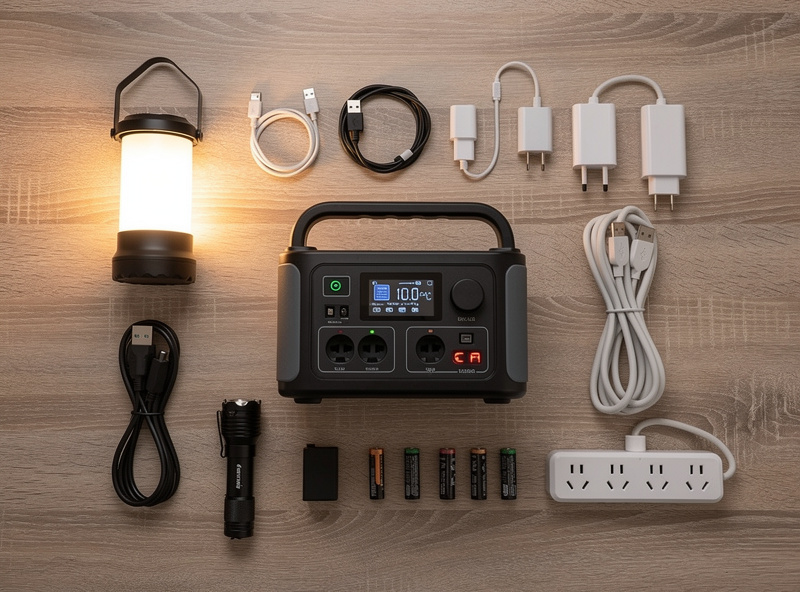
One winter caveat: LiFePO4 must not be charged below freezing, so if your backup lives in an unheated garage, confirm it has a low-temperature charge cutoff. The full chemistry-by-chemistry fire behavior is in the battery storage safety guide, and the LiFePO4 vs NMC comparison explains why I steer every indoor-backup buyer toward LFP. Pair the unit with a small rechargeable LED lantern so you are not burning precious watt-hours on lighting you could cover separately.
When a Power Station Isn’t Enough
If your honest critical-load math keeps climbing toward whole-home backup — the well pump, the furnace, the mini-split — a portable unit stops being the answer. At that scale a permanent DIY LiFePO4 bank wired to a transfer switch, or a proper hybrid-inverter backup, serves you better and cheaper per kWh than stacking expansion modules. The selection guide helps you land the right portable unit, and the portable power station guide covers where the portable form factor stops making sense.
Frequently Asked Questions
What size power station do I need for a power outage?
For fridge, lights, and internet through a two-day outage, target 2,000 to 4,000 Wh with a surge rating roughly double the continuous output. A modern fridge uses 1 to 2 kWh per day, which dominates the energy budget, so size around it first.
Can a power station run a refrigerator during an outage?
Yes, if its surge rating covers the compressor’s startup inrush, which can hit four to seven times running watts. A 150 W fridge can demand over 1,000 W at startup, so pick a unit with surge at least double its continuous rating.
Should I rely on solar to recharge during an outage?
Treat solar as the slow backup, not the primary plan. Recharge fully from the wall before an expected storm. Solar recovery is slower than people expect, and at northern latitudes in winter the harvest falls well below the panel’s nameplate.
Is LiFePO4 safe to run indoors during a blackout?
Yes. LiFePO4 has a far higher thermal-runaway threshold than NMC and a much less violent failure mode, making it the right choice for a unit running indoors for hours. Confirm a low-temperature charge cutoff if it lives in an unheated space.
How long will a power station last in an outage?
It depends on usable capacity and your critical loads. A 2,000 Wh LiFePO4 unit delivers roughly 1,700 usable Wh, enough to carry a fridge plus lights and internet for about a day, longer if you ration discretionary loads aggressively.
When should I get whole-home backup instead?
When your critical loads grow to include the well pump, furnace blower, or mini-split. At that scale a permanent DIY LiFePO4 bank on a transfer switch, or a hybrid-inverter backup, beats a portable unit on both cost per kWh and capability.