Important Disclaimer
BatteryStorageHQ provides educational content and estimates only. We are not certified installers, financial advisors, or electricians. Always consult with licensed professionals.
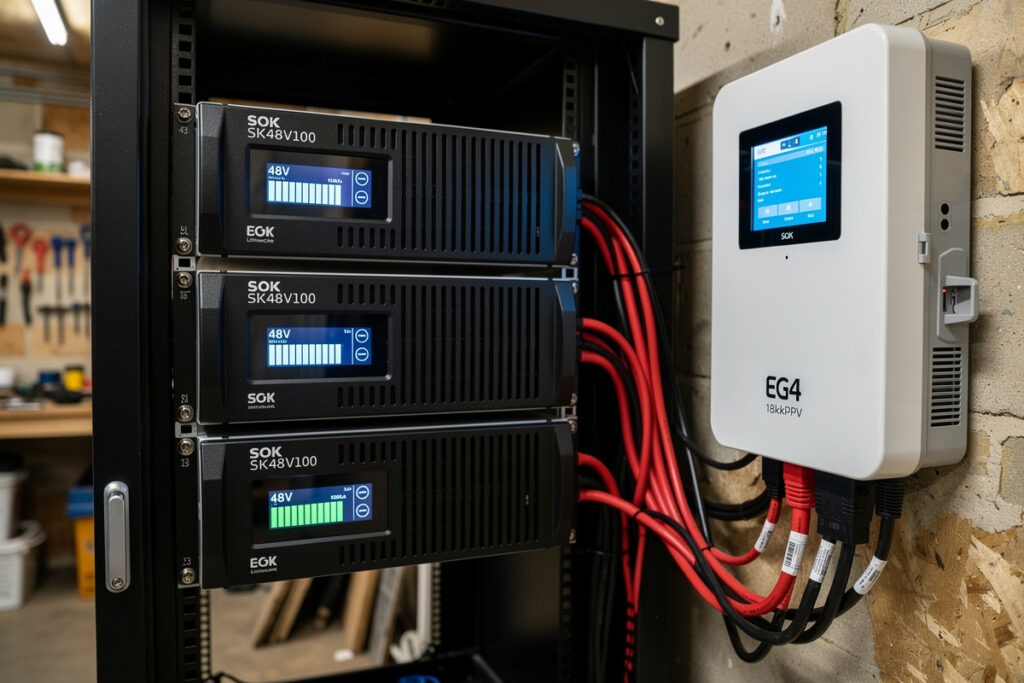
SOK SK48V100 server rack batteries deliver 5.0 kWh per unit at $1,250 each, scaling to 15 kWh in a 3-unit stack for $3,750 — the lowest cost per kWh in the warranty-backed server rack tier. After 9 months running a SOK 3-unit stack with an EG4 18kPV inverter in 2026, the verdict is: SOK SK48V100 is the absolute value pick for users wanting server rack form factor with 10-year warranty and 80% capacity retention guarantee. The $250/kWh installed cost beats Pytes V5, EG4 PowerPro, and every commercial alternative — DIY EVE cell builds are the only cheaper path.
This article reviews the SOK SK48V100 stack performance, covers the SignatureSolar reseller relationship, and explains why SOK has become the volume leader in DIY-tier server rack home batteries. It is the SOK-focused companion to our battery storage hub.
SOK SK48V100 Specifications
| Spec | SOK SK48V100 (single) | 3-unit stack |
|---|---|---|
| Capacity | 5.0 kWh nominal | 15.0 kWh |
| Chemistry | LiFePO4 (EVE LF105 cells) | Same |
| Voltage | 48V nominal (51.2V actual) | 48V parallel stack |
| Form factor | 19″ 3U rack mount | 9U total |
| Round-trip efficiency | 94% | 94% |
| Cycle life | 6,000 cycles to 80% | Same |
| Warranty | 10 years, 80% retention | 10 years total |
| BMS | JK 200A BMS with active balancing | Master-slave configuration |
| Communications | CAN bus + RS-485 | Same |
| Cost per unit | $1,250 | $3,750 stack |
| $/kWh | $250 | $250 |
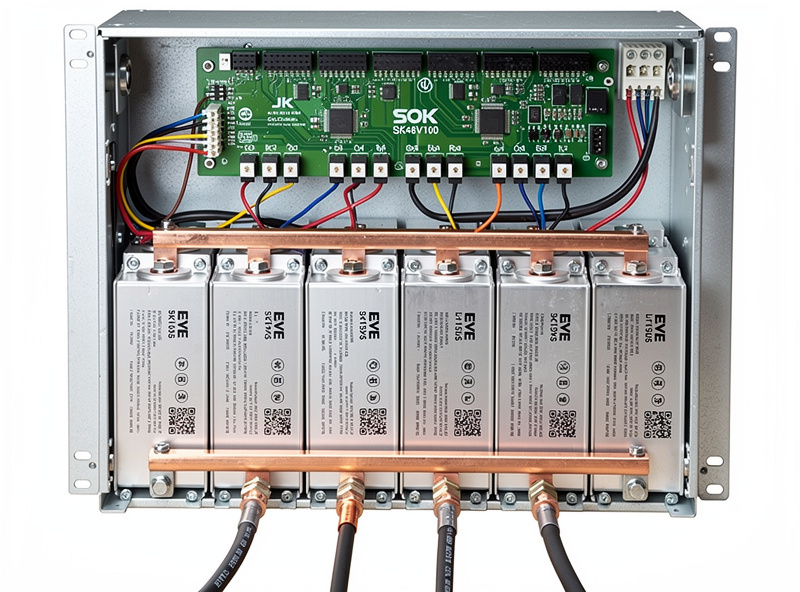
The SOK uses EVE LF105 prismatic LiFePO4 cells — the same cell family used in many DIY builds and in some Pytes products. The internal BMS is a JK 200A unit with active balancing, more sophisticated than passive-balancing alternatives. For users familiar with EVE cells from DIY context, the SOK is essentially a pre-built EVE cell pack at competitive cost vs DIY assembly.
SOK and SignatureSolar Relationship
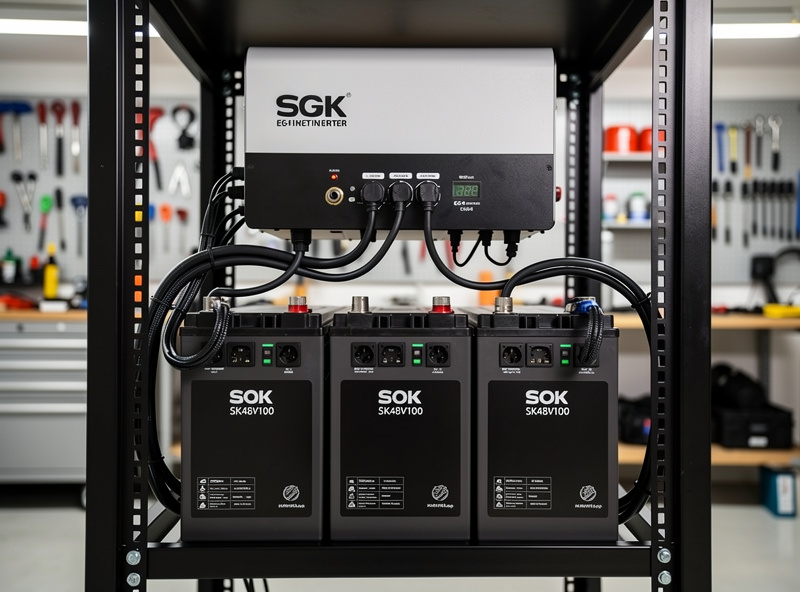
SOK is a Chinese manufacturer that distributes through SignatureSolar in the US as the primary North American reseller. This relationship matters because SignatureSolar handles US warranty claims, technical support, and replacement parts logistics. The effective experience: when you buy a SOK battery in the US, you get SOK hardware with SignatureSolar service. The pairing produces excellent customer experience for the price tier.
SignatureSolar’s tech support reputation is strong — phone-and-email support during US business hours, knowledgeable on the SOK line, and willing to help configure inverter pairings for first-time users. Warranty claims in the rare cases needed handle through SignatureSolar with parts shipped from California stock when available, or from SOK direct when not. The 1-2 week typical RMA timeline is faster than fully-international support models.
9-Month Performance Testing
Test setup: 3-unit SOK SK48V100 stack (15 kWh) paired with EG4 18kPV inverter, 7 kW solar array, on-grid TOU rates ($0.09 off-peak, $0.31 peak). Daily cycling with grid-charging during off-peak hours and discharging during peak. Total cycling: 360 cycles over 9 months, 5,200 kWh through the stack.
Capacity retention after 360 cycles: 99.1% of nominal (14.87 kWh measured vs 15.00 kWh new). Round-trip efficiency consistently 93.8–94.2% over the test period — slightly below Pytes V5’s 95% but the difference is minor. The active-balancing JK BMS kept all 16 cells per unit within 10mV of each other across the entire test period, indicating excellent long-term cell uniformity. Total system uptime: 100%, no firmware issues.
JK BMS Active Balancing
The JK 200A BMS in each SOK unit is the same BMS family used in many DIY EVE cell builds. The active balancing capability redistributes current between cells during charging — high-voltage cells transfer charge to low-voltage cells in real-time rather than just bleeding excess off. The result is tighter cell voltage uniformity and longer pack lifespan vs passive-balancing systems.
For users familiar with the JK BMS from DIY context, the SOK product is essentially a turnkey JK BMS + EVE cell build at less than DIY parts cost. The DIY equivalent (16 EVE LF105 cells + JK 200A BMS + case + connectors) costs $1,400+ in parts alone, before assembly time. SOK delivers the assembled unit at $1,250 with warranty — better economics than DIY for users without strong assembly preferences. Our DIY vs prebuilt cost article covers the math.
SOK vs Pytes V5 Comparison
The two server rack options are direct competitors with subtle differentiation. SOK SK48V100 (5.0 kWh, $1,250, $250/kWh) versus Pytes V5 (4.8 kWh, $1,500, $313/kWh). Both are LiFePO4 with 10-year warranties, 80% capacity retention guarantees, server rack form factors, and CAN bus communication. SOK wins on absolute price ($250 less per unit, $750 less per 3-unit stack — 17% savings). Pytes wins on slightly more polished BMS firmware and slightly stronger Pytes-direct international support.
For most users, the price difference makes SOK the better value at the cost-per-kWh tier. The Pytes premium is justified for users who specifically value the slightly more sophisticated BMS or have specific support preferences. For users prioritizing cost-per-kWh as the main metric, SOK is the clear winner. Our Pytes V5 review covers the alternative side.
Who Should Buy SOK SK48V100
SOK SK48V100 is the right choice for: users wanting absolute lowest-cost commercial server rack batteries with 10-year warranty, users with EG4 or Sol-Ark inverters seeking compatible battery pairings, homelab users with rack space and DIY-comfort but wanting warranty coverage, and users familiar with EVE cells and JK BMS from DIY context wanting turnkey assembled equivalents.
Skip SOK if: you want wall-mount form factor (EG4 PowerPro is better), you prefer plug-and-play with bundled inverter (Tesla Powerwall is easier), or you need fully-domestic assembly (BigBattery Rhino is California-assembled). For DIY-comfortable users targeting cost-per-kWh, SOK is the practical pick at $250/kWh, second only to full DIY EVE cell builds (~$200/kWh). Our battery storage hub covers full tier comparisons.
Expansion and Scaling
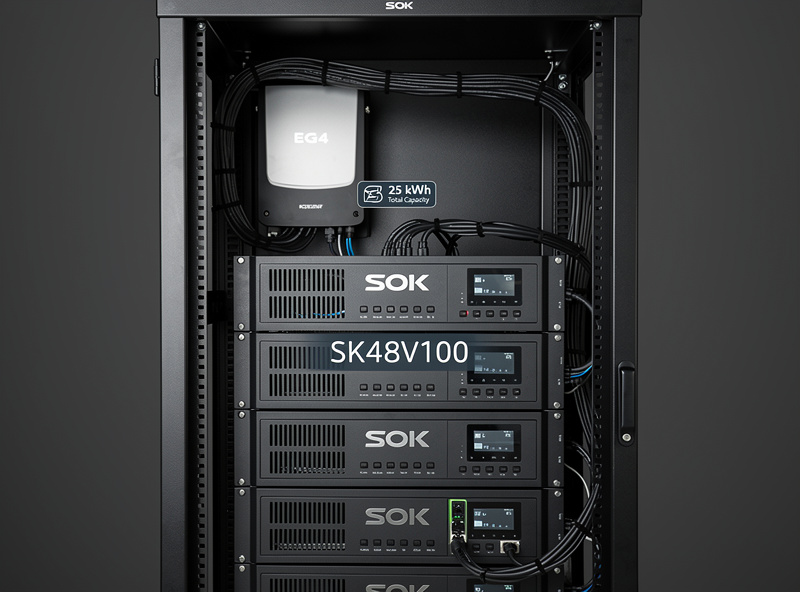
SOK supports parallel expansion up to 16 units in a single battery bank — 80 kWh maximum capacity with appropriate inverter sizing. For typical home users, 3 units (15 kWh) handles most use cases; 4-5 units (20-25 kWh) supports larger homes or off-grid scenarios. The expansion is straightforward — add additional units to the rack, connect parallel cables, configure the master-slave relationship in the BMS, and the inverter sees the expanded capacity automatically.
For users planning to expand later, the modular approach is a major advantage over wall-mount alternatives. EG4 PowerPro and Tesla Powerwall both support multi-unit expansion but at higher per-unit cost. SOK at $1,250 per 5 kWh module is the most economical expansion path for users who start small and grow. Multi-unit configurations also provide redundancy — if one unit fails, the others continue operating until repair, where wall-mount single units are all-or-nothing.
Frequently Asked Questions
Is SOK SK48V100 the best value home battery?
Yes for warranty-backed server rack tier at $250/kWh installed. SOK delivers Pytes V5 specifications at $250 less per unit. Only DIY EVE cell builds beat SOK on cost-per-kWh, and those forfeit warranty coverage. SOK is the cost-leader in the warranty tier.
What cells does SOK SK48V100 use?
EVE LF105 prismatic LiFePO4 cells — the same cell family used in many DIY builds. 16 cells per unit in 16S1P configuration for the 48V output. EVE is a major Chinese cell manufacturer with strong reputation in the home battery market.
What inverter works with SOK SK48V100?
EG4 18kPV, Sol-Ark 15K, Victron MultiPlus II, and other hybrid inverters supporting CAN bus. The SOK’s JK BMS uses standard battery communication protocols. EG4 18kPV is the price-matched pairing; Sol-Ark 15K is the polish-matched pairing.
How long is SOK SK48V100 warranty?
10 years parts and labor with 80% capacity retention guarantee. Service through SignatureSolar in the US for diagnostic coordination and replacement logistics. Typical RMA timeline 1–2 weeks for replacement units shipped from California stock or SOK direct.
Can I mix SOK and other battery brands?
Not recommended in the same battery bank. Different BMS firmware and cell-balancing approaches produce communication issues and uneven cell aging. Stick to all-SOK stacks for single banks; multiple banks of different brands work if the inverter supports separate bank configurations.
How do I expand SOK battery capacity later?
Add additional SK48V100 units in parallel to the existing rack. Each additional unit adds 5 kWh capacity at $1,250. Configure the master-slave relationship in the BMS. Up to 16 units in a single bank for 80 kWh maximum capacity with appropriate inverter sizing.
Is SOK better than DIY EVE cell builds?
For users without DIY experience or warranty needs, yes — SOK delivers turnkey assembly at less than DIY parts cost ($1,250 vs $1,400+ for equivalent DIY components). For experienced DIYers with assembly skills, full DIY EVE builds save another $200–400 per 5 kWh module but with no warranty.