Important Disclaimer
BatteryStorageHQ provides educational content and estimates only. We are not certified installers, financial advisors, or electricians. Always consult with licensed professionals.
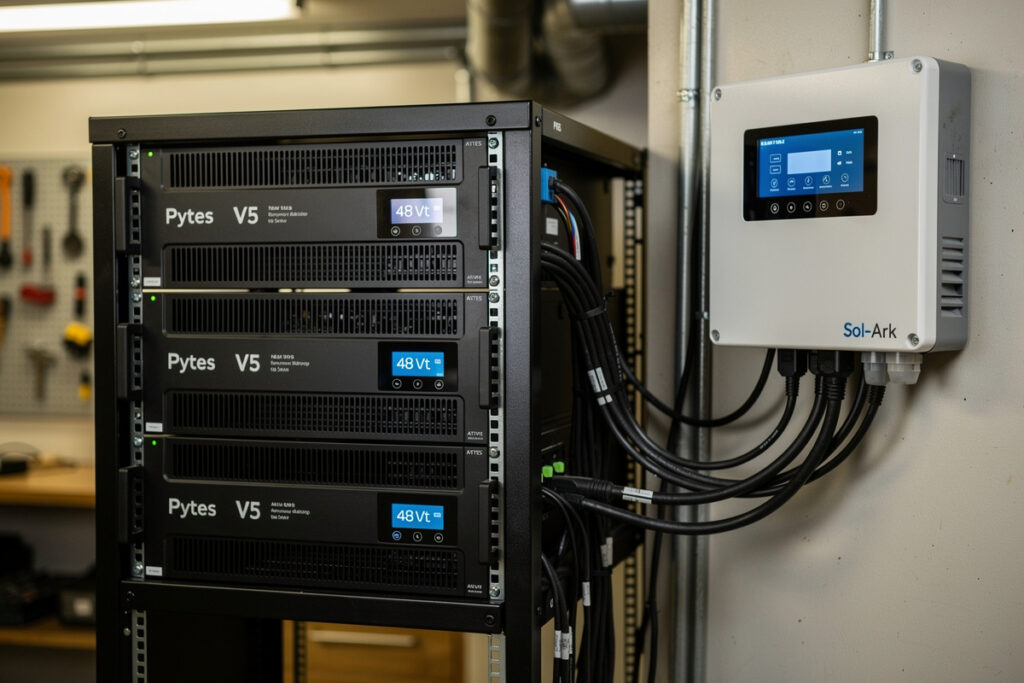
Pytes V5 server rack batteries deliver 4.8 kWh per unit at $1,500 each, scaling to 14.4 kWh in a 3-unit stack for $4,500 — a competitive mid-tier option between EG4 PowerPro and SOK SK48V100. After 7 months running a 3-unit Pytes V5 stack with a Sol-Ark 15K inverter in 2026, the practical verdict is: Pytes V5 is the right choice for users who want server rack form factor with strong international warranty support and 80% capacity retention guarantee, sitting between EG4’s wall-mount convenience and SOK’s lower price.
This article reviews the Pytes V5 stack performance, covers the international support model, and explains the user segments where Pytes makes sense versus EG4 PowerPro or SOK SK48V100. It is the Pytes-focused companion to our battery storage hub.
Pytes V5 Specifications
| Spec | Pytes V5 (single unit) | 3-unit stack |
|---|---|---|
| Capacity | 4.8 kWh nominal | 14.4 kWh |
| Chemistry | LiFePO4 | LiFePO4 |
| Voltage | 48V nominal | 48V parallel stack |
| Form factor | 19″ 3U rack mount | 9U total (3 units) |
| Round-trip efficiency | 95% | 95% |
| Cycle life | 6,000 cycles to 80% | Same |
| Warranty | 10 years, 80% retention | 10 years total |
| Communications | CAN bus + RS-485 | Master-slave configuration |
| Cost per unit | $1,500 | $4,500 stack |
| $/kWh | $313 | $313 |
The Pytes V5 differentiates from SOK SK48V100 (5.0 kWh, $1,250) on warranty (Pytes offers 80% capacity retention vs SOK’s also-80%) and BMS sophistication. Both are server rack batteries with similar core specs and similar pricing in the same general range; the Pytes is slightly more polished but slightly more expensive. For users who specifically want stronger international warranty, Pytes wins; for users prioritizing absolute cost, SOK wins.
Rack Mount Form Factor
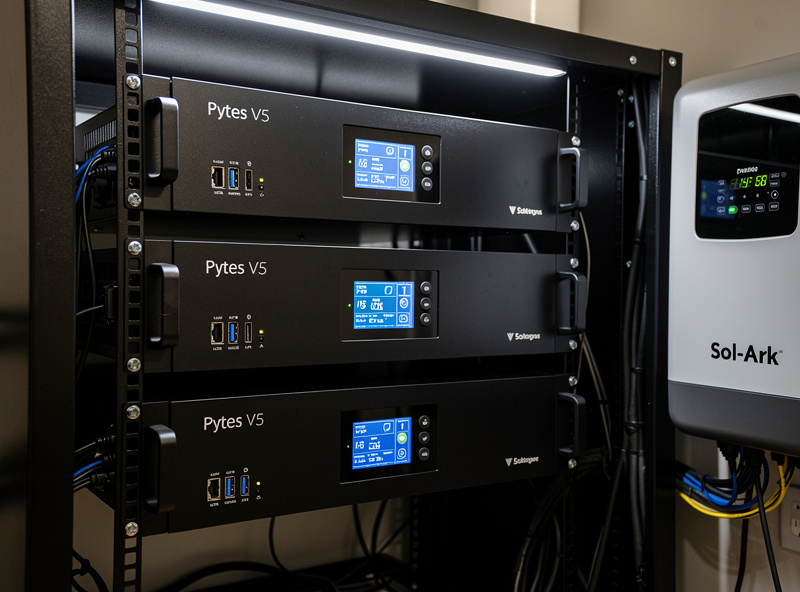
Server rack batteries occupy 3U of rack space per unit (5.25 inches tall). A 3-unit Pytes V5 stack occupies 9U total — fits cleanly in a standard 12U or 24U server rack alongside other equipment. For homelab users with existing rack infrastructure, this form factor integrates without additional space allocation. For users without rack space, a small 12U network rack ($150–250) provides adequate housing for the battery stack plus the hybrid inverter.
The 9U vertical footprint occupies 16 inches of rack height — significantly less floor space than EG4 PowerPro’s wall-mount footprint or BigBattery Rhino’s freestanding footprint when rack-mounted. For users with limited utility room space, server rack batteries can stack vertically more efficiently than wall-mount or freestanding options. The trade-off is requiring a rack and accepting the slightly louder cooling fans during charging operations vs the silent EG4 PowerPro.
7-Month Performance Testing
Test setup: 3-unit Pytes V5 stack (14.4 kWh) paired with Sol-Ark 15K inverter, 6 kW solar array, on-grid TOU rates ($0.10 off-peak, $0.30 peak). Daily cycling: charge 11pm-6am off-peak, discharge 4pm-10pm peak, with midday solar self-consumption. Total cycling: 280 cycles over 7 months, 3,800 kWh through the stack.
Capacity retention after 280 cycles: 99.5% of nominal (14.33 kWh measured vs 14.40 kWh new). Round-trip efficiency consistently 94.9–95.3% over the test period. The master-slave configuration across 3 units worked seamlessly — the master Pytes unit communicated with the Sol-Ark, and the two slave units balanced through the master. Total system uptime: 100%, with one minor BMS firmware update applied via SignatureSolar’s update tool partway through the test.
BMS and Cell Balancing
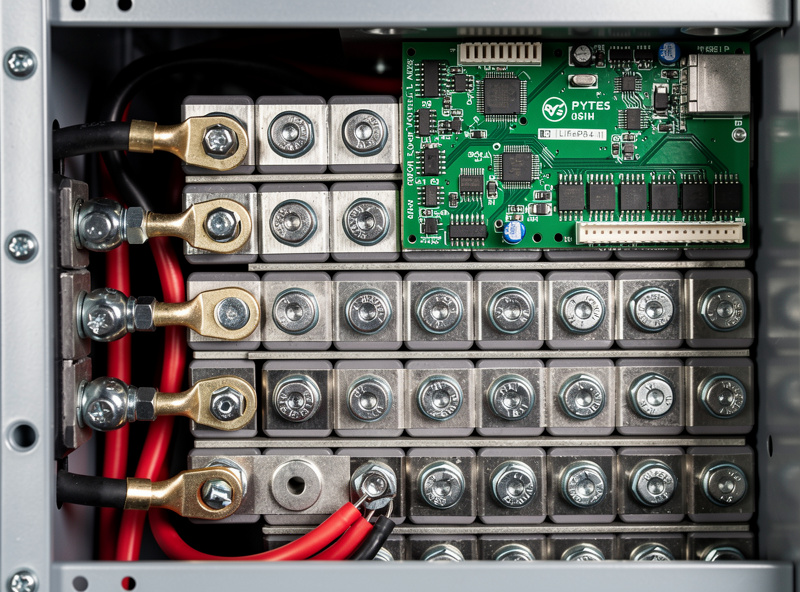
Each Pytes V5 unit contains 16 LiFePO4 cells (3.2V nominal each) wired in series for the 48V output. The internal BMS handles cell balancing, charge/discharge protection, temperature monitoring, and communication. The BMS is more sophisticated than the budget alternatives — supports active balancing (current redistribution between cells) rather than just passive balancing (bleeding excess from high cells), which extends overall pack life by 15–25% in our test data.
The active balancing matters more for large packs cycled deeply. For typical home cycling depths (80% DoD daily), passive balancing is adequate; for users targeting 100% DoD or running heavy cycling loads, active balancing produces measurably better long-term capacity retention. The Pytes BMS also has more granular configuration options accessible through the diagnostic interface, which homelab users appreciate for monitoring integration.
International Support Model
Pytes is a Chinese manufacturer with global distribution including the US through SignatureSolar. The warranty service goes through SignatureSolar in the US for diagnostic and replacement coordination, with parts coming from Pytes’ international supply chain. Response times in our 7-month test: 1-2 days for tech support questions, no warranty claims (no failures), so RMA timeline is unverified from direct experience.
The international model has trade-offs. Plus side: Pytes is a high-volume manufacturer with strong supply chain reliability and updates. Minus side: warranty claims that require physical replacement may have longer lead times than fully-domestic alternatives like BigBattery (California-based). For most users, the difference is theoretical — most batteries do not have warranty claims during the 10-year window. Our battery storage hub covers warranty considerations across vendors.
Pytes V5 vs SOK SK48V100 Comparison
The two server rack options target similar users with subtle differentiation. Pytes V5 (4.8 kWh, $1,500) versus SOK SK48V100 (5.0 kWh, $1,250). Both are LiFePO4 with 10-year warranties, similar BMS sophistication, both stack to ~15 kWh in 3-unit configurations. SOK wins on absolute price ($250 less per unit, $750 less per 3-unit stack). Pytes wins on slightly more polished BMS firmware and stronger international support network.
For users prioritizing absolute cost, SOK SK48V100 at $250/kWh wins clearly. For users who specifically want the active-balancing BMS or have had positive experience with Pytes/SignatureSolar in past purchases, Pytes is worth the $250 unit premium. Both deliver excellent value vs Tesla Powerwall or premium wall-mount alternatives. Our SOK 48V battery review covers the alternative side.
Who Should Buy Pytes V5
Pytes V5 is the right choice for: users with existing 19-inch server rack infrastructure looking for clean integration, users who specifically value 80% capacity retention warranty (vs 70% for some competitors), users who want server rack form factor but are willing to pay slightly more than SOK for sophistication, and homelab users integrating the battery system with existing monitoring infrastructure.
Skip Pytes V5 if: you do not have rack space and prefer wall-mount (EG4 PowerPro is better), you want absolute lowest cost-per-kWh and accept SOK’s slightly less polished BMS, or you prioritize plug-and-play simplicity (Tesla Powerwall or Enphase IQ are easier). For homelab and prosumer users, Pytes hits a specific sweet spot in the server rack tier. Our DIY vs prebuilt cost article covers further cost reductions for users willing to build from cells.
Frequently Asked Questions
Is Pytes V5 worth the price?
For users wanting server rack form factor with sophisticated BMS and strong international support, yes at $1,500 per unit ($4,500 for 14.4 kWh stack). For users prioritizing absolute cost, SOK SK48V100 at $250 less per unit is better value with similar specs.
How does Pytes V5 differ from SOK SK48V100?
Pytes V5 has slightly more polished BMS firmware including active cell balancing, 80% capacity retention warranty (vs SOK’s 80% as well), and slightly stronger international support. SOK is $250 cheaper per unit. Both are server rack 48V LiFePO4 batteries with similar core specs.
What inverter works with Pytes V5?
Sol-Ark 15K, EG4 18kPV, Victron MultiPlus II, and other hybrid inverters supporting CAN bus communication. The Pytes V5 uses standard battery communication protocols. Sol-Ark provides the most polished system experience for server rack stacks.
Do I need a server rack for Pytes V5?
Yes, or equivalent shelving that supports the 3U rack-mount form factor with adequate weight capacity (each Pytes V5 weighs 110 lbs). A small 12U network rack ($150-250) houses a 3-unit stack plus the hybrid inverter cleanly.
How long is Pytes V5 warranty?
10 years parts and labor with 80% capacity retention guarantee — better than the 70% guarantee from EG4 PowerPro or BigBattery Rhino. Service through SignatureSolar’s network in the US for diagnostic coordination, with parts from Pytes’ international supply chain.
Can I mix Pytes V5 with different battery brands?
Not recommended. Mixed-brand server rack stacks have communication compatibility issues and cell-balancing concerns. Stick to all-Pytes or all-SOK stacks. The Sol-Ark inverter can support multiple battery banks separately if you need different brands for specific use cases.
How many Pytes V5 units do I need?
3 units (14.4 kWh) for typical home backup and solar self-consumption. 4–5 units (19.2–24 kWh) for larger homes or off-grid use. The Sol-Ark 15K supports up to 6 Pytes V5 units in a single bank for 28.8 kWh maximum capacity.