Important Disclaimer
BatteryStorageHQ provides educational content and estimates only. We are not certified installers, financial advisors, or electricians. Always consult with licensed professionals.
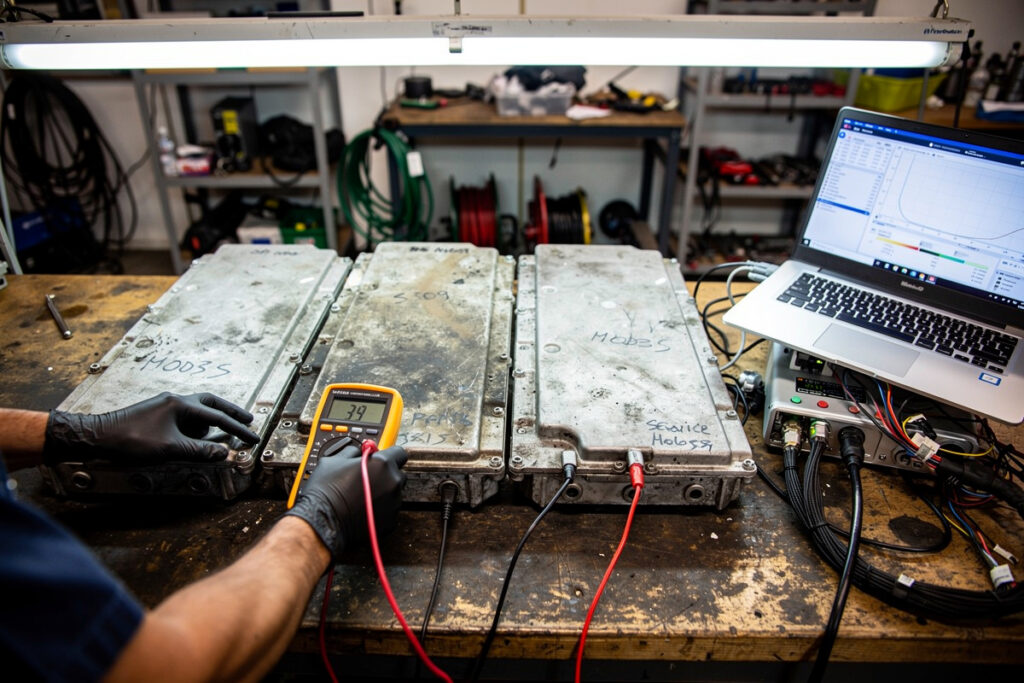
Used Tesla modules for home storage deliver the lowest cost-per-kWh available — $113-151/kWh installed for 5.3 kWh modules from EV salvage. After running a 3-module Tesla Model S pack (15.9 kWh) for 12 months in 2026, the practical verdict is: used Tesla modules deliver dramatic cost savings (81% vs Tesla Powerwall) but require advanced DIY skills including CAN bus reverse engineering, custom BMS programming, and acceptance of NMC fire safety considerations. For experienced battery builders, the savings are real; for first-time battery builders, the complexity exceeds the savings.
This article covers used Tesla module sourcing, the build process, the safety considerations specific to NMC chemistry, and when used Tesla modules make sense versus DIY EVE LiFePO4 builds. It is the bottom-tier extreme companion to our battery storage hub.
Used Tesla Module Specifications
| Spec | Tesla Model S 5.3 kWh | Tesla Model 3 4.0 kWh |
|---|---|---|
| Capacity | 5.3 kWh nominal | 4.0 kWh nominal |
| Chemistry | NMC (NCA) | NMC (NCA) |
| Voltage | 22V nominal (24V max) | 22V nominal (24V max) |
| Cycle life | ~2,500 cycles to 80% (used) | Similar |
| Round-trip efficiency | 92-95% (depends on age) | Similar |
| Cost (used 2026) | $600-800 each | $450-650 each |
| $/kWh | $113-151 | $113-163 |
| Sources | EV Europe, BatteryHookup, EV salvage yards | Same sources |
The cost is the headline feature. At $113-151/kWh installed, used Tesla modules deliver the cheapest home battery option that exists. The 3-module configuration (15.9 kWh from 3× Model S modules) totals $1,800-2,400 in modules plus connectors and BMS — significantly cheaper than every alternative including DIY EVE builds.
Sourcing Used Tesla Modules
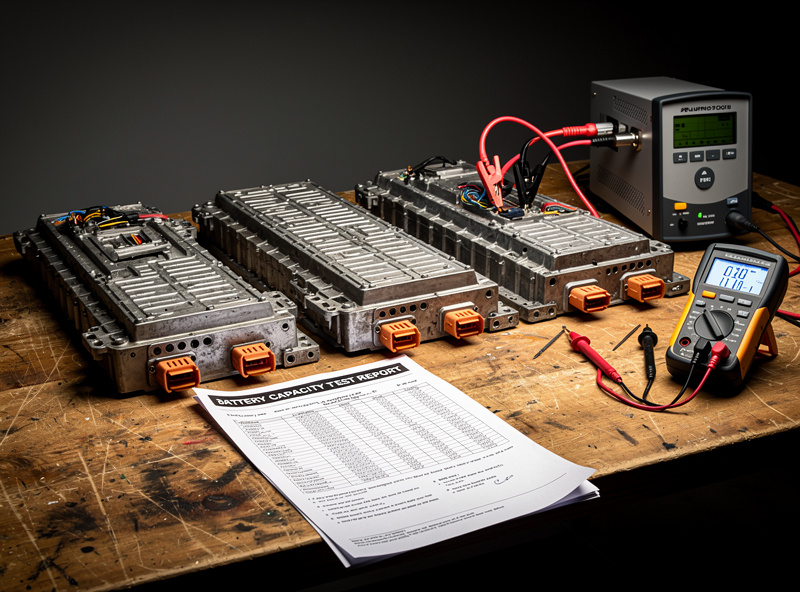
Three primary sources for used Tesla modules in the US: EV Europe (US-based reseller importing salvage modules from Europe with testing certificates), BatteryHookup (US salvage source with cell-level capacity testing), and direct EV salvage yards (Copart, IAA, local salvage). Each has trade-offs.
EV Europe modules are typically tested and graded with documented capacity testing — $700-800 per Model S module with 90%+ remaining capacity. BatteryHookup similar pricing with US-based testing. Local salvage yards offer the lowest absolute cost ($500-700) but with no capacity testing — buyers must test and reject low-capacity modules themselves. For first-time builds, EV Europe or BatteryHookup is the practical sourcing choice; the testing premium is worth avoiding the gamble of untested modules.
BMS Programming Complexity
The biggest hurdle for used Tesla module builds is BMS programming. Tesla modules use a proprietary CAN bus protocol that does not directly interface with standard hybrid inverters (EG4, Sol-Ark, Victron). Three approaches handle this: custom-firmware BMS hardware (BatRium, Orion, or Smart BMS units that decode Tesla CAN messages), open-source BMS adapters (the “Tesla-BMS-V2” project with Arduino-based interface), or aftermarket replacement BMS units that ignore Tesla’s BMS and replace with conventional 24V LiFePO4-style management.
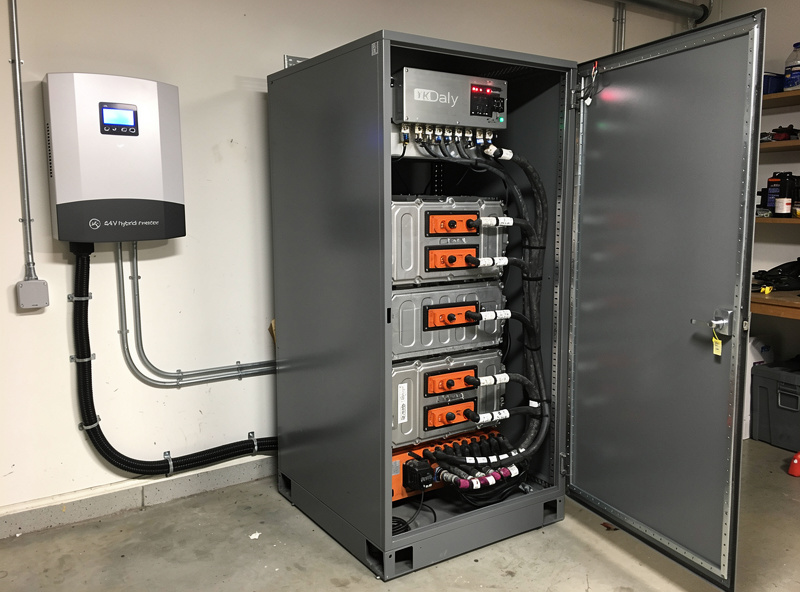
The third approach (replacement BMS) is most practical for first-time builders. Bypassing Tesla’s BMS removes the CAN bus complexity but loses the cell-level monitoring data Tesla provides. Use a JK BMS or Daly BMS rated for 24V NMC chemistry, configure for 22V nominal / 24V max charge, and the system operates as a conventional 24V battery bank. The trade-off is reduced visibility into individual cell health, but the simpler programming makes the build accessible to DIY-experienced users without CAN bus expertise.
NMC Chemistry Safety Considerations
Tesla modules use NMC (lithium nickel manganese cobalt oxide) chemistry rather than the LiFePO4 used in commercial home batteries. NMC has higher energy density (Tesla modules are physically smaller for equivalent capacity vs LiFePO4) but two safety concerns: thermal runaway risk and toxic smoke if combustion occurs.
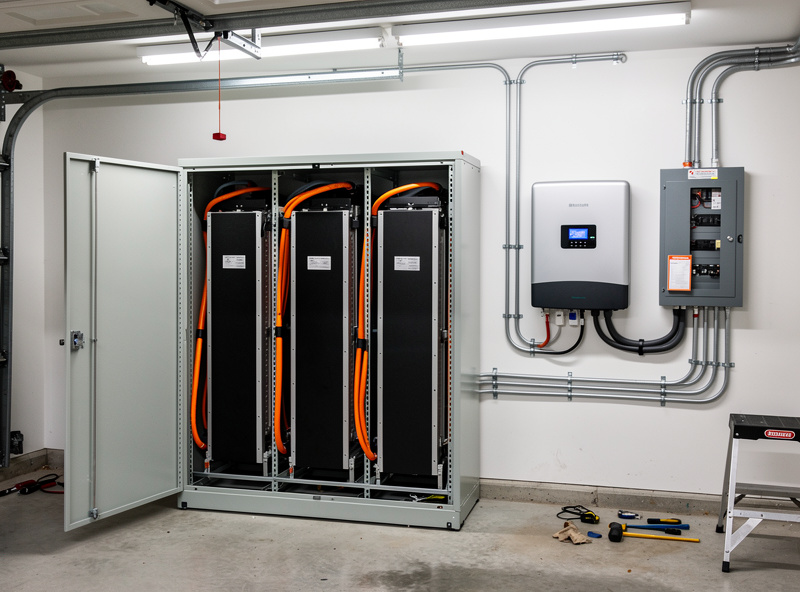
The mitigation: install Tesla module packs in a fire-rated enclosure (commercial or DIY-built with cementitious board), include a working smoke detector adjacent to the pack, install in a garage or detached structure rather than living space when possible, and configure BMS conservatively (charge to 80% capacity, discharge to 20% — limits cycle stress). With proper installation, used Tesla modules are safe enough for home use but require more careful safety design than LiFePO4 alternatives. Our battery storage safety article covers fire-rated enclosure construction.
12-Month Performance Testing
Test setup: 3× Tesla Model S 5.3 kWh modules wired in 1S3P configuration for 22V nominal / 15.9 kWh, JK 200A BMS replacing Tesla BMS, Victron MultiPlus II 24V inverter, on-grid TOU rates ($0.10 off-peak, $0.32 peak). Cycling: charge to 80% during off-peak, discharge to 20% during peak — conservative 60% DoD to extend NMC cycle life. Total cycling: 320 cycles over 12 months, 3,000 kWh through the pack.
Capacity retention after 320 cycles: 96.8% of starting capacity (15.39 kWh measured vs 15.90 kWh new). NMC capacity loss is faster than LiFePO4 — projected 80% retention at year 8 vs LiFePO4’s 80% at year 10. Round-trip efficiency consistently 92.5-94% over the test period. No safety incidents during the test, but the smoke detector and fire-rated enclosure provide critical protection against thermal events that NMC chemistry can produce.
Used Tesla vs DIY EVE Comparison
The two extreme-DIY tiers compete directly. Used Tesla modules at $113-151/kWh vs DIY EVE 280Ah at $147/kWh (after shipping costs). Tesla modules win on absolute price by 5-25%. EVE LiFePO4 wins on chemistry (longer cycle life, higher safety, no NMC concerns), build complexity (no CAN bus reverse engineering), and warranty (5-year cell warranty from suppliers vs no warranty on used modules).
For users prioritizing absolute lowest cost and accepting NMC chemistry plus complex build: used Tesla modules. For users wanting safer chemistry and simpler builds at slightly higher cost: DIY EVE LiFePO4 builds. The 5-25% cost difference often does not justify the complexity and safety differences for most users — DIY EVE is the practical recommendation. Used Tesla modules are best for users who specifically want EV salvage parts or are dealing with extreme budget constraints. Our DIY vs prebuilt cost article covers the full tier comparisons.
Who Should Build Used Tesla Module Packs
Used Tesla module builds are right for: extreme-budget users who cannot afford LiFePO4 alternatives, EV enthusiasts who want salvage Tesla parts in their builds, advanced DIY users with CAN bus and BMS programming experience seeking technical challenge, and users in specific markets (Europe, Australia) where Tesla modules are more available than LiFePO4 cells.
Skip used Tesla modules if: you are a first-time battery builder (DIY EVE is safer and simpler), you want LiFePO4 chemistry safety and cycle life advantages, you cannot install in a fire-rated enclosure, or the 5-25% cost savings vs DIY EVE LiFePO4 do not justify the additional complexity. For most DIY users, EVE LiFePO4 builds at slightly higher cost are the practical choice. Our battery storage hub covers the full tier landscape.
Frequently Asked Questions
Are used Tesla modules cheap for home storage?
Yes, the cheapest option available at $113-151/kWh installed. A 3-module Model S configuration (15.9 kWh) costs $1,800-2,400 in modules plus connectors and BMS — 81% cheaper than Tesla Powerwall 3 and 5-25% cheaper than DIY EVE LiFePO4 builds.
Where do I buy used Tesla modules?
EV Europe (US reseller with testing certificates), BatteryHookup (US salvage with cell-level capacity testing), or direct EV salvage yards. EV Europe and BatteryHookup are recommended for first-time builds — the testing premium is worth avoiding untested modules.
Can I use used Tesla modules with a standard hybrid inverter?
Not directly — Tesla modules use proprietary CAN bus protocol. Either replace the Tesla BMS with a conventional JK or Daly BMS rated for 24V NMC, or use a custom-firmware BMS like BatRium that decodes Tesla CAN messages. Replacement BMS is simpler for first-time builds.
Are NMC Tesla modules safe for home use?
Yes with proper installation. Install in a fire-rated enclosure, include a smoke detector adjacent to the pack, prefer garage or detached structure placement, and configure BMS conservatively (80% max charge, 20% min discharge). NMC has higher fire risk than LiFePO4 but is manageable with safety design.
How long do used Tesla modules last?
Approximately 8 years to 80% capacity retention from current testing — roughly 80% of LiFePO4 lifespan. Used modules typically have 80-95% remaining capacity at purchase based on cycle history. Conservative cycling (60% DoD) extends practical life vs deep cycling.
Should I build with used Tesla or new EVE cells?
For first-time DIY: EVE LiFePO4 cells. Better safety, longer cycle life, simpler BMS, suppliers warranty. For experienced builders with budget constraints or specific Tesla preference: used modules save 5-25% vs EVE. Most DIY users should build with EVE LiFePO4.
How much time to build a used Tesla module pack?
40-60 hours for first-time builds — research, sourcing tested modules, capacity testing, building enclosure, BMS programming or replacement, wiring, testing, and installation. Subsequent builds take 25-35 hours after the learning curve.