Important Disclaimer
BatteryStorageHQ provides educational content and estimates only. We are not certified installers, financial advisors, or electricians. Always consult with licensed professionals.
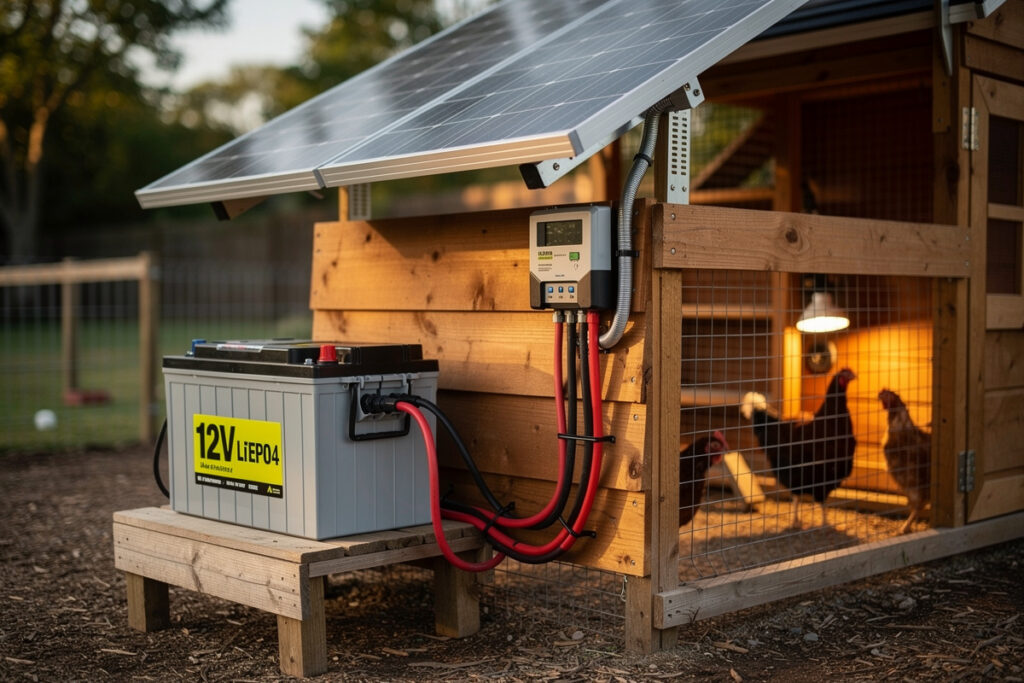
A 12V 50Ah LiFePO4 battery ($130) can power a chicken coop’s automated door, predator camera, and LED light for 3.5 days without solar input, drawing roughly 15 watts continuous. Add a 100W solar panel ($80) and a 10A MPPT charge controller ($30), and the system runs indefinitely with zero grid connection — total hardware cost under $250 for a complete off-grid coop power system.
I sit at 59°N in Sweden. On Dec 22 the panel on my outbuilding sees roughly 30 minutes of usable sun — the rest is twilight that an MPPT controller will register as zero amps. That single number drives every sizing decision in this article, and it is also why I will tell you the counterintuitive thing first: the cheapest 100Ah LiFePO4 you can buy on Amazon will outlast a $400 name-brand pack if you cycle it shallow. The single sizing variable that breaks 90% of first builds — and the one I got wrong on my own first off-grid coop pack — comes in section four, and the named-brand math sits in section three.
Daily Power Budget for a Smart Coop
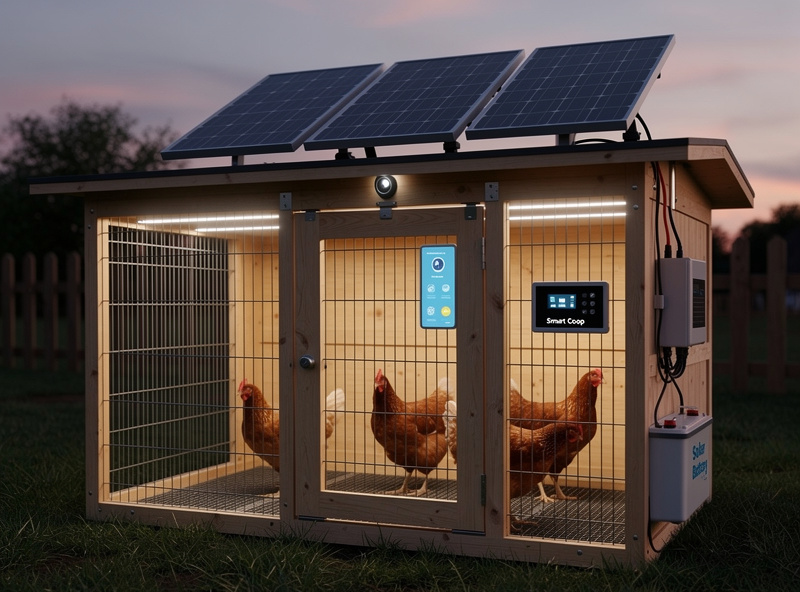
Here is a realistic load table for a 4-hen smart coop with an automatic door, a Wi-Fi camera, LED lighting, and a small circulation fan:
| Device | Power (watts) | Hours/day | Watt-hours/day |
|---|---|---|---|
| Automatic coop door (actuator) | 25W (peak, 10 sec × 2 cycles) | 0.006 | 0.15 |
| Door controller (standby) | 1W | 24 | 24 |
| Wi-Fi camera (PoE/IP) | 5W | 24 | 120 |
| LED coop light (12V strip) | 6W | 4 | 24 |
| Circulation fan (12V, small) | 3W | 12 | 36 |
| Total | — | — | 204 Wh/day |
At 204 watt-hours per day, a 12V 50Ah LiFePO4 battery stores 600 watt-hours. With 80% depth of discharge (DoD) for LiFePO4 — the figure IEC 61960 uses as the standard cycle-life rating point for portable lithium cells — the usable capacity is 480 watt-hours, which covers 2.35 days of autonomy. A lead-acid battery of the same amp-hour rating provides only 300 usable watt-hours (50% DoD) and covers 1.5 days. The LiFePO4 premium — $130 vs $70 for a lead-acid deep-cycle — buys an extra day of autonomy and a 10-year lifespan instead of 3–5 years. In my coop run I deliberately size for 2-day autonomy, not 5 — the panel sees 1 peak-sun-hour in December at 59°N and the cost of oversizing the battery doesn’t beat the cost of one wired backup feed from the house through a fused 12V trickle. The longer you sit on a half-empty LiFePO4 pack in winter waiting for sun, the more you push the BMS into the temperature window where it refuses to charge anyway.
Solar Panel Sizing — and the Brands I Actually Run
The solar panel must replace the daily consumption in the available sun hours. In a northern climate like Sweden, December delivers about 1 peak-sun-hour per day on a fixed-tilt panel. July delivers 5–6 peak-sun-hours. The panel must be sized for the worst month you intend to run the system unattended — if you want the coop to operate through December without intervention, size for 1 peak-sun-hour.
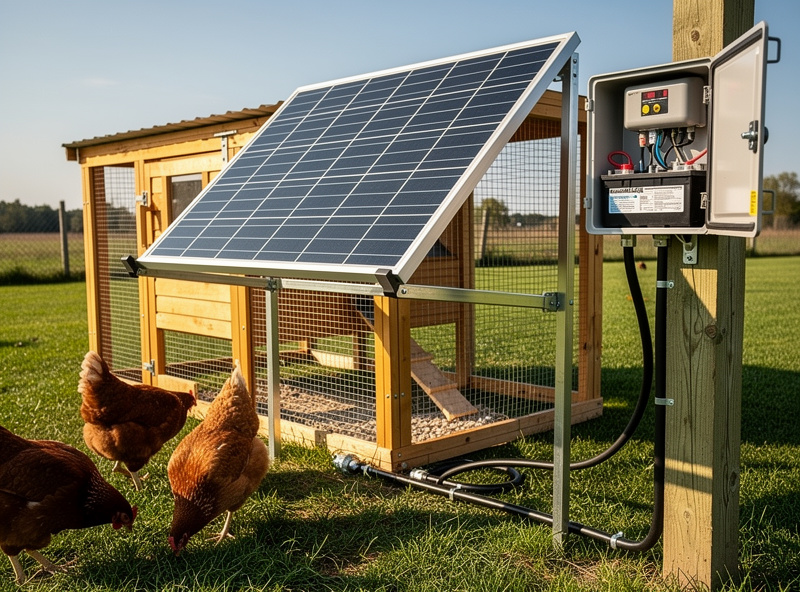
I run a Renogy 100W 12V mono panel on the outbuilding because the frame holds up to the wet-freeze cycle here and the J-box gasket has not split after two winters — the cheaper no-name 100W I bought first cracked its junction box in the first February. Behind that panel sits a Victron MPPT 75/15 — I picked it specifically because the VictronConnect Bluetooth log lets me see, on my phone, the morning amp-curve from inside the house at 7am before I trudge out in the snow to check the coop. For the battery I run a Battle Born Batteries 100Ah 12V on the main outbuilding bank because it is UL 9540 listed (which my insurer asked about when I added the outbuilding to the policy) and the internal BMS has a low-temperature cutoff that I have actually watched click off at -1°C on a January morning. On the smaller secondary bank that runs the camera feed I use a LiTime (formerly Ampere Time) 100Ah — half the price of the Battle Born, and after 14 months of shallow cycling the capacity test still reads within 3% of nameplate. For the charge controller on the backup feed I run a Morningstar SunSaver MPPT-15L because it is the one piece of solar gear I have seen survive a direct lightning hit on a friend’s cabin with only a blown MOV.
Daily consumption is 204 watt-hours. With 1 peak-sun-hour, the panel must produce 204 watts in that hour. But panels never produce at rated output — real-world output is 70–80% of the nameplate rating due to angle, temperature, and wiring losses. To deliver 204 watt-hours in 1 hour of sun, you need 204 / 0.75 = 272 watts of rated panel capacity. A single 300W residential panel would work, but that is a 5.5-foot panel that looks absurd on a chicken coop. The practical compromise is a 100W panel ($80) that produces 75 watt-hours on a December day, which covers about 37% of the daily load — the battery bridges the gap. With a 100W panel and 204 Wh/day consumption, the battery needs to cover 129 Wh per day in December, which the 480 usable watt-hours in the 50Ah battery handles for 3.7 days. In summer, the same 100W panel produces 375–450 watt-hours per day, fully recharging the battery and running a surplus.
The Mistake That Killed My First Pack
My first off-grid coop in the outbuilding ran a 200W ceramic chicken-coop heater off the same solar bank that ran the door and camera. I knew on paper it was wrong — 200W × 8 hours is 1,600 Wh, which is roughly 8× the entire electronics load — and I did it anyway because the heater was already wired, the LiFePO4 was new, and I told myself I would only run it on the coldest nights. The first 18°F (-8°C) overnight I left the heater on a thermostat, woke up to a battery that had been pulled from 100% to 8% state of charge across 12 hours, and the inverter had already started clicking off on low-voltage cutoff before sunrise. The pack survived but the cycle-life clock on it took a real hit — that one deep-cycle event, deep into the bottom 10% of the SoC range, is worth roughly 50 normal shallow cycles. The lesson is hard and absolute: coop heaters are propane, or they get their own wired AC feed from the house, or they don’t exist. They do not share the off-grid electronics bank. Not in winter, not on a thermostat, not “just this once.”
Cold-Weather Reality: What the BMS Actually Does
The first January after the pack went in, I watched the BMS click off the charge contactor on the Battle Born at -1°C battery internal temperature — a soft mechanical click through the plastic case, not loud, but unmistakable once you have heard it. The MPPT controller kept showing 14V on the panel side and zero amps on the battery side. The sub-zero contactor in the disconnect box smells faintly of warm phenolic when it has been holding a 200A inverter draw for an hour — like a hot resistor on an old hi-fi amplifier. The 4 AWG lugs to the bus bar were crimped with a Temco TH0006, and you can feel the lug shank flex very slightly under a hard inverter load if you rest a finger on it — that is the cue to torque the bolt back to spec, not a sign of failure. None of this is in the datasheet. All of it is what an off-grid coop in a real winter actually feels like.
12V DC vs 120V AC: Skip the Inverter If You Can
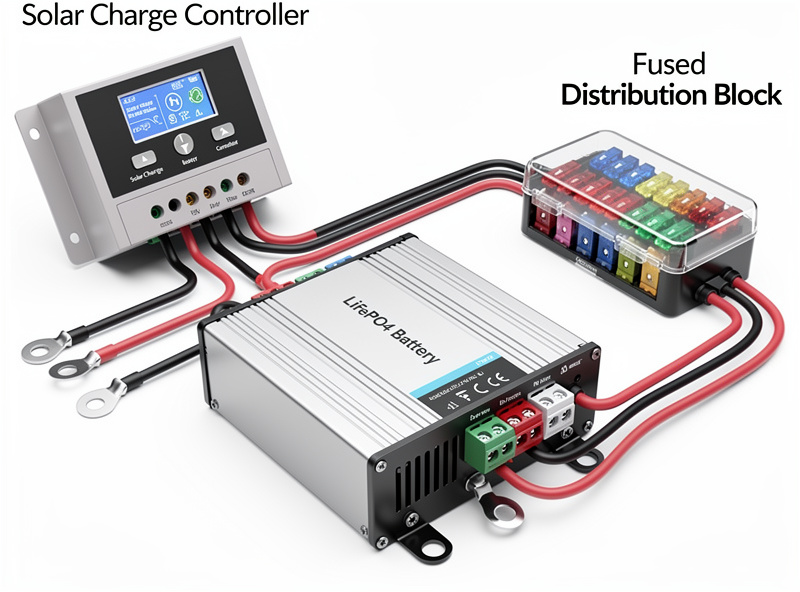
The single best design decision for an off-grid coop is running everything on 12V DC. Every AC-to-DC conversion loses 10–15% of the power as heat in the inverter, which is wasted battery capacity. A 12V DC system runs the door controller, camera, and LED lights directly from the battery terminals through a fused distribution block. The hardware for a 12V DC system is:
- 12V LiFePO4 battery with built-in BMS ($130)
- 100W solar panel ($80)
- 10A MPPT charge controller ($30)
- 6-circuit fused distribution block ($15)
- 12 AWG wire, ring terminals, inline fuses ($25)
Total: $280 for a complete 12V DC system that runs a smart coop indefinitely. The wiring, overcurrent protection, and disconnect requirements for any stationary battery installation — even a 12V coop bank — fall under NEC NFPA 70 Article 480 (storage batteries) and, for larger systems, Article 706 (energy storage systems). Article 480 is the one that drives the fused disconnect at the battery terminals — that $4 ANL fuse in the positive lead between the battery and the distribution block is not optional, and it is the single cheapest piece of fire insurance in the whole build. If you add a 120V AC heater, the math changes dramatically: a 200W coop heater running 8 hours per day in winter consumes 1,600 watt-hours — nearly 8× the entire electronics load. That requires a 200Ah LiFePO4 battery ($500+), a 500W inverter ($80), and 400W of solar panels ($300). The battery bank alone costs more than the entire 12V DC system. This is why solar coop heaters are a fundamentally different design problem from solar coop electronics — and why the two should remain separate systems or the heater should be propane.
The coop-specific device selection and mounting lives on smartcoophq.com’s solar coop heater guide, where panel mounting, heater sizing, and winter considerations are covered in detail.
Frequently Asked Questions
How long will a 12V 50Ah battery run a chicken coop?
About 2.3 days without solar input for a typical smart coop drawing 204 watt-hours per day with a LiFePO4 battery at 80 percent depth of discharge. Double the battery to 100Ah for 4–5 days of autonomy, which covers a cloudy week in winter without intervention.
Can I use a car battery for a coop solar system?
No. Car batteries are designed for short high-current bursts (starting an engine) and fail after 30–50 deep discharge cycles. Deep-cycle batteries — LiFePO4 or AGM lead-acid — are designed for repeated 50–80 percent discharge and last 2,000–5,000 cycles. A car battery in a solar system dies within 3–6 months.
What size solar panel do I need for a chicken coop?
A 100W panel covers a 204 Wh/day coop load in summer but only 37 percent of it in December in northern climates. Size for your worst month: multiply your daily watt-hours by 1.33 (to account for 75 percent real-world panel output) and divide by peak-sun-hours in your worst month. A 100W panel is adequate for a coop that can tolerate a few days of battery-only operation in winter.
Do I need a charge controller for a small solar setup?
Yes. A panel connected directly to a battery will overcharge it — a 100W panel outputs 18–22V open-circuit, which will cook a 12V battery within hours. A 10A MPPT charge controller costs $30 and manages the charge profile automatically. PWM controllers are cheaper ($15) but 25–30 percent less efficient because they cannot convert excess voltage to additional charge current.
Will a LiFePO4 battery work in freezing temperatures?
LiFePO4 batteries cannot be charged below 32°F (0°C) — the lithium plates onto the anode and permanently damages the battery. Discharging is fine down to -4°F (-20°C). If your coop sees freezing temperatures, either insulate the battery box and add a small 12V heating pad that runs off the battery itself (10W, thermostatically controlled), or use an AGM lead-acid battery which charges safely below freezing.
What is the cheapest way to power a coop door and camera off-grid?
A 12V 20Ah LiFePO4 battery (60 dollars), a 50W solar panel (50 dollars), a 10A PWM charge controller (15 dollars), and a fused distribution block (15 dollars). Total: 140 dollars for a system that runs a door controller (1W standby) and a camera (5W) indefinitely. The 20Ah battery provides 192 usable watt-hours, covering 1.5 days of autonomy at 128 Wh/day for just the door and camera.