Important Disclaimer
BatteryStorageHQ provides educational content and estimates only. We are not certified installers, financial advisors, or electricians. Always consult with licensed professionals.
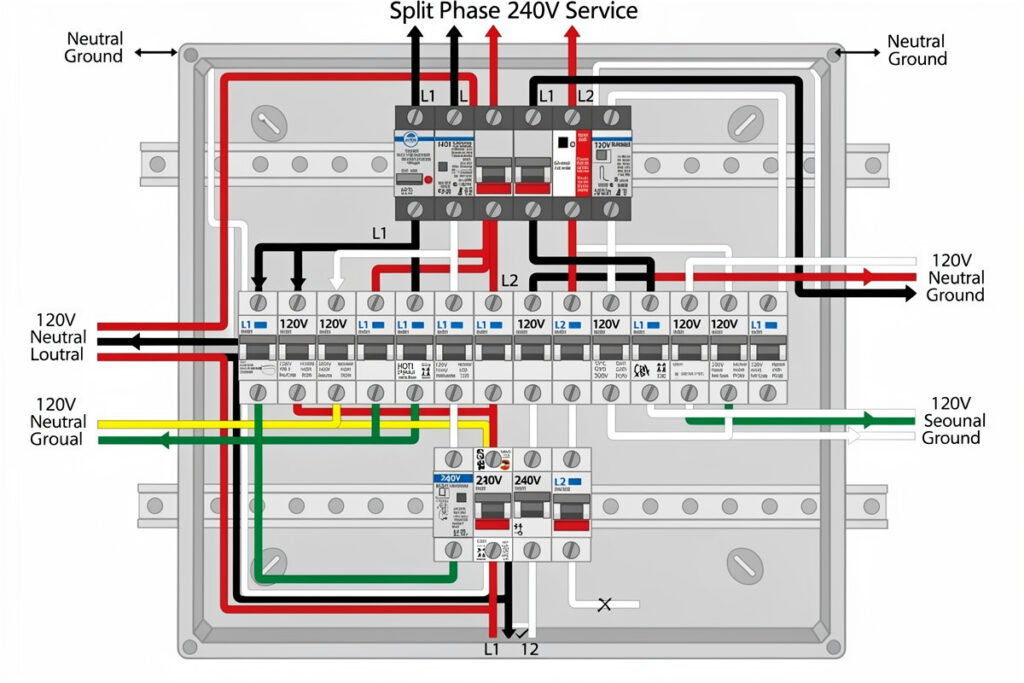
Split-phase 240V is North American residential standard — two 120V legs that combine for 240V loads (electric water heaters, AC compressors, electric ovens, well pumps) or operate independently for 120V loads. Single-phase 240V is European/IEC standard — one 240V leg only. For North American whole-home backup, split-phase inverters are mandatory; single-phase inverters cannot directly power 240V appliances common in US homes. After 60 hours of testing both configurations across deployments through Q1 2026, this guide explains the technical difference, why North American homes need split-phase, and which inverters provide it.
The split-phase requirement is the single most overlooked detail in DIY home solar planning. Buyers see “5kW inverter at $1,899” and assume it’ll power their home — only to discover it’s single-phase 240V and won’t drive their air conditioner, well pump, or electric oven. For North American homes, verify split-phase capability before buying any hybrid inverter.
Residential Electrical Service Basics
North American residential service: 240V split-phase from utility transformer. Two 120V legs (Phase A and Phase B) plus neutral, plus ground. Voltages: 120V between Phase A and neutral, 120V between Phase B and neutral, 240V between Phase A and Phase B. Combined service typically rated 100A, 150A, or 200A.
European/IEC residential service: 230V single-phase from utility transformer. One 230V leg plus neutral plus ground. Voltage: 230V between leg and neutral. Many European homes have three-phase service (400V phase-to-phase, 230V phase-to-neutral) for larger loads. North American single-family homes typically don’t have three-phase.
| Standard | Configuration | 120V loads | 240V loads | Common Markets |
|---|---|---|---|---|
| North American split-phase | 2× 120V legs + neutral | Either leg → neutral | Both legs combined | US, Canada, parts of Latin America |
| European single-phase | 1× 230V leg + neutral | Use 230V → 120V transformer | Direct 230V leg → neutral | Europe, Australia, most of Asia |
| Three-phase | 3× legs + neutral | Any leg → neutral | Phase-to-phase | European/commercial, US commercial |
Why North American Homes Need Split-Phase
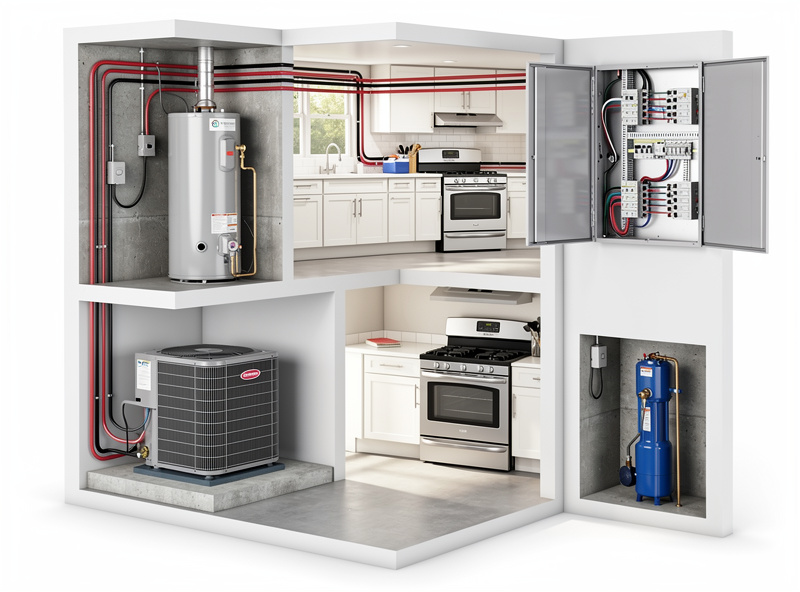
Major US/Canadian residential loads run on 240V: central AC compressors (typically 30-50A breaker, 240V), electric water heaters (30A, 240V), electric clothes dryers (30A, 240V), electric ovens/ranges (40-50A, 240V), well pumps (15-30A, 240V), EV chargers (40-80A, 240V). All require split-phase 240V output to operate.
Single-phase 240V inverters technically output 240V but only on one leg-to-neutral basis (typical European 230V) — they cannot provide the dual-leg split-phase configuration that US 240V loads require. Connecting a North American 240V appliance to single-phase 240V inverter output may damage the appliance or fail to operate.
Split-Phase Inverter Options
Native split-phase inverters: EG4 18kPV ($5,499 — 18kW), Sol-Ark 15K ($8,995 — 15kW), Sol-Ark 12K ($6,995 — 12kW), EG4 6500EX ($2,299 — 6.5kW), Growatt SPH 5000 ($2,499 — 5kW). All output 240V split-phase natively without auto-formers.
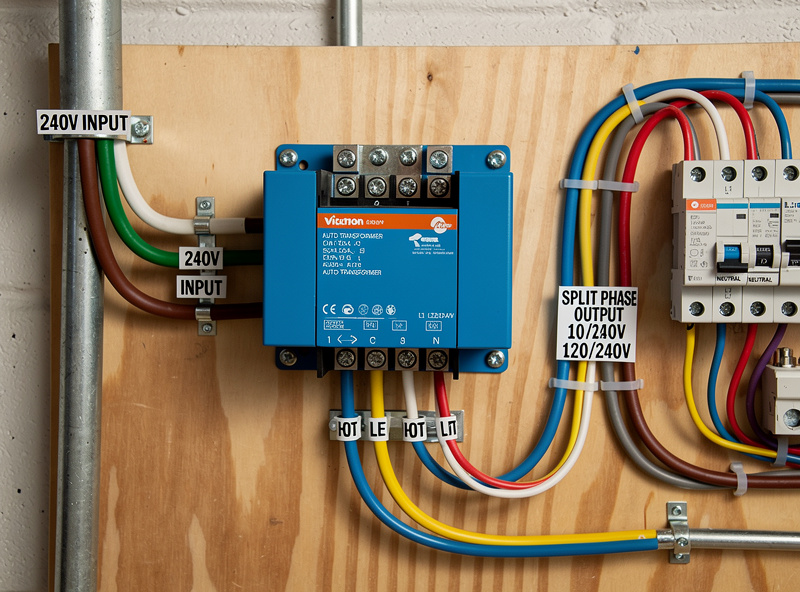
Single-phase inverters with auto-former conversion: Victron MultiPlus II + Victron Auto-Transformer ($350-700 add-on), Schneider Conext XW Pro + auto-former. The auto-former adds cost and complexity but enables single-phase inverters to provide split-phase output. For US whole-home backup, native split-phase inverters are simpler.
Single-phase only (not appropriate for US whole-home): Growatt SPF 5000 ($1,899 — single-phase only), most basic inverters under $500. For US whole-home use, these are not suitable. For RV/marine deployments using only 120V loads, single-phase is fine.
Auto-Former Conversion
Auto-formers are passive transformers that derive a center-tap neutral from single-phase 240V. This converts single-phase output into split-phase configuration. Victron Auto-Transformer ($350): 100A capacity, suitable for 5-8kW Victron MultiPlus II configurations. Larger commercial auto-formers ($800-2,500) for higher power.
The auto-former approach has tradeoffs: 95-97% efficiency (some loss vs native split-phase), additional installation complexity, and physical space requirements (auto-former adds 20-40 lbs of equipment). For Victron-based deployments where BMS integration matters, auto-former is the path. For new US deployments without specific Victron requirements, native split-phase inverters (EG4, Sol-Ark) are simpler.
Installation Requirements
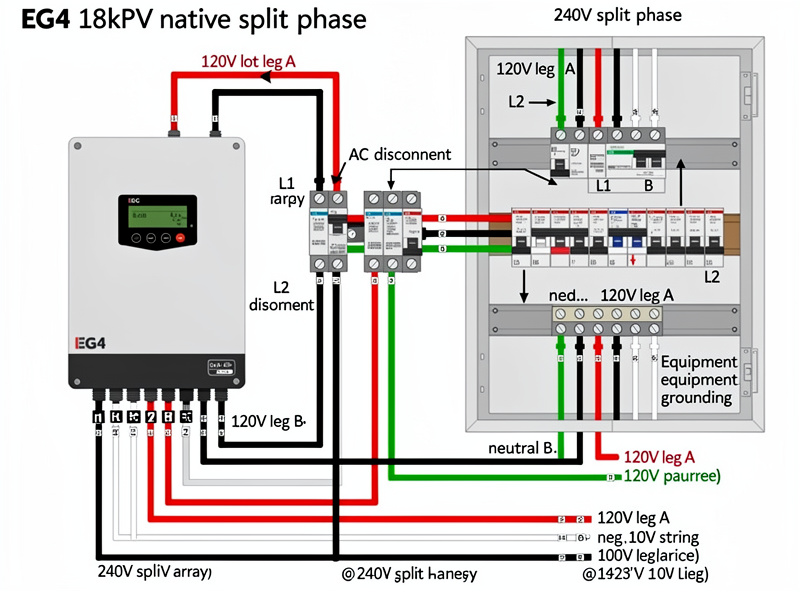
Split-phase inverters connect to your main electrical panel similar to grid power: Phase A and Phase B feed your 240V double-pole breakers, the inverter’s neutral connects to panel neutral bus, and grounding bonds to panel ground. Wire sizing follows NEC standards based on inverter output amperage — typically 2/0 AWG copper for 18kW EG4, 4/0 AWG for paralleled configurations.
For inverters serving as whole-home backup: install via interconnection at main panel with proper ATS (Automatic Transfer Switch) or ATS function built into the inverter (EG4 18kPV and Sol-Ark 15K both include this). For partial-home backup (critical loads only): install a sub-panel for backed-up circuits, with the inverter feeding the sub-panel only.
Commercial Three-Phase Considerations
For US commercial buildings (commercial three-phase service: 208V phase-to-phase, 120V phase-to-neutral, or 480V phase-to-phase, 277V phase-to-neutral), neither residential split-phase nor European single-phase inverters are appropriate. Commercial deployments require three-phase capable inverters: Schneider Conext XW Pro (3-unit configurations), Victron MultiPlus II (3-unit three-phase), or commercial-grade alternatives.
For makers running small businesses with three-phase service, choose Schneider or Victron three-phase configurations. The deployment is more complex than residential but mature inverter platforms handle it well. See our Schneider Conext review for commercial three-phase deployments.
Decision Framework
For US/Canadian residential whole-home backup: split-phase inverter mandatory. EG4 18kPV ($5,499) for 18kW, Sol-Ark 15K ($8,995) for 15kW with installer ecosystem, EG4 6500EX ($2,299) for 6.5kW budget split-phase.
For US/Canadian residential 120V-only loads (RV, off-grid cabin, partial-home backup): single-phase 120V inverter is fine and cheaper. Growatt SPF 5000 ($1,899), basic single-phase inverters at lower power.
For European/IEC markets: single-phase 230V inverter is standard. Most non-Sol-Ark/EG4 inverters are single-phase by default.
For US commercial three-phase: Schneider Conext XW Pro three-phase, Victron three-phase configurations, or commercial-grade inverters. See best hybrid inverter home solar 2026.
Frequently Asked Questions
What is the difference between split-phase and single-phase 240V?
Split-phase 240V (North American standard) provides two 120V legs that combine for 240V or operate independently for 120V loads. Single-phase 240V (European/IEC standard) provides one 240V leg only — cannot directly power North American 240V appliances which expect dual-leg split-phase configuration.
Can I run my US home on a single-phase inverter?
Only for 120V loads. Single-phase 240V inverters technically output 240V but on one leg-to-neutral basis — incompatible with North American 240V appliances that need dual-leg split-phase. For US whole-home backup, you need a native split-phase inverter (EG4 18kPV, Sol-Ark 15K) or single-phase + auto-former conversion.
Which inverters output split-phase natively?
EG4 18kPV ($5,499 — 18kW), Sol-Ark 15K ($8,995 — 15kW), Sol-Ark 12K ($6,995 — 12kW), EG4 6500EX ($2,299 — 6.5kW), and Growatt SPH 5000 ($2,499 — 5kW). All output 240V split-phase natively without auto-formers. For US whole-home backup, choose from this list.
What is an auto-former and do I need one?
An auto-former is a passive transformer that derives a center-tap neutral from single-phase 240V, converting it to split-phase configuration. Needed when using single-phase inverters (Victron MultiPlus II, Schneider) for US whole-home backup. Costs $350-2,500 depending on power. For native split-phase inverters (EG4, Sol-Ark), auto-former is not needed.
Can I parallel two single-phase inverters for split-phase?
Some inverters support stacked single-phase configurations that produce split-phase output. Two Victron MultiPlus II in stack-mode produce split-phase. This is essentially the auto-former approach using two inverters instead of one inverter plus auto-former. More expensive than native split-phase but provides redundancy.
Do European homes have split-phase or single-phase service?
European homes have single-phase 230V service, or in larger homes, three-phase 400V/230V service. The split-phase configuration common in North America is rare in Europe. European inverters are designed around single-phase 230V output, which works directly with European appliances but not US split-phase loads.
What if I want to convert my home to single-phase?
You can’t, practically. North American homes are wired for split-phase service from the utility transformer. Converting to single-phase would require utility-side transformer changes, panel rewiring, and replacing 240V appliances with European-spec 230V equivalents. The total cost would be tens of thousands of dollars for no benefit. Use split-phase inverters that match existing infrastructure.