Important Disclaimer
BatteryStorageHQ provides educational content and estimates only. We are not certified installers, financial advisors, or electricians. Always consult with licensed professionals.
For LiFePO4, the optimal depth of discharge is about 80–90% of nameplate capacity — deep enough to use the bank you paid for, shallow enough to roughly double cycle life versus running it flat. Leaving a 10–20% reserve at the bottom is the highest-return setting on the whole system, and it costs nothing.
Depth of discharge (DoD) is simply how much of a battery’s capacity you use before recharging: pull 80 Ah from a 100 Ah cell and that is 80% DoD. It is the inverse of the state of charge you stop at. This guide covers what DoD is optimal for each chemistry, why the curve is so steep at the extremes, and — the part most guides skip — exactly how to set your cutoff so the limit is enforced. It is part of the broader battery maintenance and troubleshooting cluster.
What Depth of Discharge Actually Controls
DoD controls two things at once: how much energy you get per cycle, and how many cycles you get before the pack fades. Those pull in opposite directions, which is why “optimal” is a balance rather than a maximum. Run shallow and each cycle delivers less but the bank lasts far longer; run deep and you wring out every amp-hour at the cost of lifespan. The sweet spot for LiFePO4 lands around 80–90% usable.
The reason LFP gets such a generous DoD recommendation compared to lead-acid is its flat discharge curve and tolerance of deep cycling. A lead-acid bank punished by 80% DoD daily would die in a year or two; an LFP bank shrugs it off for thousands of cycles. That difference is the whole reason lithium won home storage, and it is covered in LiFePO4 vs NMC for home storage.
The Cycle-Life vs DoD Relationship
The relationship between DoD and cycle life is not linear — it is a steep curve. A quality LFP cell rated for roughly 6,000 cycles at 80% DoD may deliver only 3,000–4,000 at 100%, but pull the DoD back further to 60% and the rated cycles climb dramatically again. The last slice of discharge is where the damage concentrates, because that is where cell voltage drops fastest and internal stress peaks.
The practical takeaway is that the first 20% of reserve you leave buys most of the longevity benefit, and going shallower than about 80% DoD gives diminishing returns for the capacity you sacrifice. That is why 80–90% is the recommendation rather than “as shallow as possible.” For the full chart and the chemistry behind it, see battery cycle life vs DOD; for the other longevity levers that stack with DoD, see extending LiFePO4 cycle life.
Usable vs Nameplate Capacity
This is where people overspend or undersize. If you cap DoD at 80%, a nameplate 14 kWh bank gives you about 11.2 kWh usable. You should size to the usable figure, not the nameplate — plan your daily loads against the 80%, and treat the reserve as untouchable except in a genuine emergency. The mistake is buying to nameplate and then routinely dipping into the reserve, which quietly erases the longevity you were paying for.
The reserve is not wasted, either. On a backup-capable system it is exactly the headroom that keeps the lights on when an outage runs long, so the longevity habit and the resilience habit are the same habit. Size the bank so your normal daily draw sits comfortably inside the usable window and shallow cycling happens automatically without you thinking about it.
How to Actually Set Your Cutoff
This is the part that matters and the part most guides hand-wave. There are two places a DoD limit gets enforced, and they do different jobs. The inverter’s low-voltage cutoff (or SoC cutoff, if it reads a shunt) is your working limit — it is what stops normal discharge at your chosen reserve. The BMS low-voltage cutoff is the hard safety backstop, set lower, that should only ever fire if the inverter limit fails.
On my bank I set the inverter to stop discharge with about 10–20% left, using a state-of-charge cutoff driven by a shunt rather than raw voltage, because LFP’s flat curve makes voltage a poor fuel gauge in the middle of the range. The BMS under-voltage protection sits below that as the last line of defense. Never rely on the BMS cutoff as your daily limit — it is protection, not a setting you use on purpose. Getting the shunt-based SoC right is covered in the SmartShunt monitor guide and the wider battery monitoring guide.
Optimal DoD by Chemistry
Depth-of-discharge recommendations vary enormously by chemistry, which is why a single number is misleading. The table below compares the practical, longevity-respecting DoD for the common home-storage chemistries. The lead-acid figure is the one that surprises people coming from an RV or marine background — those cells genuinely do not like being emptied.
| Chemistry | Recommended Usable DoD | Why |
|---|---|---|
| LiFePO4 (LFP) | 80–90% | Flat curve, tolerates deep cycling, thousands of cycles |
| NMC lithium | 80–90% (cycle), avoid 100% storage | High energy density, more sensitive at the top |
| AGM lead-acid | ~50% | Cycle life collapses with deep discharge |
| Flooded lead-acid | ~50% | Sulfation accelerates below ~50% SoC |
Backup Bank vs Daily-Cycle Bank
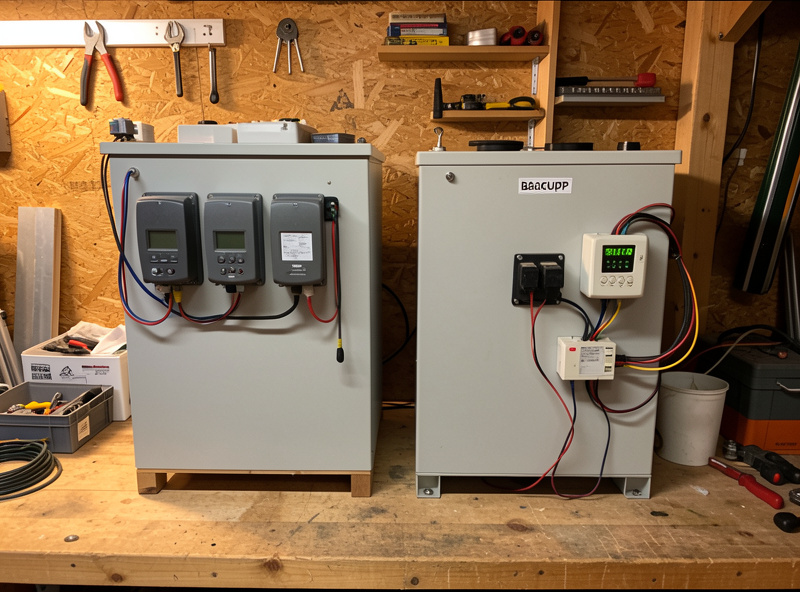
Your DoD strategy should follow how the bank is used. A daily-cycling solar bank benefits from a consistent shallow cycle — charge from the array, discharge to your reserve overnight, repeat. A backup bank that mostly sits is a different problem: there, the bigger threat is calendar aging from sitting full, so you want a resting state of charge in the 60–80% range rather than 100%, with the full capacity reserved for an actual outage.
Either way, the principle holds: do not routinely touch the bottom 10–20%, and do not park at the very top. That single discipline does more for pack longevity than any premium cell upgrade. When a bank is sized and cut off correctly, it also stays in balance more easily and gives cleaner results on a yearly capacity test — the maintenance habits all reinforce each other. On my own daily-cycle bank I park the inverter cutoff at about 15% and have watched the yearly capacity test barely move across three years of that routine – the shallow-cycle discipline shows up directly in the Home Assistant logs.
Frequently Asked Questions
What is the best depth of discharge for a LiFePO4 battery?
About 80-90% of nameplate capacity. That uses most of the bank you paid for while roughly doubling cycle life versus running it to 100% every time. Leaving a 10-20% reserve at the bottom captures most of the longevity benefit, and going shallower gives diminishing returns.
Can you discharge a LiFePO4 battery to 100%?
You can without damaging it the way deep-discharging lead-acid does, but you will shorten cycle life. LFP rated for 6,000 cycles at 80% DoD may deliver only 3,000-4,000 at 100%. For occasional emergencies it is fine; as a daily habit it noticeably ages the pack.
What depth of discharge should I use for lead-acid?
Around 50% for both AGM and flooded lead-acid. Their cycle life collapses with deep discharge and flooded cells sulfate below roughly 50% state of charge. This is far shallower than LiFePO4 and is one of the main reasons lithium replaced lead-acid for home storage.
Should I set the depth-of-discharge limit on the inverter or the BMS?
Set your working limit on the inverter, using a shunt-based state-of-charge cutoff so normal discharge stops with about 10-20% left. Keep the BMS under-voltage cutoff lower as a hard safety backstop. The BMS cutoff is protection, not a setting you should hit on purpose every day.
Does leaving a battery reserve waste capacity?
No. On a backup-capable system the reserve is exactly the headroom that keeps critical loads running when an outage runs long, so the longevity habit and the resilience habit are identical. Size the bank to its usable capacity, around 80% of nameplate, rather than to the nameplate figure.
Why is voltage a poor way to set depth of discharge on LiFePO4?
LiFePO4 has a very flat discharge curve, so cell voltage barely changes across most of the usable range and only drops sharply near empty. That makes voltage an unreliable fuel gauge in the middle. A shunt that counts amp-hours in and out gives a far more accurate state of charge for setting your cutoff.