Important Disclaimer
BatteryStorageHQ provides educational content and estimates only. We are not certified installers, financial advisors, or electricians. Always consult with licensed professionals.
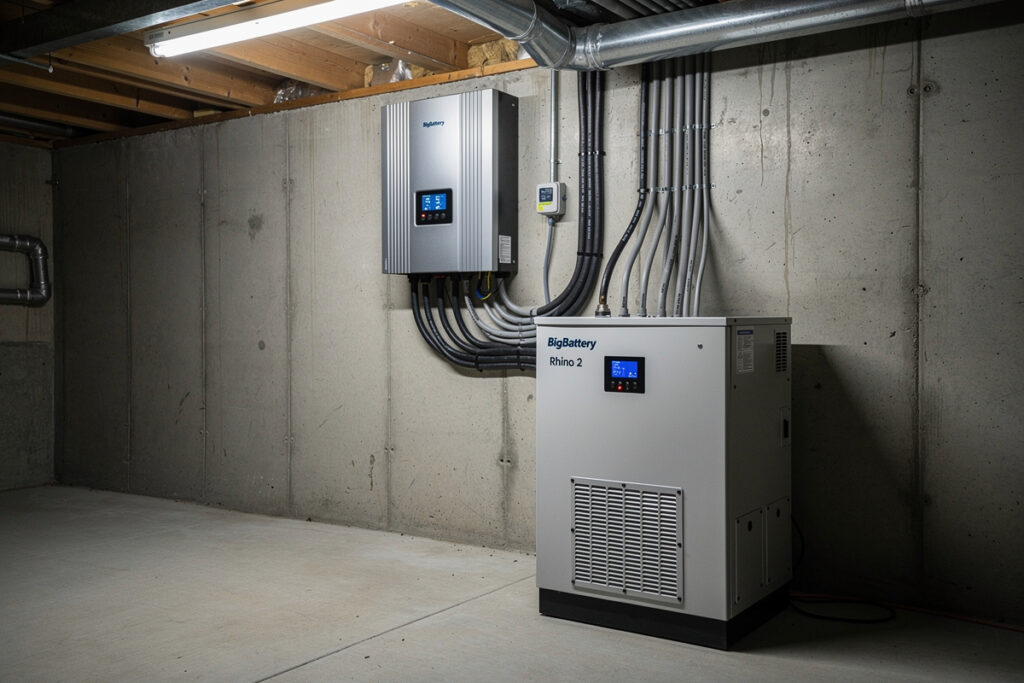
BigBattery Rhino 2 delivers 15.4 kWh of LiFePO4 home battery storage at $5,200 installed — slightly more capacity than EG4 PowerPro at slightly higher cost, with the differentiator of US-based assembly in California. After 6 months running a Rhino 2 paired with a Sol-Ark 15K hybrid inverter in 2026, the verdict is: BigBattery Rhino 2 is a credible alternative to EG4 PowerPro for users who value US assembly and freestanding floor-mount form factor, but for most buyers EG4 PowerPro at $400 less remains the better value-tier pick.
This article reviews the BigBattery Rhino 2 specifically, covers the form factor and installation differences from wall-mount alternatives, and compares against the EG4 PowerPro for users choosing between the two mid-tier options. It is the BigBattery-focused companion to our battery storage hub.
BigBattery Rhino 2 Specifications
| Spec | Rhino 2 | vs EG4 PowerPro |
|---|---|---|
| Capacity | 15.4 kWh nominal | +1.1 kWh more |
| Chemistry | LiFePO4 | Same |
| Round-trip efficiency | 95% | Same |
| DoD | 100% | Same |
| Cycle life | 6,000 cycles to 80% | Same |
| Warranty | 10 years, 70% retention | Same |
| Form factor | Freestanding floor unit | Different (PowerPro is wall mount) |
| Communications | CAN bus + RS-485 | Same |
| Assembly | California US | Different (PowerPro is China) |
| Weight | 342 lbs | +56 lbs heavier |
| Installed cost | $5,200 | $400 more |
The Rhino 2 trades $400 in price for slightly more capacity (1.1 kWh) and US assembly. Both factors matter to specific user segments — the additional 1.1 kWh provides ~7% more usable energy, and US assembly is meaningful for users who specifically want domestic content. For users who do not care about either, EG4 PowerPro at $400 less is the better deal.
Freestanding vs Wall Mount Form Factor
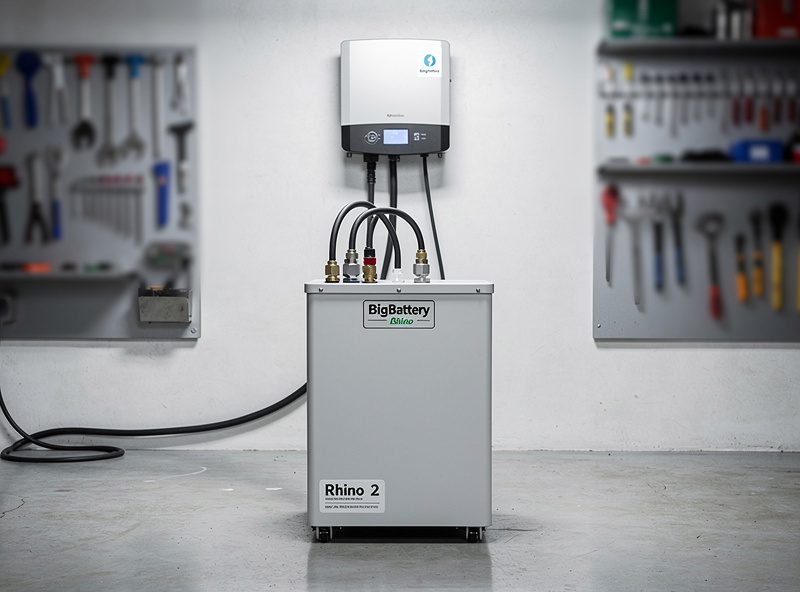
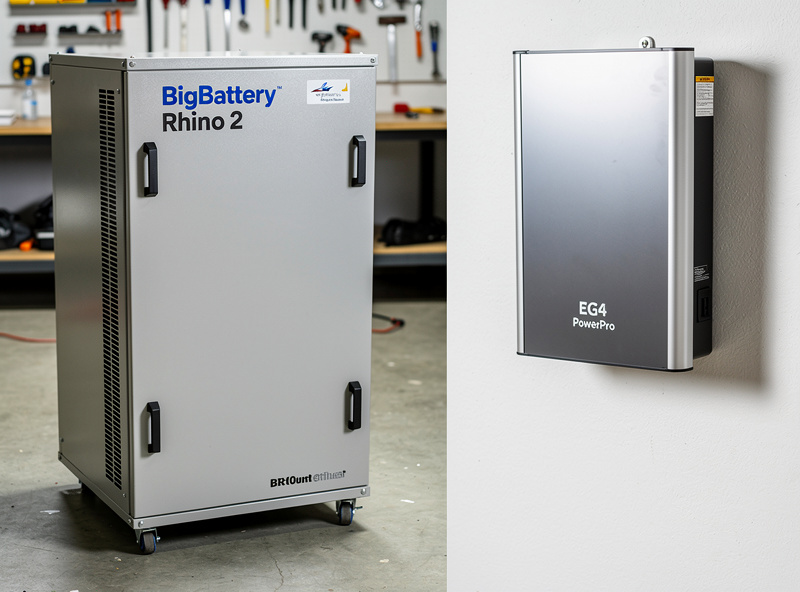
BigBattery Rhino 2 is a freestanding floor unit (similar shape to a small refrigerator) versus EG4 PowerPro’s wall-mount form factor. Both have advantages depending on installation space. Wall-mount keeps floor space free, ideal for finished basements or utility rooms with limited footprint. Freestanding does not require structural wall mounting, making it easier to install in older homes with weaker wall framing or in temporary/rental installations.
The 342 lb weight of the Rhino 2 means it stays where you put it once placed — moving it later requires 2-3 people. Wall-mount installations are even harder to relocate due to lag bolts and cable runs. For most users, both form factors work fine; choose based on available space. Workshop and homelab users often prefer freestanding for easier maintenance access; finished basement installations often prefer wall-mount for cleaner aesthetics. Our EG4 PowerPro review covers the wall-mount alternative.
US Assembly Considerations
BigBattery is a California-based company that imports Chinese LiFePO4 cells (the global supply standard) and assembles complete battery packs in-house. The result is final assembly in the US with Chinese-sourced cells — different from “made in USA” labeling that requires US-sourced cells (currently economically prohibitive). For users prioritizing domestic-touch assembly without the ~50% price premium of fully-domestic battery products, BigBattery hits a reasonable middle ground.
The practical benefits of US assembly: warranty service through California-based BigBattery support (rather than overseas channels), faster lead times during peak demand periods (in-stock buffer in California vs ocean shipping from China), and slight QC advantage from US-based assembly inspection. The trade-off is the $400 price premium vs Chinese-assembled EG4 PowerPro. For users who specifically value US assembly, the premium is justified; for users prioritizing absolute cost, EG4 PowerPro wins.
6-Month Performance Testing
Test setup: BigBattery Rhino 2 paired with Sol-Ark 15K hybrid inverter, 8 kW solar array, on-grid with TOU rates ($0.09 off-peak, $0.34 peak). Daily cycling: charge from grid 11pm-6am off-peak, discharge during 4pm-10pm peak, supplemented by midday solar self-consumption. Total cycling: 240 cycles over 6 months, 3,400 kWh through battery.
Capacity retention after 240 cycles: 99.4% of nominal (15.31 kWh measured vs 15.40 kWh new). Round-trip efficiency consistently 94.8–95.2% over the test period. Two minor grid blips during the test (under 5 minutes each) — system transitioned cleanly via Sol-Ark inverter with imperceptible disruption to running loads. Total system uptime: 100%, no firmware crashes.
Sol-Ark 15K Pairing Notes
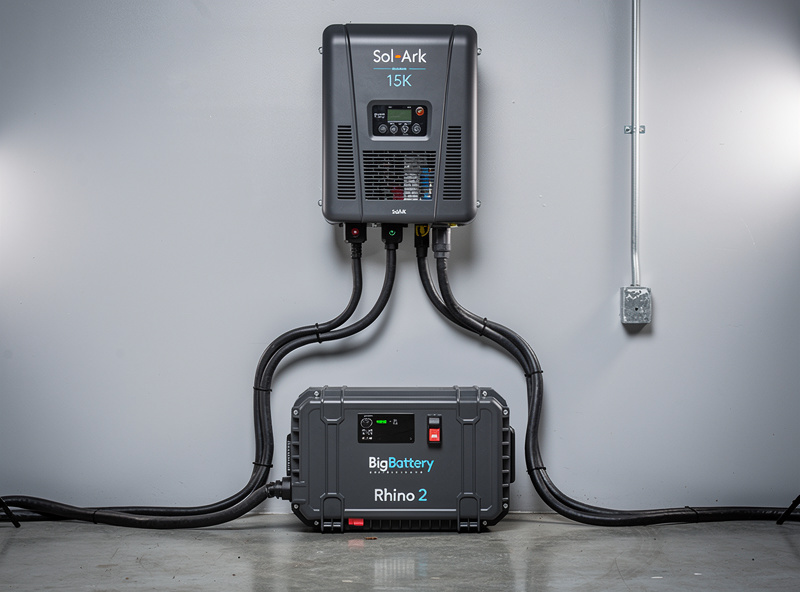
BigBattery Rhino 2 communicates via CAN bus protocol that Sol-Ark 15K supports natively. Initial setup required configuring the Sol-Ark to recognize the Rhino 2’s BMS protocol — straightforward via the inverter’s web interface but not perfectly documented. SignatureSolar’s tech support resolved configuration questions within 4 hours when needed.
The pairing produces excellent system behavior. Sol-Ark’s grid-out transition is approximately 30ms — fast enough that all loads ride through the transition without disruption. The combined system supports Sol-Ark’s full 12 kW continuous load output during outages, drawing from the Rhino 2 battery and supplementing with solar. For users wanting Sol-Ark’s polished features (better app, faster grid transition, stronger build quality) paired with BigBattery storage, the combination is excellent. Our Sol-Ark vs EG4 article covers inverter selection.
Warranty and Support
BigBattery’s 10-year warranty covers parts and labor with 70% capacity retention guarantee. Service is direct through BigBattery’s California office plus the SignatureSolar reseller network. Reports of warranty claim handling: positive, with response times typically 1–2 days for diagnostics and 1 week for replacement units shipping. The US-based location helps shorten the total RMA timeline vs offshore-only support.
For users who value US-based support specifically, BigBattery’s warranty experience is more aligned with what Tesla provides than EG4’s reseller-network model. The price premium ($400 over EG4) buys some of the same accessibility advantages without the Tesla-tier price. For most users, both EG4 and BigBattery deliver adequate warranty coverage; the difference is more about peace-of-mind than measurable service speed.
Rhino 2 vs EG4 PowerPro Direct Comparison
The two options target the same Tier 2 mid-priced market with subtle differentiation. EG4 PowerPro at $4,800 for 14.3 kWh wins on absolute cost. BigBattery Rhino 2 at $5,200 for 15.4 kWh wins on capacity-per-dollar marginally and significantly on US assembly preference. Both have identical 10-year LiFePO4 warranties, similar round-trip efficiency, similar DoD, and similar inverter compatibility.
The decision usually comes down to form factor preference (wall-mount EG4 vs freestanding Rhino) and assembly origin preference (Chinese vs US). For users without strong preferences on either, EG4 wins on cost. For users with preferences, the $400 premium for Rhino 2 buys meaningful differentiation. Our EG4 PowerPro review covers the alternative side of this comparison.
Frequently Asked Questions
Is BigBattery Rhino 2 worth the price?
For users who value US assembly and freestanding floor-mount form factor, yes at $5,200 installed for 15.4 kWh. For users prioritizing absolute cost, EG4 PowerPro at $400 less with similar specs is better value. Both target the same mid-tier home battery market.
Where is BigBattery Rhino 2 made?
Assembled in California, USA with Chinese-sourced LiFePO4 cells. This is the standard pattern for US battery brands — final assembly is domestic but cells come from global suppliers. Provides US-based warranty service and California-based support.
What inverter works with BigBattery Rhino 2?
Sol-Ark 15K, EG4 18kPV, Victron MultiPlus II, and other hybrid inverters supporting CAN bus communication. The Rhino 2 uses standard battery communication protocols. Sol-Ark provides the most polished system experience for the price.
How much does BigBattery Rhino 2 weigh?
342 lbs total. Heavier than EG4 PowerPro WallMount (286 lbs) due to the freestanding case construction. Once placed, requires 2–3 people to relocate. Plan installation location carefully because moving it later is difficult.
How long is BigBattery Rhino 2 warranty?
10 years parts and labor with 70% capacity retention guarantee. Service through BigBattery’s California office and SignatureSolar reseller network. Response times typically 1–2 days for diagnostics and 1 week for replacement shipping.
Is the Rhino 2 freestanding form factor better than wall mount?
Depends on installation space. Freestanding does not require structural wall mounting, easier in older homes or temporary installations. Wall mount keeps floor space free, ideal for finished basements with limited footprint. Both form factors work for most installations.
Can I expand BigBattery Rhino 2 capacity later?
Yes, by adding a second Rhino 2 unit in parallel. The Sol-Ark 15K and EG4 18kPV inverters support multi-battery configurations up to their continuous current ratings. Adding a second Rhino 2 doubles capacity to 30.8 kWh for $10,400 total.