Important Disclaimer
BatteryStorageHQ provides educational content and estimates only. We are not certified installers, financial advisors, or electricians. Always consult with licensed professionals.
A cold plunge chiller rated at 300 watts of cooling capacity draws roughly 500 watts from an inverter once you account for compressor startup surge,.
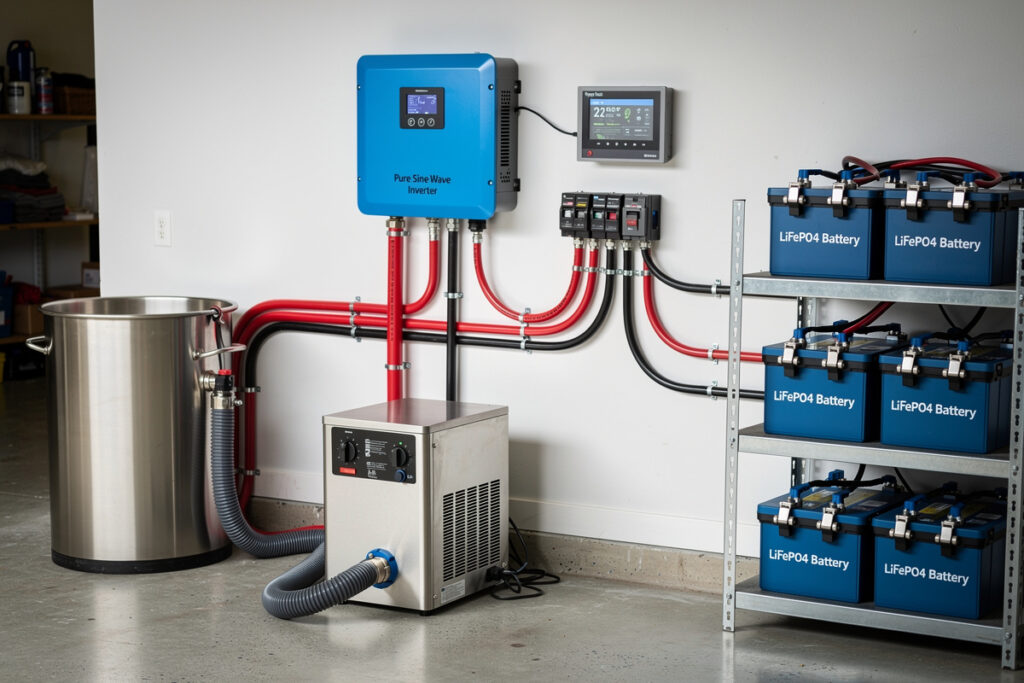
In my setup, the 2000W pure-sine inverter that powers the cold plunge chiller shares a 48V LiFePO4 bank with the workshop tools — sizing the surge capacity for a chiller compressor is the same math as sizing for a table saw motor. The Off-Grid Wellness Battery Sizing covers the foundational networking setup this article depends on. pump load, and inverter efficiency losses. That 500-watt draw sustained for 14 hours to cool a 100-liter tub from tap temperature to 10 degrees Celsius totals 7 kilowatt-hours — a third of a typical LiFePO4 battery bank’s usable capacity. Running the same chiller on a 200-watt inverter trips the surge-protection circuit on compressor startup and the chiller never reaches operating temperature. Inverter sizing for cold-plunge chillers is not a “bigger is better” decision. It is a surge-capacity math problem, and getting it wrong means your tub is warm when you want it cold.
The reason most inverter-sizing guides fail the cold-plunge use case is that they treat chillers as resistive loads — a heating element with a constant power draw. But a chiller is a motor load: it has a compressor that draws 2 to 3 times its running wattage for the first 200 to 500 milliseconds of startup while the rotor accelerates and the refrigerant pressure equalizes. A resistive load draws its rated wattage from the moment it turns on. A motor load draws 500 to 900 watts for half a second before settling to 300 watts. The inverter’s surge rating — usually listed as “peak power” and sustained for somewhere between 100 milliseconds and 5 seconds depending on the manufacturer — determines whether the chiller starts or stalls. The running wattage determines whether the inverter can sustain it for hours. Both numbers matter. Most buyers check only the running wattage and wonder why the chiller never starts.
The Surge Capacity Math: Why Your Inverter Needs 2x to 3x Headroom
A compressor motor’s locked-rotor amperage — the current it draws at the instant of startup before the rotor begins turning — is typically 2 to 3 times the full-load amperage printed on the nameplate. A chiller rated at 2.5 amps running current at 120 volts — 300 watts — draws 5 to 7.5 amps for the first half-second of startup, or 600 to 900 watts. An inverter rated for 500 watts continuous and 1,000 watts surge handles this with margin because the surge duration is well within the inverter’s peak-rating window. An inverter rated for 300 watts continuous and 450 watts surge fails on startup because the surge demand exceeds the surge rating, the inverter’s protection circuit disconnects the load, and the chiller never reaches running speed.
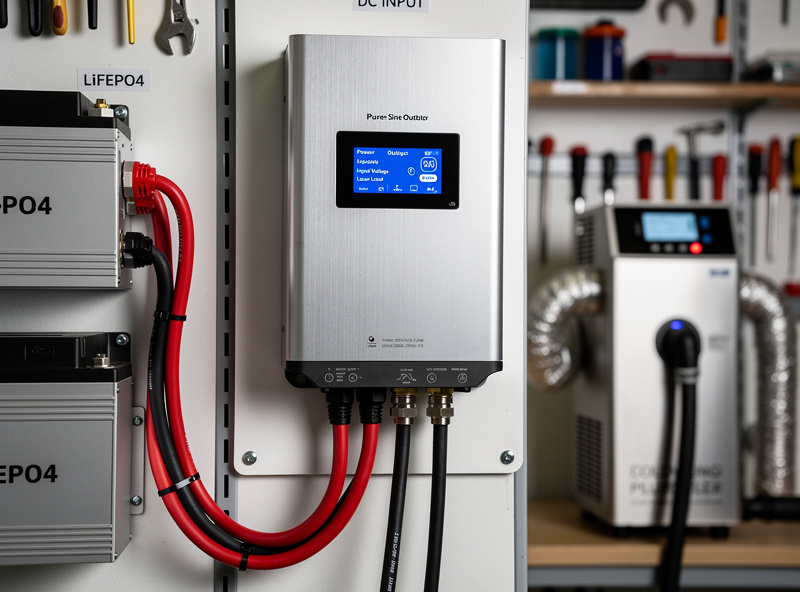
The practical rule: take the chiller’s nameplate running wattage, multiply by 3, and buy an inverter with a continuous rating at or above that number. A 300-watt chiller needs a 900-watt continuous inverter if the manufacturer’s surge rating is unclear or suspiciously short — many budget inverters quote surge ratings at 100 milliseconds, which is shorter than a compressor’s startup duration. A 500-watt continuous inverter with a 1,500-watt surge rating from a reputable manufacturer (Victron, Samlex, Giandel) handles the 300-watt chiller with comfortable margin and runs at roughly 60 percent of its continuous rating during steady-state operation, which is the efficiency sweet spot for most pure-sine-wave inverters.
Pure Sine Wave vs Modified Sine Wave for Chiller Motors
Compressor motors run on pure-sine-wave inverters and overheat on modified-sine-wave inverters. A modified sine wave — which is actually a stepped square wave — contains harmonic distortion that the motor windings see as excess heat. The motor runs, but it runs 10 to 15 degrees Celsius hotter than it would on a pure sine wave, and that excess heat accumulates over the 14-hour cooldown period until the thermal overload protection in the compressor trips. The chiller shuts off, the tub warms up, and the inverter’s lower purchase price is recouped in spoiled cold-plunge sessions.
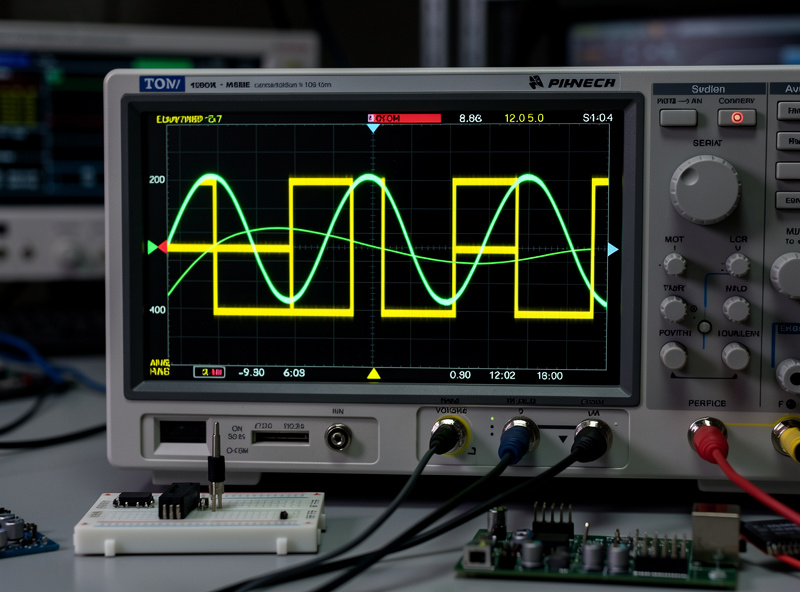
Pure-sine-wave inverters cost roughly 50 percent more than their modified-sine-wave equivalents at the same wattage rating, and every dollar of that premium goes to the output waveform that the compressor motor was designed to run on. Modified-sine-wave inverters are appropriate for resistive loads — heaters, incandescent lights, simple power supplies — and inappropriate for any motor that runs for more than a few minutes at a time. A cold-plunge chiller runs for 10 to 14 hours continuously during the initial cooldown and cycles for 20 minutes every hour during steady-state temperature maintenance. That is thousands of hours of motor runtime per year. The inverter must deliver a clean sine wave for every one of those hours. The full breakdown of how inverter sizing intersects with battery-bank capacity — including capacity planning for the overnight runtime that cold-plunge chillers demand — is covered in the cold plunge cooling guide, which covers the thermal physics side of the same system.
Battery Bank Sizing for Overnight Chiller Operation
A 300-watt chiller drawing 500 watts from the inverter — accounting for inverter efficiency of roughly 90 percent and the circulation pump’s additional 50-watt draw — consumes 7 kilowatt-hours over a 14-hour initial cooldown from tap temperature. A LiFePO4 battery bank rated at 5 kilowatt-hours with 80 percent depth of discharge provides 4 kilowatt-hours of usable capacity. That covers roughly 8 hours of chiller runtime — enough for a maintenance cycle but not enough for the initial cooldown. The initial cooldown needs either a larger battery bank, grid passthrough from a hybrid inverter, or pre-chilled water that reduces the chiller’s runtime from 14 hours to 2 hours of temperature maintenance.
The smart approach: pre-chill the tub with bagged ice or frozen water bottles to bring the water temperature from 22 degrees Celsius to 15 degrees — a 7-degree drop that takes the chiller roughly 4 hours at full cooling capacity instead of 14 hours starting from tap temperature. The battery bank then covers 4 hours of cooldown plus 2 hours of overnight temperature maintenance — 3 kilowatt-hours total, well within a 5-kilowatt-hour bank’s usable capacity. Pre-chilling cuts the battery requirement by roughly 60 percent, and a $10 bag of ice is cheaper than another $800 battery module. The same load-sizing logic that matches battery capacity to daily usage applies to every load on the bank — the battery sizing calculation guide walks through the step-by-step math for matching battery capacity to real-world loads across the whole system.
Installing the Inverter for Cold Plunge Duty
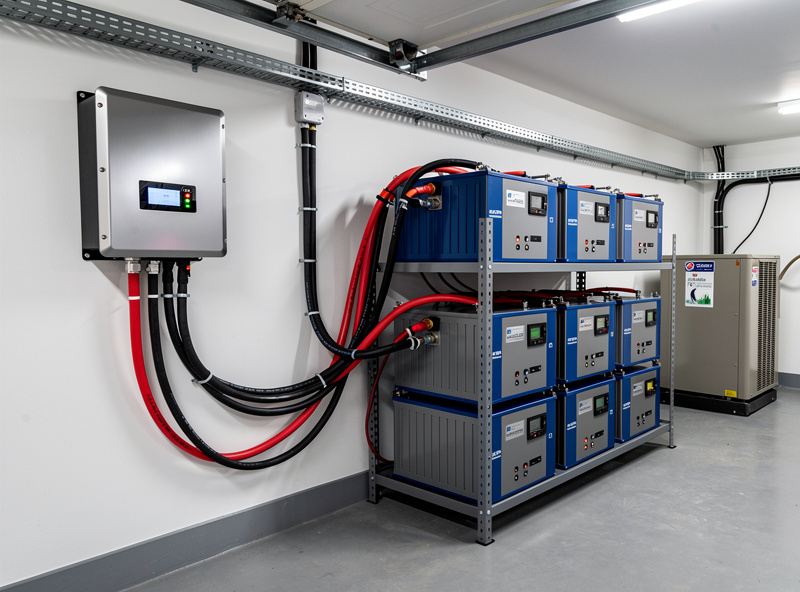
The inverter lives in the same room as the battery bank, not in the wet room with the cold plunge. DC cables from the battery to the inverter carry high current at low voltage — a 500-watt load at 12 volts draws 42 amps — and the cable run must be as short as possible to keep voltage drop below 3 percent. A 1-meter 6 AWG cable run between the battery and the inverter at 42 amps drops roughly 0.04 volts. A 5-meter run of the same cable at the same current drops 0.2 volts, which at 12 volts is a 1.7 percent voltage drop — still acceptable but approaching the threshold where the inverter’s low-voltage cutoff triggers prematurely during surge events. The battery bank and inverter should be within 2 meters of each other, with the AC output from the inverter running to the chiller through a GFCI-protected outlet in the wet room.
The AC run from the inverter to the chiller can be any length — AC voltage drop at 120 volts and 4 amps is negligible across normal residential distances — and the cable should be outdoor-rated SOOW or SJOW cord if it passes through an unconditioned space. The GFCI protection at the chiller outlet is mandatory because the chiller is a water-adjacent appliance, and the ground fault that trips the GFCI is more likely to be condensation inside the chiller’s electrical compartment than a wiring fault. The GFCI trips, the chiller stops, the tub warms, and you know to check the chiller’s enclosure seals before the next session. Better a tripped GFCI than a shock from the water.
Frequently Asked Questions
What size inverter do I need for a cold plunge chiller?
Size the inverter to 3 times the chiller’s running wattage to cover compressor startup surge. A 300-watt chiller needs a 900-watt continuous inverter or a 500-watt continuous inverter with a 1,500-watt surge rating from a reputable manufacturer. Always use pure sine wave — modified sine wave overheats compressor motors during sustained operation.
How many kilowatt-hours does a cold plunge chiller use per day?
A 300-watt chiller draws roughly 500 watts from the inverter including pump load and efficiency losses. The initial cooldown from tap temperature uses 7 kilowatt-hours over 14 hours. Steady-state temperature maintenance uses 1 to 2 kilowatt-hours per day cycling 20 minutes per hour. Pre-chill the tub with ice to cut initial cooldown energy by 60 percent.
Can I run a chiller directly from DC without an inverter?
Not with a standard AC chiller. Most aquarium and cold-plunge chillers run on 120V or 240V AC because the compressor motor is designed for mains voltage. Running a 120V AC chiller from a 12V or 48V DC-to-DC converter requires a specialized DC compressor that most hobbyist-grade chillers do not have. Use a pure-sine-wave inverter between the battery bank and the chiller.
Will a 500-watt inverter run a 500-watt chiller?
No. The chiller’s 500-watt nameplate rating is its running wattage, not its startup wattage. The compressor draws 1,000 to 1,500 watts for the first half-second of startup and 500 watts continuously once running. A 500-watt continuous inverter will trip its protection circuit on startup. The inverter’s continuous rating must include headroom for the surge load.
How long will a 5 kWh LiFePO4 battery run a cold plunge chiller?
With 4 kilowatt-hours usable at 80 percent depth of discharge, a 5 kilowatt-hour battery runs a chiller with a 500-watt total draw for approximately 8 hours. That covers steady-state maintenance for 3 to 4 days or an initial cooldown with pre-chilled water. It does not cover a full 14-hour cooldown from tap temperature.
Do I need a GFCI on the inverter output for a cold plunge chiller?
Yes. The chiller is a water-adjacent appliance, and condensation inside the electrical compartment can create a ground fault path through the water. A GFCI-protected outlet on the inverter’s AC output is mandatory for safety. The inverter must be bonded to the grounding system — a floating-ground inverter will not trip a GFCI and provides no shock protection.