Important Disclaimer
BatteryStorageHQ provides educational content and estimates only. We are not certified installers, financial advisors, or electricians. Always consult with licensed professionals.
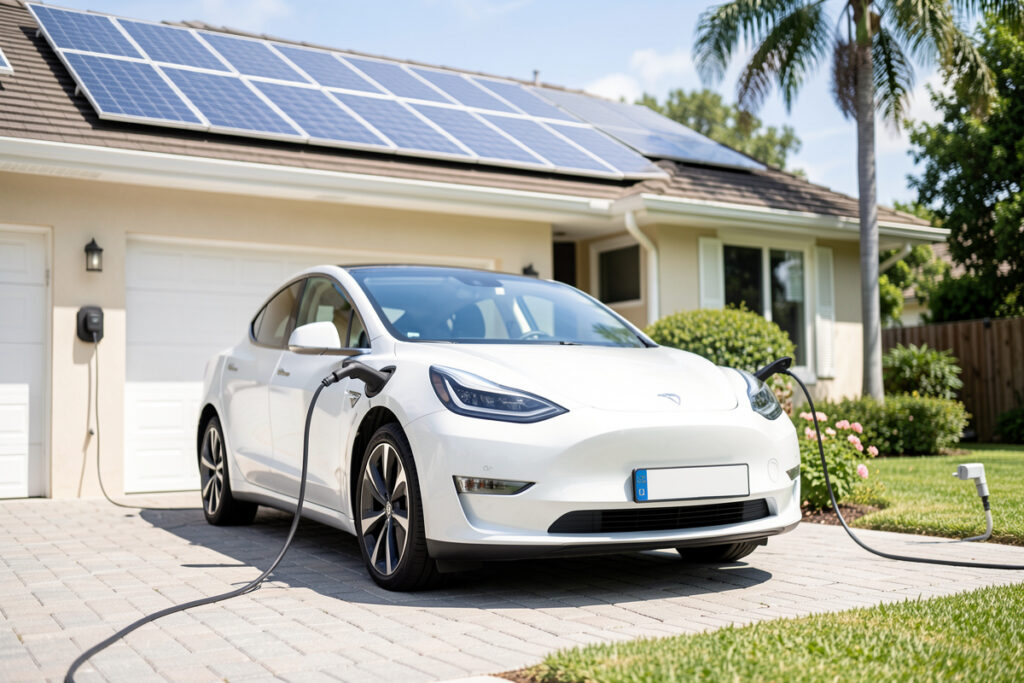
Charging an EV from solar and batteries works, but only if you frame it correctly: it’s a solar self-consumption strategy, not a backup one. A Level 2 charger pulls around 7,200–11,500 W continuously for hours, which empties a typical 10 kWh home battery in roughly an hour. The sensible approach is to charge the car directly from live solar while the sun is up, and use the battery only to shift a modest amount of that energy into the evening — never to fast-charge a car off stored power.
I run a 16S LFP bank and a south-facing array monitored through Home Assistant, and the EV question is the one where people most often confuse kilowatts with kilowatt-hours. This guide untangles that — how much solar an EV really needs, when the battery genuinely helps, and the round-trip losses that make “charge the car from my wall battery” a worse idea than it sounds. For where this load sits among everything else, see the hub on what a battery system can power.
Kilowatts vs Kilowatt-Hours: The Mistake Everyone Makes
An EV charger’s headline number is power — 7.2 kW, 11 kW — but what fills your battery is energy, measured in kilowatt-hours. A car needs roughly 0.25–0.30 kWh per mile, so a 40-mile daily commute is about 10–12 kWh of energy regardless of how fast you push it in. The U.S. DOE Alternative Fuels Data Center lays out the home-charging levels behind those numbers. That’s the number that matters, and it’s why a home battery’s capacity, not its inverter rating, decides how much driving you can cover from storage.
Here’s the trap: a 10 kWh wall battery holds roughly one day’s commute of energy. Dump it into the car through a 7 kW charger and it’s gone in an hour and now your house has no backup. That’s why battery-to-car charging only makes sense for shifting a little solar into the evening, not for replacing grid or daytime solar charging.
Charge From the Sun, Not From the Battery
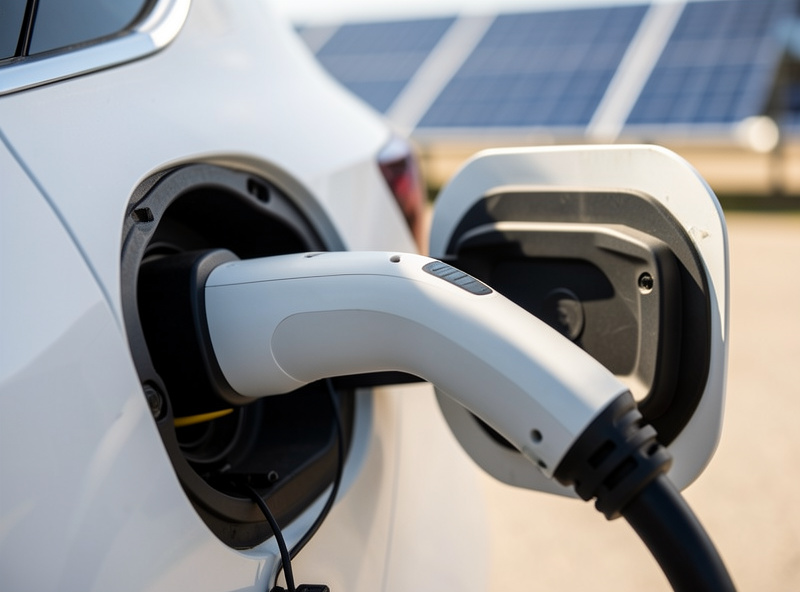
The efficient path is direct: solar panels to charge controller to car, while the sun is shining. Every time you instead route energy through the home battery you pay a round-trip tax — charging the battery and then discharging it loses roughly 10–15% to conversion and the battery’s own efficiency. Send 12 kWh into the bank and you might get 10 kWh back out to the car. The first time I tried topping the car off the bank overnight, my Home Assistant logs showed I had drained most of the house battery for barely a third of a charge — and handed roughly 12% of it to the round trip on the way. My Victron SmartSolar MPPT now sends midday production straight to the car instead, and the bank keeps what the house actually needs. Charging the car directly from midday solar skips that loss entirely.
So the order of preference is simple: charge the car directly from solar during peak production hours, use any surplus to top the home battery, and only tap the battery for the car if you specifically need to shift a small amount of charging into the evening. This is exactly the logic behind sizing solar to an EV in solar system size for EV charging and the broader home EV charging integration guide.
The Charging Levels and What Each Needs
How you charge changes everything about whether solar can keep up. The table shows the practical picture.
| Method | Power | Miles added per hour | Solar/battery fit |
|---|---|---|---|
| Level 1 (120 V) | 1,200–1,400 W | 3–5 mi | Easy — matches solar, gentle on the bank |
| Level 2 (240 V, 32 A) | ~7,700 W | 25–30 mi | Needs a big array or daytime charging |
| Level 2 (240 V, 48 A) | ~11,500 W | 35–40 mi | Exceeds most home solar output |
| DC fast charging | 50,000 W+ | hundreds | Not a home solar/battery scenario |
The quiet hero here is Level 1. A slow 120 V charge of 1.2–1.4 kW roughly matches what a modest array produces and barely touches the battery, so for low daily mileage it’s often the most solar-friendly option. Many adjustable Level 2 chargers can also be dialled down to track available solar, which is the smarter move than charging flat-out and draining the bank.
When the Battery Genuinely Helps
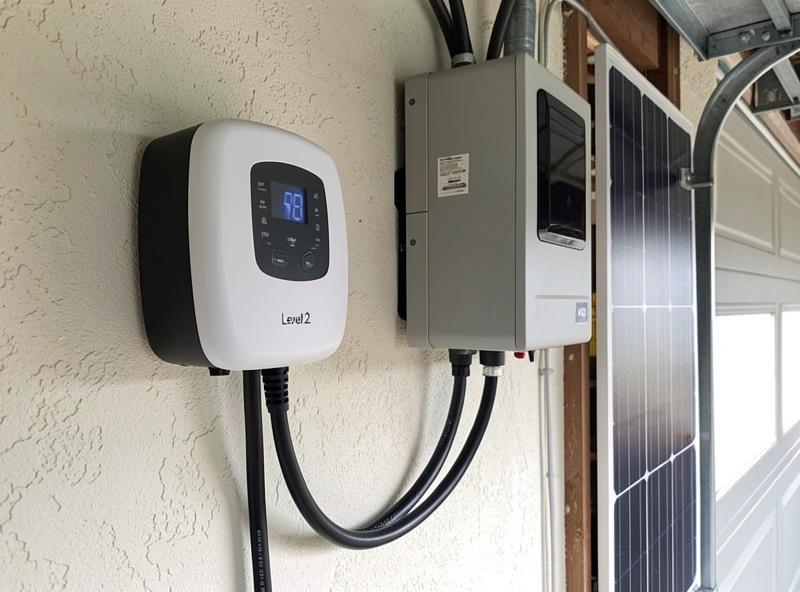
There are real cases for routing some EV charging through the home battery. If your solar peaks midday but you only get home in the evening, the bank lets you bank that midday sun and trickle it to the car after dark — accepting the round-trip loss as the price of using your own production instead of grid power. Time-of-use tariffs can also make it worth charging the bank cheaply off-peak and feeding the car later, though that’s a jurisdiction-specific economics question I won’t pretend is universal. What the battery should not do is try to be a fast charger; its job is energy shifting, not power delivery.
Inverter, Wiring, and Hardware
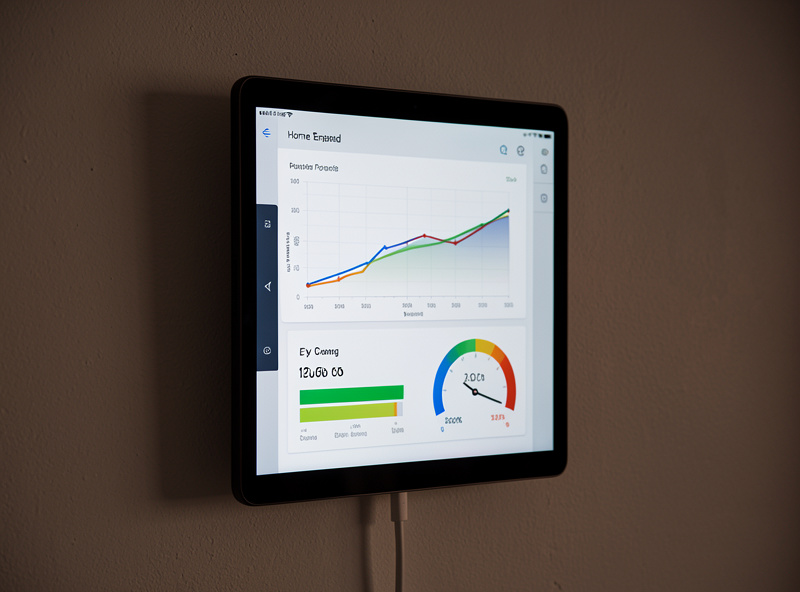
A dedicated Level 2 charger is a continuous, sustained load, so the inverter has to carry its full power for hours without derating — read the continuous rating at a realistic temperature, not the surge. For 240 V charging in a US home you need the right topology, which is the whole point of split-phase vs single-phase inverters. And an adjustable charger that can throttle to match solar is worth more than raw speed; a smart adjustable Level 2 charger lets you cap the draw to what your array and bank can actually spare. As an Amazon Associate I earn from qualifying purchases. If you want to choose the inverter around this load, the best hybrid inverter guide covers it.
How I’d Approach It
For most homes the right answer is: charge directly from solar during the day whenever possible, set the charger to track surplus rather than charge flat-out, keep the home battery for the house and only shift a little EV charging into the evening, and accept that covering a long commute purely from storage needs a much larger array and bank than people expect. Size the solar to the car’s daily kWh, not its charger’s kilowatts, using the EV solar sizing method and the foundational battery sizing guide.
Frequently Asked Questions
Can I charge my EV from a home battery?
You can, but it is best for shifting a small amount of solar into the evening, not for fast charging. A Level 2 charger pulls 7,200 to 11,500 W and empties a 10 kWh home battery in about an hour. Charging the car directly from live solar during the day is far more efficient.
How much solar do I need to charge an EV?
Size it to the car’s energy use, not the charger’s power. An EV uses about 0.25 to 0.30 kWh per mile, so a 40-mile daily commute needs roughly 10 to 12 kWh per day. Covering that from solar typically takes a sizeable array, especially in winter when production collapses.
Is it better to charge the EV directly from solar or through the battery?
Directly from solar, whenever possible. Routing energy through the home battery costs a round-trip loss of roughly 10 to 15 percent to conversion. Charging the car straight from midday solar skips that loss; use the battery only to shift charging into hours when the sun is down.
Will a Level 1 charger work with solar and battery?
Often very well. Level 1 at 120 V draws only 1,200 to 1,400 W, which roughly matches a modest array’s output and barely touches the battery. For low daily mileage it is frequently the most solar-friendly way to charge, adding around 3 to 5 miles per hour.
Can I charge my EV during a power outage from my battery?
It is rarely worth it. A single car charge can consume a full home battery, leaving nothing for the fridge, well and heating that actually matter in an outage. During a blackout, prioritise critical loads and treat the car as a load you pause, not one you keep topping up.
Should I get an adjustable EV charger for solar?
Yes. An adjustable Level 2 charger lets you cap or throttle the draw to match what your array and bank can spare, instead of charging flat-out and draining storage. Charging slower to track surplus solar uses more of your own production and protects the home battery for the house.