Important Disclaimer
BatteryStorageHQ provides educational content and estimates only. We are not certified installers, financial advisors, or electricians. Always consult with licensed professionals.
EV charging at home with a solar-and-battery system works when you stop thinking of the car as a load and start treating it as the single biggest variable battery in the house. A Level 2 charger pulls 7.4 kW to 11 kW continuously for hours — more than my entire workshop draws at once — so the real question is never “can solar charge a car” but “where does that energy actually come from, minute by minute, and what does it do to the rest of the system.” I run a small south-facing array and a 16S LiFePO4 bank in Sweden, monitored through Home Assistant, and I have watched a single EV session flatten a day’s solar surplus in twenty minutes. This guide is the integration map: how the charger, the panels, the home battery, and the grid actually share the load, and where the honest limits are.
I am going to be blunt about one thing up front, because the brochures never are: at a northern latitude, you do not charge an EV “on solar” the way the marketing pictures imply. You charge it on a blend — some sun, some stored battery, some grid — and the engineering is about steering that blend intelligently. Get the steering right and you genuinely cut grid draw and shift it off peak. Get it wrong and the car just becomes an expensive way to discharge your house battery into the grid’s most expensive hours.
How an EV fits into a home solar-and-battery system
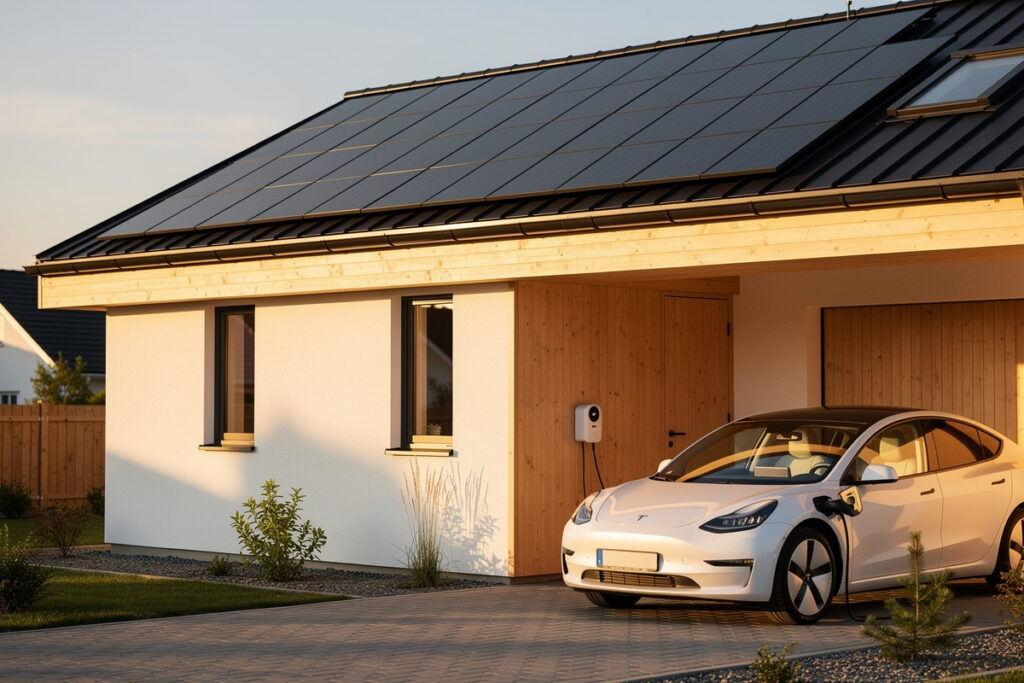
The cleanest mental model is a four-way junction. Solar produces, the home battery stores and buffers, the grid backstops, and the EV consumes — and in the bidirectional case, the EV can also produce back into the house. Every smart-charging decision is about which of those sources feeds the car at any given moment. On a bright midday in June my array can briefly cover most of a 7 kW charge; on a grey November afternoon it covers almost none, and the energy comes from the bank and the grid instead.
The number that decides everything is the gap between your charger’s power and your solar’s real output. A 7.4 kW single-phase charger needs 32 A of continuous solar to run purely on sun. My array, like most residential arrays in the real world, only hits its nameplate for a handful of hours around solar noon in summer — the rest of the time it is producing a fraction of that. So a “solar EV charger” that only draws what the panels are exporting will, most of the year, trickle the car at a rate far below its rated power. That is not a flaw; it is physics. The home battery exists precisely to bridge that gap, and understanding the integration between panels, charge controller, and inverter is the foundation everything else here sits on.
It helps to put the EV in scale against the rest of the house. My whole workshop — the welder idle, the CNC spindle, the curing-chamber heaters, the hydro pumps — rarely sustains more than a couple of kilowatts for long stretches. A Level 2 charger doubles or triples that the instant the car plugs in, and it holds that draw flat for hours, not minutes. Nothing else in a normal home behaves like that. An electric kettle pulls 2 kW for ninety seconds; an EV pulls 7 kW for four hours. That flat, multi-hour shape is exactly why it dominates the energy balance and why every design decision below is really a decision about how to absorb it.
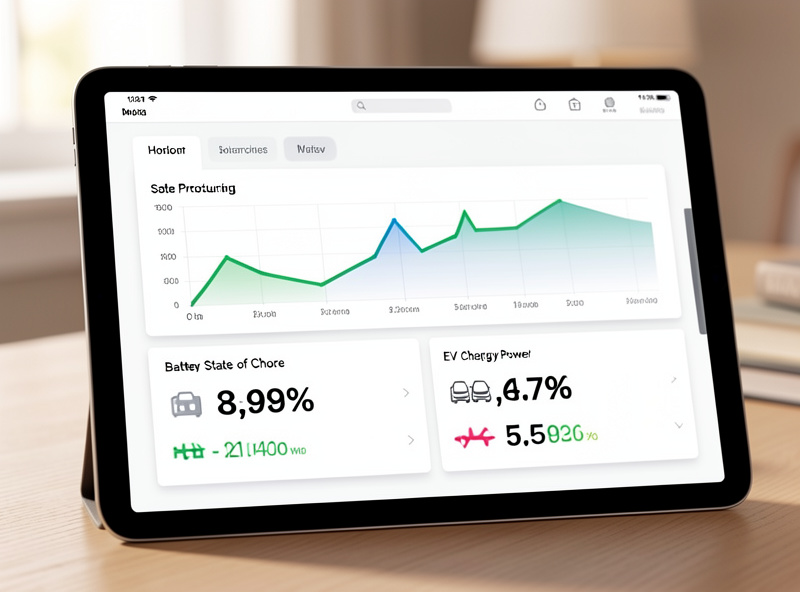
This is also where the polymath wiring pays off: the same Home Assistant rule engine that watches my battery state-of-charge and the curing-chamber humidity also watches the EV charger’s draw, and it is the rule logic — not any single clever box — that makes the whole thing behave. The charger is just a contactor and a meter; the intelligence is upstream.
The four ways to feed an EV charger at home
There are exactly four energy paths into a home EV charger, and most installs use a shifting mix of all four. Knowing which one is dominant at a given moment is the difference between a system you understand and one that just surprises you on the bill.
1. Direct grid charging (the default)
The simplest path: the charger pulls from the grid at full rated power whenever the car is plugged in. It ignores solar and battery entirely. It is also the worst path for cost and self-consumption, because it makes no attempt to use your own production. Every “dumb” EVSE does this. The fix is not to throw it out but to put a brain in front of it — which is what time-of-use scheduling and solar-aware charging do.
2. Solar-surplus (PV-excess) charging
The charger watches a meter at your grid connection and only ramps up when you are exporting surplus solar, modulating its current to soak up exactly what the panels are sending out. This is the “free sunshine into the car” path everyone wants. It is genuinely excellent in summer at low latitudes and genuinely frustrating in a Swedish January, when surplus is rare. The honest version of this feature charges the car slowly and intermittently, following the clouds. How big an array you would need to make this practical is a sizing question that depends entirely on your latitude and driving pattern — the same kind of arithmetic I run in the broader solar panel sizing work, just pointed at a car-shaped load — I walk through it specifically in sizing a solar system for EV charging.
3. Home-battery charging
The car draws from your stationary LiFePO4 bank through the inverter. This lets you charge at night on energy you banked at noon, or smooth out a cloudy stretch. The catch is brutal arithmetic: a 10 kWh home battery holds roughly 40 km of EV range, and you will round-trip that energy through two conversions (PV-to-battery, battery-to-car), losing a slice each way. It is a real tool for shifting and surge-smoothing, not a primary fuel source — I dig into when it actually makes sense in EV charging from home battery storage. How much usable energy your bank actually delivers comes straight out of its capacity and the depth-of-discharge you are willing to run — the relationship I lay out in battery cycle life and depth of discharge, which is the same number that decides how many EV kilometres a stored kWh is worth.
4. Time-of-use grid charging
The car charges from the grid, but only during cheap off-peak windows your utility defines — typically overnight. This is the single highest-impact, lowest-cost change most people can make, and it needs no solar at all. A smart charger or the car’s own scheduler shifts the entire session into the cheap hours, the approach I lay out in smart EV charger time-of-use scheduling. The same off-peak logic is exactly how a home battery earns its keep on a time-of-use tariff even without a car — charge the bank cheap, discharge it expensive — and the smart charger just extends that arbitrage to the largest load in the house.
Comparing the charging strategies
Each path optimizes for something different, and the right answer depends on your latitude, your tariff, and how big your home battery is. Here is how they stack up in the way that actually matters — honestly, not in marketing terms.
| Strategy | Energy source | Typical charge rate | Best for | Main limitation |
|---|---|---|---|---|
| Direct grid | Grid only | Full rated (7.4–11 kW) | Fastest, simplest charging | Highest cost, zero self-consumption |
| Solar-surplus (PV-excess) | Excess solar | Variable, follows the sun | Maximizing self-consumption in summer | Slow/intermittent at high latitude or in winter |
| Home-battery | Stored LiFePO4 | Limited by inverter output | Shifting solar into night charging | Double conversion loss; small range per kWh |
| Time-of-use grid | Off-peak grid | Full rated in cheap window | Cost shifting with no solar needed | No carbon benefit unless grid is clean off-peak |
| Solar + battery + ToU blend | All sources, steered | Adaptive | Real-world year-round optimization | Needs smart logic and a meter |
In my own system the honest answer is the bottom row: a blend, steered by rules. Summer leans on surplus solar, winter leans on cheap off-peak grid, and the home battery smooths the edges. Anyone selling you a single “best” mode is selling a season, not a system.
What size charger, and what does it demand from your wiring?
Residential Level 2 charging in most of the world means either 7.4 kW on a single 240 V / 32 A circuit, or up to 11 kW on three-phase where that is available (common in much of Europe, including here). That continuous current is the real install constraint — an EVSE is one of the few household loads that genuinely runs at full rated current for hours, so the circuit, breaker, and any load-management device have to be sized for continuous duty, not peak. This is firmly licensed-electrician territory: I will happily build a battery bank from bare cells on my own bench, but the moment a 32 A continuous circuit and a service-panel tie-in are involved, that is a job for a licensed electrician who knows your local code, not a DIY weekend — the full job is covered in the Level 2 EV charger home installation guide. Whether the supply is single-phase or three-phase changes the whole picture, in the same way it does for inverters — the same surge-and-continuous thinking I bring to the Victron MultiPlus-II applies the moment a high-power charger lands on the system.
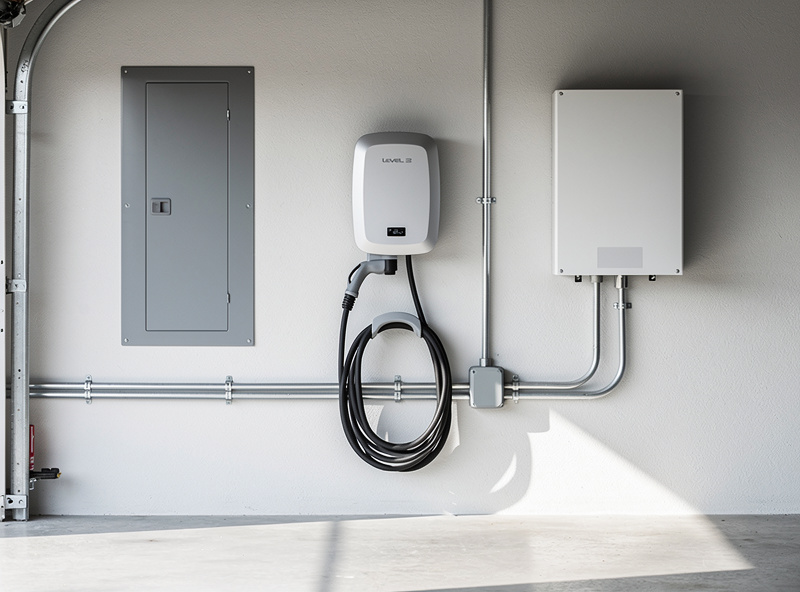
The matching question — how the charger’s kW relates to your home battery’s capacity and your inverter’s output — is where most DIY-leaning owners go wrong. A charger rated higher than your inverter can deliver simply cannot be fed from the battery at full speed; it will pull the difference from the grid. The inverter’s continuous output is almost always the real ceiling, not the charger’s rating or the battery’s nameplate kWh. This is the same surge-versus-continuous distinction that decides whether an inverter browns out when the workshop fires up — the lesson I learned the hard way and document in the hybrid inverter guide — only now the sustained load is a car instead of a welder. Pick the charging plan to fit the inverter you have, not the inverter to chase a charger spec — I untangle the whole power-versus-energy relationship in EV charger kW vs battery size.
Vehicle-to-home: the car as a house battery
The most interesting frontier is bidirectional charging — vehicle-to-home (V2H) and vehicle-to-grid (V2G). A typical EV carries 60 kWh or more, several times the size of a generous home battery bank. The idea of using that pack to back up the house during an outage, or to discharge it into the home during expensive peak hours, is genuinely compelling, and it is finally moving from concept to shipping product. But the practical reality — the special bidirectional charger, the hardware-handshake compatibility between car and charger, the islanding and grid-protection requirements — is full of caveats that the headlines skip. There is a real difference between a car that can technically push power out and a car-plus-charger-plus-panel combination that is certified to island your house safely when the grid drops, and that gap is where most of the disappointment lives — I pull the three terms apart in vehicle-to-home (V2H) explained.
My standing advice: treat V2H as a powerful capability that is still maturing, not as the reason to buy a particular car this year. The compatibility matrix between vehicles, chargers, and inverters is still narrow, and certification regimes differ by jurisdiction — this is one of the genuine edges where I defer to what professional installers and the manufacturers report rather than claiming a settled, lived setup, and I lay out the hardware reality in bidirectional EV charging at home. What I can speak to firsthand is the stationary side: a properly sized LiFePO4 bank already gives you the outage backup most people actually want, today, without waiting for the car’s blessing. If outage resilience is your real goal, I would build the bank first and treat any future V2H capability as a bonus — the real-world backup and off-grid projects show how far a well-sized stationary system already gets you.
Where the energy actually leaks away
Every conversion in this chain costs you something, and the “charge the car on solar” fantasy quietly ignores most of them. When sunlight goes straight from the panels into the car through the inverter, you pay one conversion penalty and it is modest. But the moment you route energy through the home battery to charge the car later, you pay twice: once charging the bank, once discharging it. Each LiFePO4 round trip is efficient by battery standards, but stack two of them with inverter losses on top and the energy that reaches the wheels is noticeably less than what the panels made. This is not a reason to avoid storage — it is a reason to charge the car directly from surplus solar whenever the sun is actually up, and reserve the battery path for genuine shifting and smoothing.
The practical rule I follow: let the car drink straight from the panels when production is high, let it sip cheap grid overnight when it is not, and only pull from the stationary bank when neither of those is available and you specifically need the energy moved in time. Charging an EV out of a home battery “because it feels self-sufficient” is the kind of decision that loses you a slice of every kilowatt-hour for an emotional payoff. The honest engineer’s answer is to minimise the number of times an electron changes form between the panel and the pavement.
The smart-charging brains that make it work
None of the four paths above happen automatically. A bare EVSE is a dumb relay; the intelligence comes from a meter at the grid connection, a charger that can modulate its current dynamically, and a controller that decides moment to moment which source should feed the car. In my setup that controller is the same Home Assistant rule engine that already watches per-cell voltage on the bank, the hydro reservoir level, and the curing-chamber humidity — the car’s charger is just one more entity on a dashboard I already trust. The big win of putting one rule engine in charge of everything is that the EV stops being a special case: it becomes another load the system schedules around solar production, tariff windows, and battery state-of-charge, exactly the way the workshop loads already are.
You do not strictly need a hyperscaled home-automation stack to get the basics. A good smart charger plus your car’s built-in scheduler will handle time-of-use shifting and, on many models, basic solar-surplus following. The deeper integration — coordinating the charger against your battery’s SoC so it never deep-discharges the bank to feed the car — is where a proper rule engine earns its place, and it is the layer that separates a tidy installation from a clever one.
The northern-latitude reality check
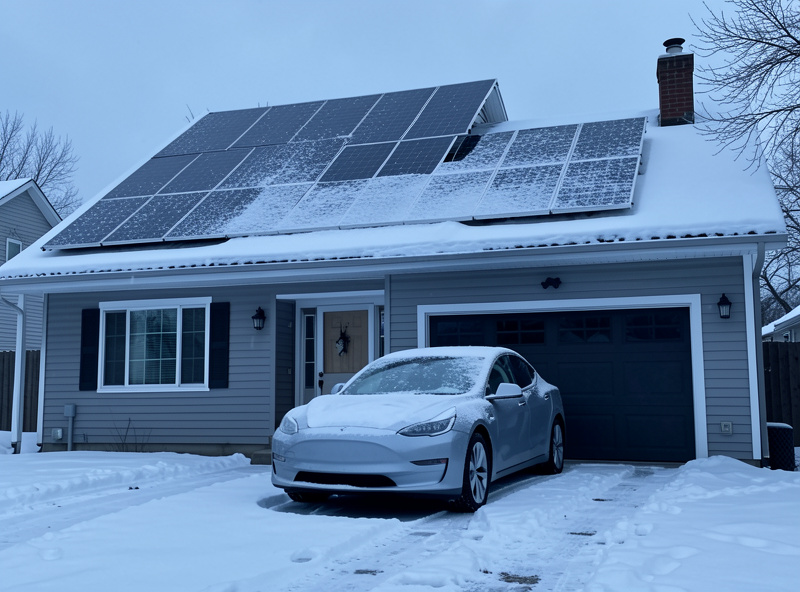
Here is the part the sunbelt blogs never write. An EV is a big load, and big loads collide hardest with the season when solar collapses. My array’s winter production is a fraction of its summer figure — the same brutal reality I document for every part of this system — so for roughly half the year, “charging on solar” is mostly aspirational and the smart move is to lean on cheap off-peak grid instead and stop pretending. The honest framing is the same one I apply to the whole bank: solar is a summer abundance and a winter trickle, and a system designed around that truth beats one designed around a brochure. The seasonal math is the same wall I hit with winter solar storage generally; an EV just makes the gap bigger and more obvious.
This is also why I am allergic to payback-promise marketing around EV-on-solar. Whether it “pays off” depends on your tariff structure, your latitude, your driving pattern, and policy that changes constantly — jurisdiction-specific economics I deliberately do not put a number on, because anyone who does is guessing. What I will say is that the carbon and cost wins come from self-consumption and load-shifting, not from some imagined free-energy car. Shift the charging off peak, soak up genuine surplus when it exists, and the system earns its keep without the hype.
How I would actually build this, in order
If you are integrating an EV into an existing solar-and-battery home, the sequence matters. First, get a smart Level 2 charger and a licensed install — the charger’s intelligence is what unlocks every later optimization. Second, turn on time-of-use scheduling immediately; it is free and it is the biggest single win. Third, add solar-surplus charging if your latitude and array make it worthwhile — it shines in summer and sulks in winter. Fourth, decide whether the home battery should ever feed the car (usually only for smoothing and outage cases, given the conversion losses). And fifth, watch V2H from the sidelines until the compatibility matrix for your car and charger is real, not promised.
Underneath all of it sits the system you already need regardless of the car: a correctly sized battery storage system, a hybrid inverter with enough continuous output, and a BMS you trust. The EV does not change those fundamentals; it just raises the stakes on getting them right. If you are still choosing the storage half of the equation, start with the home battery storage overview and the broader solar panel guide, then come back and bolt the car on top. For the absolute basics of the chemistry doing the storing, the beginner’s guide to battery storage and the LiFePO4 vs NMC comparison are the right starting points, and LiFePO4 in cold weather matters once winter charging enters the picture. The same surge-first logic I apply to split-phase inverter selection applies the moment a high-power charger lands on the system.
Frequently asked questions
Can I charge an EV entirely on solar at home?
Only in the right season and latitude. A 7.4 kW Level 2 charger needs about 32 A of continuous solar to run purely on sun, which a residential array hits only for a few hours around solar noon in summer. The rest of the year you charge on a blend of solar, stored battery, and grid. Solar-surplus charging soaks up genuine excess but trickles the car slowly when production is low.
How much EV range does a home battery actually provide?
Roughly 40 km of range per 10 kWh of usable home battery, before conversion losses. Because the energy is round-tripped through two conversions (PV-to-battery, then battery-to-car), the real figure is lower. A home battery is excellent for smoothing cloudy stretches and outage backup, but it is not a primary fuel source for a car that may need 60 kWh for a full charge.
What is the single biggest cost saving for home EV charging?
Time-of-use scheduling. Shifting the entire charging session into your utility’s cheap off-peak window costs nothing to set up and needs no solar at all. A smart charger or the car’s own scheduler handles it. It is the highest-impact, lowest-effort change most owners can make, and it stacks cleanly on top of any solar charging you add later.
Is vehicle-to-home (V2H) worth waiting for?
It is a powerful capability that is still maturing. An EV pack of 60 kWh or more dwarfs a typical home battery, so using it for outage backup is genuinely attractive. But the bidirectional charger, the car-charger compatibility handshake, and jurisdiction-specific grid-protection rules are still narrow and evolving. A properly sized stationary LiFePO4 bank gives most people the backup they want today without waiting.
Does my inverter limit how fast I can charge from the battery?
Yes. When the car draws from your home battery, the inverter’s continuous output is usually the real ceiling, not the charger’s rating or the battery’s capacity. A charger rated above your inverter’s continuous output will simply pull the difference from the grid. Match the charging plan to your inverter’s sustained output, and size the inverter for continuous duty rather than its surge figure.