Important Disclaimer
BatteryStorageHQ provides educational content and estimates only. We are not certified installers, financial advisors, or electricians. Always consult with licensed professionals.
A backup generator is sized by the load it actually has to carry, not by the breaker panel rating. In a battery home that load is usually the inverter-charger’s AC input plus a little pass-through, which means a 5,000–7,500 W generator backs a house that a salesperson would try to sell a 22 kW standby unit for. Size to the job and the math collapses.
I run a 16S LiFePO4 bank — roughly 280 Ah of EVE LF280K at 51.2 V nominal — through a hybrid inverter, charged off a small south-facing array. For nine months of the year the sun does the work. In a dark Swedish December it does not, and that gap is exactly where a generator earns its keep. So I came at generator sizing from a battery-first angle, and it changed every number. This guide is the whole method: how to read the spec that matters, how a battery system lets you buy a far smaller generator than the whole-house calculators tell you, and how to connect it without killing a lineman or your electronics.
Running Watts vs Starting Watts: The Spec That Actually Sizes a Generator
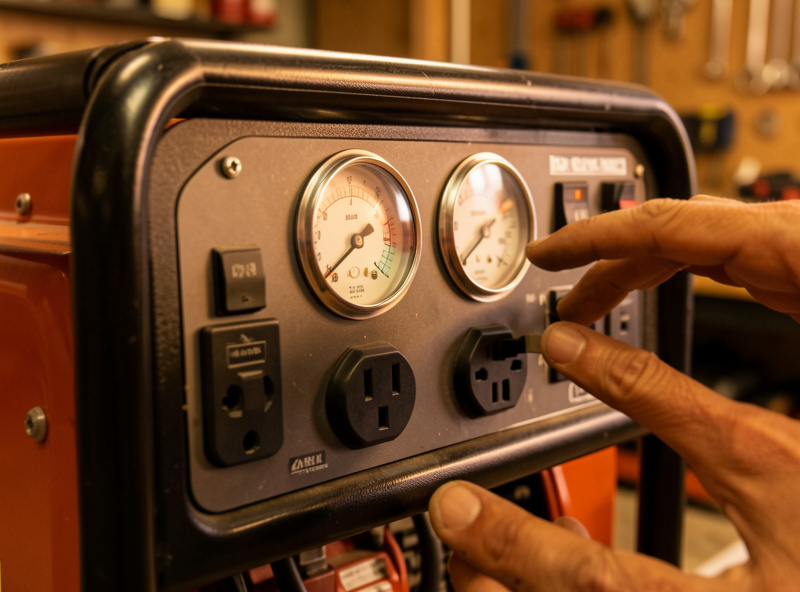
Every generator carries two numbers: running (continuous) watts and starting (surge) watts. Running watts is what it delivers all day. Starting watts is a brief overage — usually held for a few seconds — that covers the inrush when a motor spins up. A well-known split is a generator rated 7,000 running / 8,750 starting watts. You size the running figure to your steady load and the starting figure to your single largest motor inrush stacked on top of everything already running.
This is the same surge problem I deal with on inverters, and it bites people the same way. A 1 hp well pump or a deep-freeze compressor can pull three to six times its running wattage for a fraction of a second on start — the locked-rotor amps (LRA) printed on the motor’s data plate. A generator that comfortably runs the load can still stall, sag, or trip when that motor kicks. The fix is not a bigger running rating; it is enough starting headroom, or an inverter generator whose electronics ride through brief surges more gracefully than a conventional alternator does. If you size only to running watts you will eventually meet the brownout, usually at the worst moment.
The Battery-Home Shortcut: Size to the Charger, Not the House
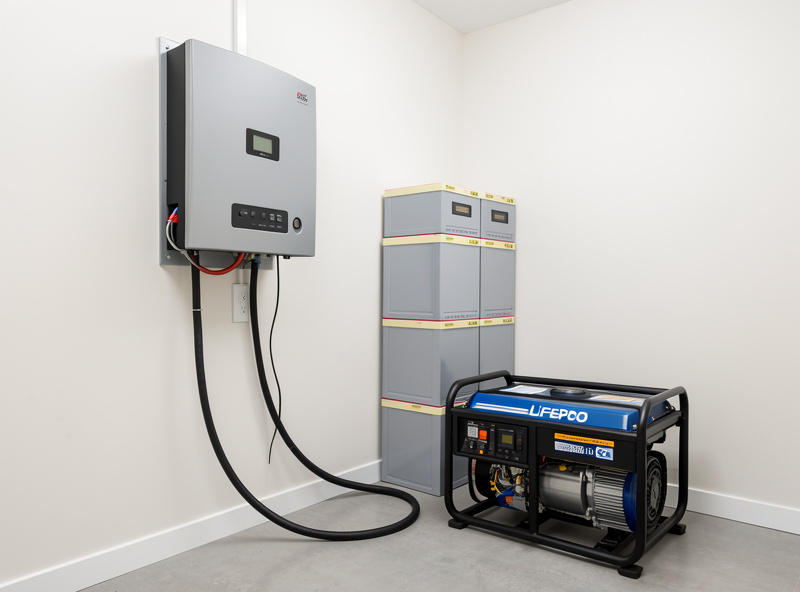
Here is the insight no whole-house calculator gives you, because most of them assume the generator runs the house directly. In a battery system, it usually does not. The honest architecture is: generator feeds the AC input of your hybrid inverter, the inverter charges the bank and passes through whatever loads it can, and the battery absorbs every surge. The generator never sees your well pump’s LRA — the inverter does, and it covers it from the bank.
That decouples generator size from house size entirely. My Victron MultiPlus-II will accept a generator on its AC input and meter the charge current down to whatever the incoming source can sustain — the input-current-limit setting. So I size the generator to charge rate plus pass-through, not to peak household draw. A 3 kW charge into the bank plus a couple of kilowatts of pass-through means a clean 5,000 W inverter generator runs the entire property through a December outage, charging the battery while it carries the lights, the freezer, and the pumps. The bank handles the spikes; the generator just tops it up. People spend thousands on a 22 kW liquid-cooled standby to do what a battery and a 5 kW inverter generator do quieter, on less fuel, and without a foundation pad.
The corollary: if you do not have a battery, you are back to sizing for the whole house and its worst surge, and the generator gets big fast. That is the real reason whole-house standby units are huge — they have to be the surge buffer that a battery would otherwise be. I walk the full kW-and-kWh method, battery or not, in the whole house generator sizing calculator, and it pairs directly with how I do whole-home battery backup sizing.
Sizing a Backup Generator, Step by Step
Whether you are charging a bank or running a house directly, the method is the same four steps. Do them with a clamp meter on real loads, not nameplate guesses, because nameplate ratings are almost always conservative high and you will oversize.
Step one: list the loads you actually need during an outage. Not everything — the loads that matter. Refrigerator, freezer, furnace blower or mini-split, well or sump pump, a few circuits of lights and outlets, internet. Skip the electric range, the dryer, and the resistive water heater unless you genuinely must run them; they are what force people into oversized machines.
Step two: add the running watts. Sum the continuous draw of everything that runs at once. A fridge and a freezer together are often under 400 W running; a 1/2 hp furnace blower is 600–900 W; a mini-split might be 600–1,500 W depending on output. Realistic essential loads land between 2,000 and 5,000 running watts for most homes.
Step three: find your single biggest surge and stack it. Take the largest starting load — usually the well pump or the deep freeze compressor — and add its starting watts on top of the running total of everything else. That peak is your required starting wattage. This is where a measured LRA beats a guess by a mile.
Step four: add a margin and derate for reality. Add about 20% for the loads you forgot and for altitude/temperature derating (engines lose roughly 3–4% of output per 1,000 ft of elevation and a few percent in extreme heat). And if you are running on propane or natural gas instead of gasoline, derate the generator’s rating another 10% or so — gaseous fuels carry less energy per unit and most machines lose output on them. I cover that penalty in the generator fuel type comparison.
Matching the Generator Class to the Job
Generators are not one product. The four classes solve different problems, and picking the wrong class is a more expensive mistake than picking the wrong size within a class.
Inverter portables (typically 2,000–7,500 W) make clean, regulated power — total harmonic distortion under 3% — and throttle the engine to the load, so they sip fuel at light load and run quiet. They are my default for charging a battery bank, because the inverter-charger wants clean AC and the variable-speed engine matches a tapering charge beautifully. Conventional portables are cheaper per watt, louder, dirtier power (fine for resistive loads, marginal for sensitive electronics), and run the engine at a fixed 3,600 rpm regardless of load. Air-cooled standby units (typically 7.5–24 kW) are permanently installed, wired through an automatic transfer switch, and run on natural gas or propane — convenient and hands-off, but loud, thirsty, and overkill for a battery home. Liquid-cooled standby units (24 kW and up) are for genuinely large whole-house direct-drive loads and light commercial. The honest comparison is in the standby vs portable generator comparison.
| Class | Typical Output | Power Quality | Fuel | Noise (approx.) | Best Role |
|---|---|---|---|---|---|
| Inverter portable | 2,000–7,500 W | <3% THD (clean) | Gasoline / propane (dual-fuel) | 52–60 dBA | Charging a battery bank; sensitive loads |
| Conventional portable | 3,000–10,000 W | 5–25% THD (rough) | Gasoline / dual-fuel | 65–75 dBA | Resistive loads, jobsite, budget backup |
| Air-cooled standby | 7.5–24 kW | Clean (regulated) | Natural gas / propane | 63–70 dBA | Hands-off whole-house without a battery |
| Liquid-cooled standby | 24 kW and up | Clean (regulated) | Natural gas / propane / diesel | 65–72 dBA | Large homes, light commercial, direct drive |
Fuel Type Changes the Sizing Math
Fuel is not just a running-cost decision; it changes the rated output and the runtime you can plan for. Gasoline has the highest energy density and gives a generator its headline wattage, but it degrades in storage — stabilized fuel buys you months, not years, and stale gasoline is the single most common reason a stored generator won’t start. Propane stores essentially indefinitely, runs cleaner, and is my choice for a unit that sits unused most of the year waiting for a winter outage, but it costs you roughly 10% of rated output. Natural gas means never refueling, but it delivers the lowest output of the common fuels and depends on utility line pressure that can drop in a regional emergency. Diesel is the most fuel-efficient per kWh and the choice at large sizes, but it gels in the cold without a winter blend or a block heater — a real concern at my latitude.
Because fuel choice moves the rated watts, decide fuel before you finalize size. A dual-fuel inverter generator is the flexible answer for most battery homes: run propane for clean long-term-storage backup, keep gasoline as the high-output option. How much of each fuel you actually burn per hour — and how to plan a fuel reserve for a multi-day outage — is its own calculation in the generator fuel consumption guide.
Connecting It Safely: Transfer Switches and the Backfeed Rule
This is the part where sizing stops being academic and becomes a fire-and-electrocution question. Never connect a generator to your house wiring through a double-male “suicide cord” plugged into a dryer or range outlet. Backfeeding that way energizes your home’s wiring and pushes power back through the utility transformer onto the grid at lethal voltage, where it can kill a lineman working to restore power — OSHA treats generator backfeed as a recognized electrocution hazard during power restoration. It is illegal, it defeats every protection in your panel, and it is the most dangerous thing an amateur does with a generator. There is no acceptable version of it.
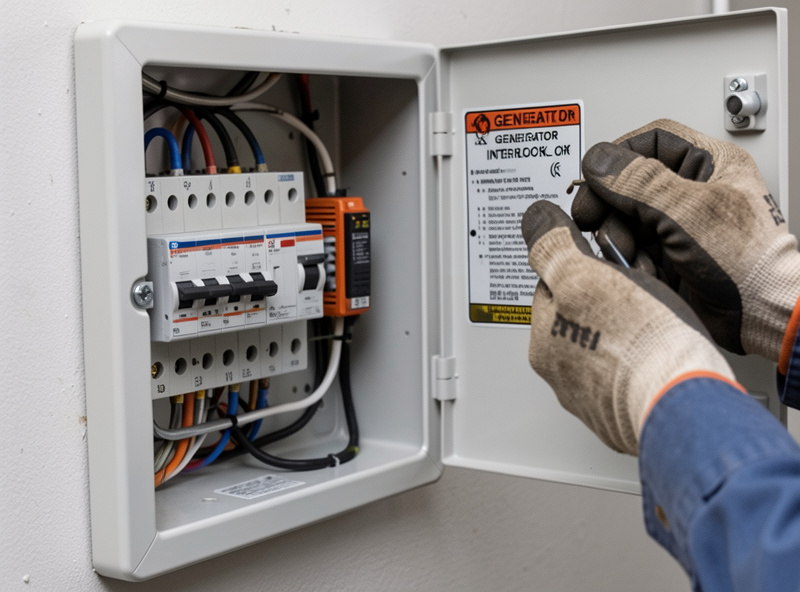
The correct connection is a transfer device that physically prevents the generator and the grid from ever being connected at the same time. You have three honest options: a manual transfer switch (a sub-panel of selected circuits you flip by hand), a generator interlock kit (a sliding plate on your main panel that makes it physically impossible to have the main breaker and the generator breaker on together — the cheapest code-compliant whole-panel option), and an automatic transfer switch (ATS) that senses the outage and switches the load over with no human present. Standby generators always pair with an ATS. For a battery system, the inverter often is the transfer device — it switches from grid to battery in milliseconds and treats the generator as just another AC input. I walk the wiring, the neutral-bonding question, and the permit reality in the automatic transfer switch installation guide, and there is a battery-specific deep dive in transfer switch selection for battery backup.
One more correctness point that trips people: neutral bonding. A generator feeding a transfer switch that does not switch the neutral must have a floating (unbonded) neutral, or you create a dangerous second ground-neutral bond. A generator feeding a switch that does switch the neutral needs a bonded neutral. Get this wrong and you either trip GFCIs constantly or defeat your ground-fault protection. Match the generator’s neutral configuration to the transfer equipment — do not guess.
Quiet Operation, Placement, and the CO Rule That Kills People
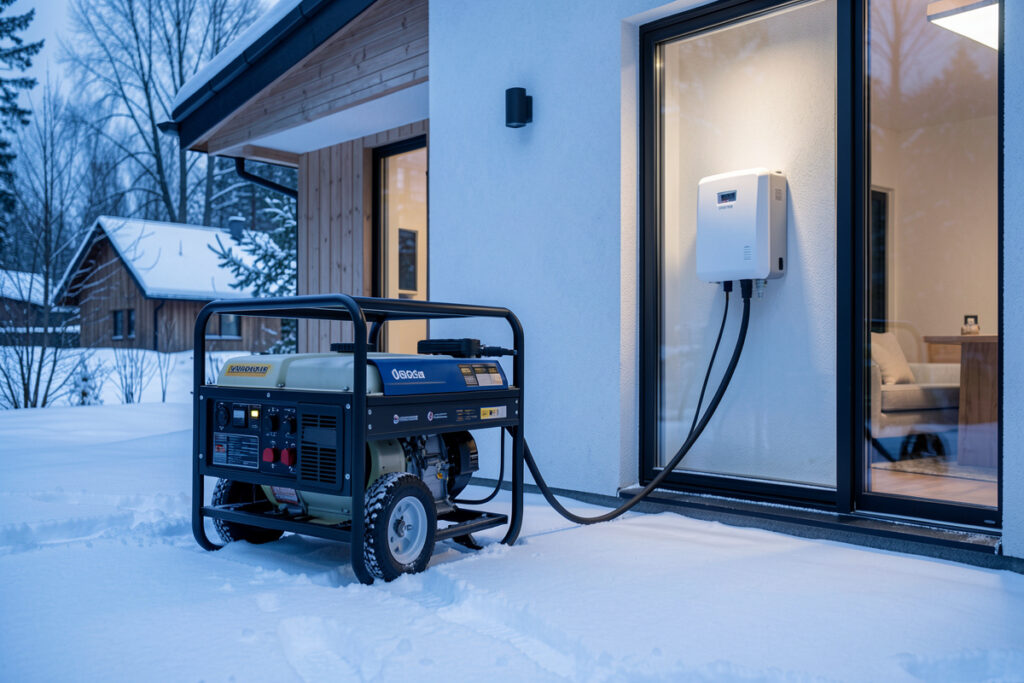
Carbon monoxide from generators kills people every single outage season, and the cause is always the same: running the machine too close to the house. Run a generator outdoors only, never in a garage or shed even with the door open, and keep it at least 20 feet from any window, door, or vent, with the exhaust pointed away from the building. CO is colorless and odorless; a battery-powered CO alarm in the living space is non-negotiable backup, and Ready.gov ranks portable generators among the leading causes of carbon-monoxide deaths after storms. No wattage rating is worth a dead family.
Within that hard safety rule, noise is the livability factor. Inverter generators are dramatically quieter than conventional ones — a good inverter unit at quarter load sits around 52–58 dBA, conversational-speech territory, while a conventional open-frame unit at 70+ dBA is a lawnmower running all night. For a unit that may run for days during an outage, noise is not a luxury spec. I rank the genuinely quiet machines and explain what makes them quiet — enclosure, variable-speed engine, muffler design — in the best quiet standby generator 2026 roundup.
The Northern-Latitude Reality: A Generator Is a Winter-Gap Filler, Not a Lifestyle
I am allergic to the off-grid-forever fantasy, and a generator is where that fantasy meets a fuel bill. Here is the honest framing from someone living a real Swedish winter on stored sun: solar carries the house most of the year, the battery rides through normal outages and overnight, and the generator exists for the specific, predictable failure — a multi-day grid outage in the dark months when the array produces a fraction of nameplate and the bank can’t recharge from the sky. In that role it is brilliant. As a primary power source it is a noisy, fuel-hungry chore.
The numbers behind that are brutal and worth knowing before you buy: a northern array in December can produce under 10% of its summer daily yield, which is exactly why the battery alone can’t bridge a long winter outage and why a small generator is the cheapest insurance against it. I lay out that production collapse in solar panel winter output and the design response in northern-latitude solar array sizing. The generator-as-winter-charger architecture specifically — sizing it to top up the bank rather than run the house — is the whole subject of generator backup for solar. And remember the cold-charging rule that ties the two systems together: LFP must not be charged below freezing, so a generator charging a bank in a cold space needs the bank warmed first — see LiFePO4 cold weather performance and the BMS charge-temperature cutoff.
If you want a measured starting point for your own loads, a basic plug-in watt meter on each appliance for a week tells you more than any calculator. A plug-in energy monitor is the cheapest tool you’ll buy in this whole project and the one that stops you oversizing. As an Amazon Associate I earn from qualifying purchases.
Frequently Asked Questions
What size backup generator do I need for a battery home?
Size to your inverter-charger’s AC input plus pass-through loads, not the whole house. A 3 kW charge plus a couple kilowatts of pass-through is covered by a 5,000 W inverter generator, because the battery absorbs every surge the generator would otherwise have to.
What is the difference between running watts and starting watts?
Running watts is continuous output all day; starting watts is a brief surge held for a few seconds to cover motor inrush. Size running watts to your steady load and starting watts to your largest single motor’s locked-rotor draw stacked on top of everything else running.
Can I plug a generator into a dryer outlet to power my house?
No. A double-male cord backfeeds your wiring and pushes lethal voltage onto the grid, which can kill a lineman. It is illegal and defeats your panel’s protections. Use a manual transfer switch, an interlock kit, or an automatic transfer switch instead.
Does propane reduce a generator’s output compared to gasoline?
Yes, by roughly 10%. Propane carries less energy per unit than gasoline, so most generators lose about 10% of rated output on it. The tradeoff is indefinite storage life, which makes propane ideal for a generator that sits unused most of the year.
How far from the house should a generator run?
At least 20 feet from any window, door, or vent, outdoors only, with exhaust pointed away from the building. Never run a generator in a garage or shed even with the door open. Carbon monoxide is colorless and odorless and kills people every outage season.
Do I still need a big generator if I have a home battery?
No. The battery becomes the surge buffer the generator would otherwise have to be, so the generator only needs to recharge the bank plus carry pass-through loads. That typically means a 5,000-7,500 W inverter generator instead of a 22 kW standby unit.
Related Guides in This Cluster
- Whole House Generator Sizing Calculator — the full kW-and-kWh method with a worked example.
- Standby vs Portable Generator — which class fits your outage profile.
- Automatic Transfer Switch Installation — wiring, neutral bonding, and permits.
- Generator Fuel Type Comparison — gasoline, propane, natural gas, diesel.
- Best Quiet Standby Generator 2026 — what actually makes a generator quiet.
- Generator Fuel Consumption Guide — burn rates and planning a fuel reserve.